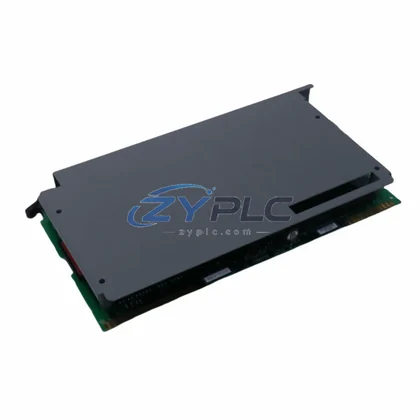
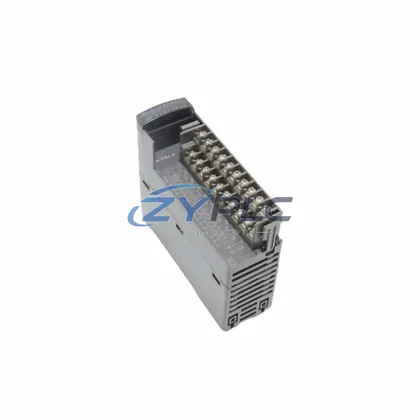
OMRON SRT2-VOD16ML-1 Digital Output for SRT2
In modern industrial automation, the reliability of a distributed control system depends not on any single component, but on the seamless coordination of every layer — from the central CPU to the field-level actuators. The OMRON SRT2-VOD16ML-1 is a 16-point NPN transistor digital output module engineered specifically for the SRT2 CompoBus/S remote I/O platform, and it plays a critical role in bridging the control layer with the execution layer across a wide range of industrial environments.
When deployed within a CompoBus/S network, the SRT2-VOD16ML-1 operates as a remote slave node, receiving discrete output commands from a master unit such as the CJ1W-SRM21 or CS1W-SCB21 CompoBus/S master module. These master units, installed in a CJ2M or CS1 series PLC backplane, manage the cyclic data exchange that drives field devices — solenoid valves, indicator lamps, relay coils, and motor starters — with deterministic timing and minimal latency. The SRT2-VOD16ML-1 ensures that output signals are delivered accurately and consistently, even in electrically noisy industrial environments.
The module’s NPN open-collector transistor outputs are rated for 24 VDC loads, making it directly compatible with the majority of 24 V field devices used in manufacturing, packaging, and process control applications. Its compact terminal block design allows for straightforward wiring in control cabinets, and its DIN rail mounting profile integrates cleanly alongside other SRT2 series nodes such as the SRT2-ID16ML input module and the SRT2-ROF16 relay output module, enabling engineers to build a balanced, mixed I/O architecture at the remote station level.
Product Specification Table
| Parameter |
Specification |
| System Role |
CompoBus/S Remote Slave — Digital Output Node |
| Output Points |
16 points, NPN transistor (sink type) |
| Rated Output Voltage |
24 VDC |
| Maximum Load Current |
0.3 A per point, 2.4 A total |
| Communication Protocol |
CompoBus/S (High-speed / Long-distance mode) |
| Network Topology |
Multi-drop bus, up to 32 slave nodes |
| Compatible Master Units |
CJ1W-SRM21, CS1W-SCB21, SRM1 series |
| Power Supply |
24 VDC (supplied via I/O power terminals) |
| Electrical Isolation |
Photocoupler isolation between bus and output circuit |
| Operating Temperature |
0°C to 55°C |
| Mounting |
DIN rail (35 mm) |
| Protection Rating |
IP20 |
| Warranty |
warranty terms confirmed during quotation — Covered by ZYPLC |
System Compatibility Notes
The SRT2-VOD16ML-1 does not operate in isolation — its value is realized through its position within a fully coordinated control architecture. A typical system built around this module might include a CJ2M-CPU31 as the central processing unit, managing program execution and data routing across the entire control network. The CPU communicates with field I/O through a CJ1W-SRM21 CompoBus/S master installed in the CJ2M expansion backplane, which in turn manages up to 32 remote slave nodes distributed across the production floor.
At the remote station, the SRT2-VOD16ML-1 works alongside the SRT2-ID16ML, a 16-point NPN input module that captures discrete signals from proximity sensors, limit switches, and pushbuttons. Together, these two modules form a complete remote I/O station capable of handling 16 inputs and 16 outputs within a single compact enclosure. For applications requiring relay-isolated outputs — such as driving higher-voltage loads or providing galvanic separation — the SRT2-ROF16 relay output module can be added to the same station.
Power distribution within the control cabinet is typically handled by a PA205R or PD025 power supply unit, providing stable 24 VDC to both the communication bus and the I/O field circuits. For applications requiring EtherNet/IP or DeviceNet connectivity alongside CompoBus/S, a CJ1W-DRM21 DeviceNet master or CJ1W-EIP21 EtherNet/IP unit can be installed in the same PLC rack, enabling multi-network architectures that support both legacy and modern field devices.
Operator interaction is managed through an NS8-TV01B-V2 or NS10-TV01B-V2 HMI terminal, connected to the CJ2M CPU via RS-232C or Ethernet. The HMI provides real-time visualization of output states, alarm management, and process trending, giving operators full visibility into the status of every SRT2-VOD16ML-1 output channel. For systems requiring redundancy at the CPU or network level, OMRON’s CS1D series with dual CPU and dual power supply configurations can be integrated, with CompoBus/S slaves including the SRT2-VOD16ML-1 continuing to operate transparently under the redundant control architecture.
Industrial Application Notes
The SRT2-VOD16ML-1 is well-suited for a broad range of industrial applications where distributed digital output control is required at the field level. In automotive manufacturing and general assembly lines, the module drives solenoid valves, pneumatic actuators, and conveyor control relays, with the CompoBus/S network ensuring that output commands from the central PLC are executed within the cycle time requirements of high-speed production.
In the power generation and electrical distribution sector, the module is used to control switching devices, indicator panels, and protection relay coils within substation automation panels. Its photocoupler isolation and robust NPN output design provide the electrical noise immunity required in high-voltage environments. In water treatment and municipal infrastructure projects, the SRT2-VOD16ML-1 controls pump starters, valve actuators, and dosing system outputs across geographically distributed remote stations, with the CompoBus/S long-distance mode supporting cable runs of up to 500 meters.
Petrochemical and oil and gas facilities benefit from the module’s ability to operate reliably in high-temperature, high-humidity environments, driving field devices in hazardous area control panels when installed with appropriate enclosure ratings. In food and beverage packaging lines, the module’s fast response time and deterministic output behavior support high-speed filling, capping, and labeling operations where precise timing is critical to product quality and throughput.
Mining and metallurgical applications leverage the SRT2-VOD16ML-1 for conveyor belt control, crusher interlock systems, and ventilation fan management, where the distributed I/O architecture reduces wiring complexity and simplifies maintenance in large underground or open-pit installations. Across all these sectors, the module’s compatibility with the broader OMRON SRT2 and CJ/CS series ecosystem ensures that system integrators can design, commission, and maintain control architectures with a consistent toolset and a unified spare parts strategy.
Product Compatibility FAQ
Q1: Is the SRT2-VOD16ML-1 compatible with both CJ-series and CS-series PLC platforms?
Yes. The SRT2-VOD16ML-1 is a CompoBus/S slave module and is compatible with any OMRON PLC platform that supports a CompoBus/S master unit, including the CJ1W-SRM21 for CJ-series racks and the CS1W-SCB21 for CS-series racks. The module operates identically regardless of the host PLC series, as communication is managed entirely at the CompoBus/S protocol level. This makes it straightforward to integrate into both new CJ2M-based systems and existing CS1 installations without any firmware or configuration changes to the slave module itself.
Q2: Can the SRT2-VOD16ML-1 be used in a redundant control architecture, and what happens to outputs during a CPU switchover?
The SRT2-VOD16ML-1 can be used within systems that employ OMRON’s CS1D dual-CPU redundancy architecture. During a CPU switchover event, the CompoBus/S master continues to maintain cyclic communication with all slave nodes, including the SRT2-VOD16ML-1, with the switchover time typically within the range of the CompoBus/S cycle time. Output states are maintained according to the last valid data transmitted by the active CPU, and the standby CPU assumes control with minimal disruption to field device operation. Engineers should verify the specific switchover behavior with the CS1D system documentation and configure output hold/clear settings in the master unit to match the application’s safety requirements.
Q3: What is covered under the warranty terms confirmed during quotation for the SRT2-VOD16ML-1, and how does ZYPLC support long-term maintenance?
ZYPLC provides a warranty terms confirmed during quotation on the SRT2-VOD16ML-1 covering manufacturing defects, component failures, and communication interface faults under normal operating conditions. The warranty period begins from the date of shipment and includes technical support for installation, configuration, and commissioning. ZYPLC supports RFQ sourcing for SRT2 series modules to support long-term maintenance programs, enabling customers to source replacement units quickly without extended lead times. For facilities managing large installed bases of OMRON CompoBus/S equipment, ZYPLC can provide volume procurement agreements and advance replacement services to minimize unplanned downtime.