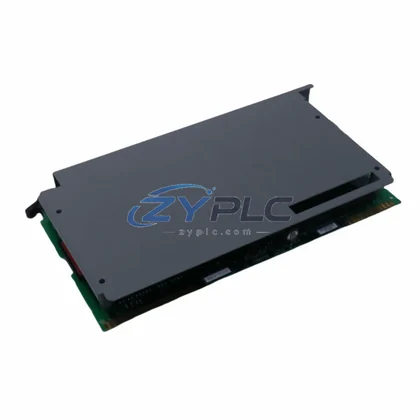
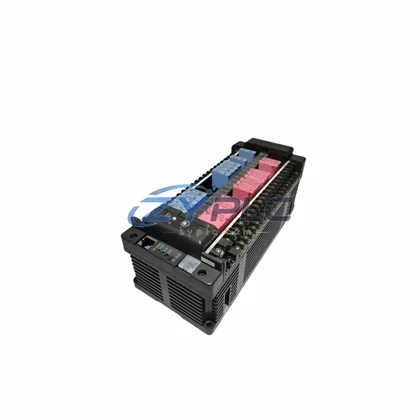
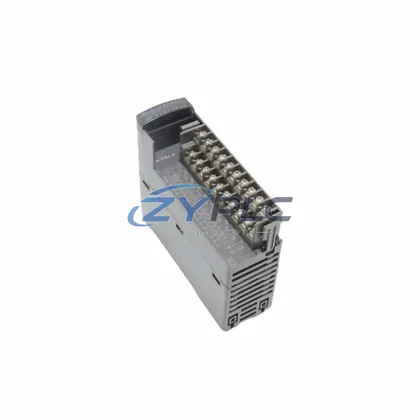
The Omron XWT-ID16 is a 16-point digital input remote I/O module purpose-built for deployment within the XWT Series distributed I/O architecture. Designed to operate as a front-end signal acquisition node in layered industrial automation systems, the XWT-ID16 captures discrete field-level signals and transmits them reliably to the host PLC controller via EtherNet/IP or DeviceNet communication backbones. Its role within the control hierarchy is not limited to simple signal collection — it serves as a critical interface between the physical process environment and the supervisory control layer, enabling real-time decision-making, system diagnostics, and coordinated multi-axis response across the entire automation platform.
In modern industrial control architectures, the integrity of the I/O layer directly determines the responsiveness and reliability of the entire system. The XWT-ID16 addresses this requirement by providing stable, noise-resistant 24 VDC digital input acquisition across 16 channels, with each channel independently isolated to prevent cross-channel interference. This design philosophy ensures that signal fidelity is maintained even in electrically noisy environments such as motor drive cabinets, high-frequency welding stations, and variable-frequency drive (VFD) enclosures. The module’s compact DIN-rail form factor allows it to be installed in close proximity to field devices, minimizing wiring runs and reducing signal degradation over long cable distances.
From a system architecture perspective, the XWT-ID16 is engineered to integrate seamlessly with the broader Omron control ecosystem. It is fully compatible with the CJ2M-CPU3x and CJ2H-CPU6x series programmable logic controllers, which serve as the central processing units in mid-to-large-scale automation systems. When paired with the XWT-OD16 digital output module, the XWT-ID16 forms a balanced I/O node capable of handling both input acquisition and output actuation within the same distributed I/O station, reducing the number of communication nodes required and simplifying network topology management.
Power distribution within the XWT Series architecture is managed through dedicated power supply modules such as the CJ1W-PA202 and CJ1W-PD025, which provide regulated 24 VDC and 5 VDC rails to the I/O bus. Proper power architecture design ensures that the XWT-ID16 and co-located modules receive stable operating voltage even during transient load conditions caused by simultaneous output switching or motor startup events. Engineers specifying the XWT-ID16 should account for the cumulative current draw of all modules on the shared power rail when sizing the power supply for the control cabinet.
Network communication is a foundational element of the XWT Series distributed I/O strategy. The XWT-ID16 communicates over EtherNet/IP using standard CIP (Common Industrial Protocol) messaging, allowing it to be addressed and configured from the host CJ2M or CS1D controller without requiring proprietary communication adapters. For legacy installations using DeviceNet, the module can be integrated via a CS1W-DRM21 DeviceNet master unit, enabling backward compatibility with existing network infrastructure. Communication cables such as the XW2Z series shielded twisted-pair assemblies are recommended for all field wiring connections to ensure EMC compliance and long-term signal stability.
Human-machine interface integration is achieved through Omron’s NB-series and NS-series HMI panels, which can display real-time input status, alarm conditions, and diagnostic data sourced directly from the XWT-ID16 via the host PLC. This visibility layer is essential for operators managing complex process lines where rapid fault identification and response are critical to minimizing unplanned downtime. The XWT-ID16’s channel-level LED status indicators also provide local visual feedback, enabling field technicians to verify input states without requiring a laptop or programming device.
For applications requiring high-availability or redundant control architectures, the XWT-ID16 can be deployed within systems utilizing the CS1D dual-CPU redundancy platform. In this configuration, the distributed I/O network continues to operate without interruption during a CPU switchover event, as the XWT-ID16 maintains its communication link with the active CPU at all times. This capability is particularly valuable in continuous process industries such as petrochemical refining, power generation, and water treatment, where even brief control interruptions can result in significant safety or production consequences.
All Omron XWT-ID16 modules supplied by ZYPLC are covered by a comprehensive warranty terms confirmed during quotation, ensuring that your system investment is protected against manufacturing defects and premature component failure. Our inventory is sourced directly from authorized distribution channels, and each unit undergoes pre-shipment inspection to verify physical integrity and labeling accuracy. Expedited shipping options are available for urgent maintenance and replacement requirements, with global logistics coverage supporting customers across Asia, Europe, the Middle East, and the Americas.
Product Specification Table
| Parameter |
Specification |
| System Role |
Distributed Digital Input Node — XWT Series Remote I/O |
| Input Points |
16 Points (Sink/Source selectable) |
| Input Voltage |
24 VDC (20.4–28.8 VDC operating range) |
| Input Current |
Approx. 6 mA per channel at 24 VDC |
| ON Voltage |
15 VDC minimum |
| OFF Voltage |
5 VDC maximum |
| Response Time |
1.5 ms (ON), 1.5 ms (OFF) |
| Isolation Method |
Photocoupler isolation per channel group |
| Communication Protocol |
EtherNet/IP (CIP), DeviceNet compatible via adapter |
| Compatible Controllers |
CJ2M, CJ2H, CS1D, NJ/NX Series via EtherNet/IP |
| Power Consumption |
0.8 W (internal bus) |
| Operating Temperature |
0°C to +55°C |
| Storage Temperature |
-25°C to +65°C |
| Humidity |
10% to 90% RH (non-condensing) |
| Protection Rating |
IP20 (panel-mounted installation) |
| Mounting |
DIN Rail (35 mm) |
| Dimensions (W×H×D) |
Approx. 40 × 90 × 60 mm |
| Weight |
Approx. 100 g |
| Country of Origin |
Japan |
| Warranty |
warranty terms confirmed during quotation (ZYPLC) |
System Compatibility Notes
The XWT-ID16 achieves its full architectural value when deployed as part of a coordinated multi-layer control system. At the controller layer, the CJ2M-CPU34 or CJ2H-CPU65 serves as the central processing unit, executing ladder logic and function block programs that process the digital input data collected by the XWT-ID16. The controller communicates with the distributed I/O network via an integrated EtherNet/IP port, eliminating the need for a separate communication unit in most standard configurations.
At the power layer, the CJ1W-PA202 AC power supply unit provides the regulated 100–240 VAC to 5 VDC conversion required by the CPU and communication backplane, while the CJ1W-PD025 DC power supply supports installations where only 24 VDC input power is available. Proper power supply selection and redundancy planning are essential when the XWT-ID16 is deployed in safety-critical or continuous-process environments.
On the output side, the XWT-OD16 digital output module mirrors the XWT-ID16’s form factor and communication interface, allowing engineers to build balanced I/O stations with matched input and output channel counts. For applications requiring analog signal handling, the XWT-AD04 analog input module can be co-located on the same EtherNet/IP node, enabling mixed digital and analog I/O within a single distributed station.
Network infrastructure components such as the CS1W-DRM21 DeviceNet master unit and CJ1W-SCU21 serial communication unit extend the XWT-ID16’s connectivity options for legacy field devices and serial-protocol instruments. At the human-machine interface layer, the NB10W-TW01B touchscreen HMI provides operators with a graphical overview of system status, including real-time channel state visualization sourced from the XWT-ID16 via the host PLC. Wiring between the XWT-ID16 and field terminal blocks is best accomplished using XW2Z-200J series pre-wired cable assemblies, which reduce installation time and minimize wiring errors in high-density I/O cabinets.
Industrial Application Notes
Manufacturing & Assembly Lines: In automotive body assembly and electronics manufacturing, the XWT-ID16 collects discrete signals from proximity sensors, limit switches, and safety light curtains distributed across the production line. Its fast response time and reliable EtherNet/IP communication ensure that the host CJ2M controller receives accurate positional and safety interlock data with minimal latency, supporting high-speed cycle times and precise sequencing control.
Power Generation & Electrical Substations: In power plant auxiliary systems and substation automation panels, the XWT-ID16 monitors breaker status, relay feedback, and protection relay trip signals. Its photocoupler isolation and wide operating voltage range make it suitable for the electrically noisy environments typical of medium-voltage switchgear rooms and generator control panels.
Petrochemical & Refinery Process Control: In continuous process plants, the XWT-ID16 is deployed within distributed control cabinets to monitor valve position feedback, pump run/stop status, and emergency shutdown (ESD) system inputs. When integrated with a CS1D redundant CPU platform, the module supports uninterrupted process monitoring during planned CPU maintenance or unplanned controller failover events.
Water & Wastewater Treatment: Municipal water treatment facilities use the XWT-ID16 to monitor level switches, flow switch contacts, and pump seal failure signals across geographically distributed pump stations. The module’s compact form factor and DIN-rail mounting allow it to be installed in space-constrained remote terminal unit (RTU) enclosures without requiring a full-size PLC rack.
Mining & Metallurgy: In ore processing and smelting operations, the XWT-ID16 collects discrete status signals from conveyor belt safety switches, crusher overload contacts, and furnace door position sensors. Its robust operating temperature range and vibration resistance make it suitable for the harsh environmental conditions encountered in underground and surface mining control rooms.
Product Compatibility FAQ
Q1: Is the XWT-ID16 compatible with both CJ-series and NJ/NX-series Omron controllers?
A: Yes. The XWT-ID16 communicates via EtherNet/IP using standard CIP protocol, which is supported by Omron’s CJ2M, CJ2H, CS1D, NJ301, NJ501, and NX1P2 series controllers. No proprietary communication adapter is required for EtherNet/IP-based integration. For DeviceNet-based CJ1 or CS1 systems, a CS1W-DRM21 master unit is required to bridge the network protocols.
Q2: Can the XWT-ID16 be used in a redundant control architecture, and what are the configuration requirements?
A: The XWT-ID16 is compatible with Omron’s CS1D dual-CPU redundancy platform when deployed on a DeviceNet or EtherNet/IP network that supports redundant communication paths. In a redundant configuration, the distributed I/O network remains active during CPU switchover, and the XWT-ID16 continues to report input states to the newly active CPU without requiring a module restart. Engineers should verify network switch redundancy (e.g., ring topology with RSTP) to eliminate single points of failure at the network layer.
Q3: What does the warranty terms confirmed during quotation cover, and how does ZYPLC handle warranty claims for the XWT-ID16?
A: The warranty terms confirmed during quotation provided by ZYPLC covers manufacturing defects, premature component failure, and functional non-conformance under normal operating conditions as specified in the Omron XWT-ID16 datasheet. Warranty claims are processed by contacting ZYPLC’s technical support team at plc.sales@zyplc.com or +86 19859288691. Upon receipt of the defective unit and verification of the fault condition, ZYPLC will arrange for repair, replacement, or credit at its discretion. Warranty coverage does not extend to damage caused by incorrect installation, overvoltage conditions, or unauthorized modification of the module.