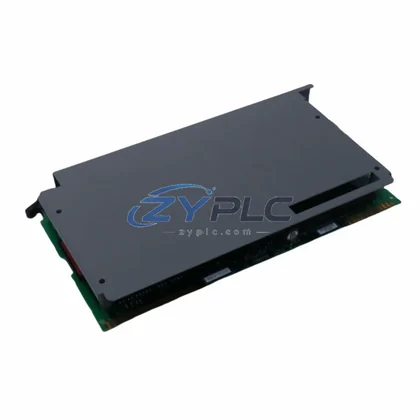
The Reliance Electric 57C421B is a 16-point, 24VDC digital input module engineered for seamless integration within the 57C-Series distributed control system architecture. Designed to serve as a critical signal acquisition node at the I/O layer, this module bridges field-level instrumentation and the central control layer with precision, reliability, and long-term serviceability. Rather than functioning as a standalone component, the 57C421B is purpose-built to operate within a coordinated system hierarchy — where every module, backplane slot, and communication pathway contributes to overall plant automation performance.
In modern industrial control environments, the integrity of the I/O layer directly determines the responsiveness and accuracy of the entire control loop. The 57C421B captures discrete field signals — from limit switches, proximity sensors, pushbuttons, and relay contacts — and transmits them to the CPU module for real-time processing. Its 24VDC input compatibility ensures broad applicability across standard field wiring practices used in manufacturing, power generation, and process industries. With a robust signal conditioning circuit and optical isolation on each channel, the module maintains signal fidelity even in electrically noisy environments typical of motor control centers and high-voltage switchgear panels.
System architects integrating the 57C421B benefit from its slot-based installation within the 57C-Series backplane chassis, which supports modular expansion without rewiring. The backplane’s passive bus architecture distributes power and communication signals uniformly across all installed modules, enabling the 57C421B to operate in conjunction with analog input modules, digital output modules, and specialty function cards within the same rack. This modular co-location reduces inter-module latency and simplifies cabinet layout — a key advantage during both initial commissioning and long-term maintenance cycles.
From a system architecture perspective, the 57C421B occupies the field interface tier, working upstream from the CPU module (such as the Reliance Electric 57C410A or 57C411A) and downstream from field devices. The CPU module polls the input module at each scan cycle, ensuring that process state changes are captured and acted upon within the system’s defined response time. For applications requiring redundancy, the 57C-Series architecture supports dual-CPU configurations where the 57C421B’s data is mirrored across both processors, maintaining control continuity during planned maintenance or unexpected processor faults.
At the network and communication layer, the 57C-Series platform supports integration with supervisory systems via serial communication interfaces and, in upgraded configurations, industrial Ethernet gateways. The 57C421B’s data is made available to SCADA platforms, historian servers, and HMI terminals — including operator panels and touchscreen workstations — enabling real-time visualization of field input states across the plant floor. This system integration capability ensures that operators and engineers have accurate, up-to-date process data at every level of the automation hierarchy.
Power supply integrity is equally critical to the 57C421B’s reliable operation. The module draws regulated 24VDC from the rack’s internal power bus, which is typically fed by a dedicated DIN-rail mounted power supply unit. In high-availability installations, redundant power supply modules feed the backplane through diode-ORing circuits, ensuring that a single power supply failure does not interrupt I/O scanning. This power architecture, combined with the module’s built-in diagnostics, supports predictive maintenance strategies that reduce unplanned downtime.
For long-term plant operations, the availability of tested, verified 57C421B modules is essential to sustaining system uptime without forcing premature platform migrations. Each unit supplied by ZYPLC undergoes functional testing prior to shipment and is backed by a warranty terms confirmed during quotation, providing procurement teams and maintenance engineers with the confidence needed for critical spare parts planning. Our inventory of Reliance Electric 57C-Series components — including output modules, power supplies, CPU cards, and communication adapters — supports multi-site operations and emergency replacement scenarios with fast turnaround.
Product Specification Table
| Parameter |
Specification |
| Part Number |
57C421B |
| Brand |
Reliance Electric |
| Series |
57C-Series DCS |
| Module Type |
Digital Input Module |
| System Role |
Field Signal Acquisition – I/O Layer |
| Number of Input Points |
16 Points |
| Input Voltage |
24VDC |
| Signal Isolation |
Optical Isolation per Channel |
| Installation Method |
Backplane Slot Mount – 57C-Series Chassis |
| Communication |
Backplane Bus (Parallel I/O Scan) |
| Compatible CPU Modules |
Reliance Electric 57C410A, 57C411A |
| Operating Temperature |
0°C to 60°C |
| Relative Humidity |
5% to 95% Non-Condensing |
| Power Consumption |
24VDC via Backplane Bus |
| Mounting Environment |
Control Cabinet / DIN-Rail Panel |
| Warranty |
warranty terms confirmed during quotation (ZYPLC) |
| Condition |
Tested, Verified, shipment arranged after confirmation |
System Compatibility Notes
The 57C421B achieves its full operational value when deployed as part of a coordinated 57C-Series control system. At the control layer, the Reliance Electric 57C410A CPU module or 57C411A CPU module serves as the system’s processing core, executing ladder logic and function block programs that respond to input states captured by the 57C421B. The CPU communicates with all I/O modules through the 57C-Series backplane chassis, which provides both the physical mounting structure and the electrical bus for data and power distribution.
On the output side, the Reliance Electric 57C422B digital output module works in tandem with the 57C421B to complete the control loop — receiving commands from the CPU and driving field actuators, solenoid valves, motor starters, and relay coils. For analog process variables such as temperature, pressure, and flow, the 57C431A analog input module complements the 57C421B by providing 4–20mA and 0–10V signal acquisition within the same rack, enabling mixed I/O configurations without additional hardware.
System power is supplied through the Reliance Electric 57C401 power supply module, which converts incoming AC mains to the regulated 24VDC and 5VDC rails required by the backplane and installed modules. In redundant power configurations, a secondary power supply module operates in hot-standby mode, monitored by the CPU’s built-in diagnostics. Communication to upper-level SCADA and DCS platforms is facilitated by the 57C-Series serial communication adapter, which supports RS-232 and RS-485 protocols for integration with historian servers and operator workstations.
At the human-machine interface layer, operator panels and touchscreen HMI terminals display real-time input states sourced from the 57C421B, enabling process visualization and alarm management. Terminal blocks and marshalling panels at the field wiring interface ensure organized, labeled connections between field cables and the module’s input terminals, simplifying troubleshooting and reducing wiring errors during commissioning and maintenance activities.
Industrial Application Notes
The Reliance Electric 57C421B is deployed across a wide range of industrial sectors where reliable discrete input acquisition is fundamental to safe and efficient operations. In manufacturing and assembly lines, the module monitors conveyor position sensors, part-present detectors, and safety interlocks, feeding real-time status data to the CPU for sequencing and fault detection logic. In power generation and electrical distribution facilities, the 57C421B captures breaker status, relay contact states, and protection relay outputs, providing the control system with accurate grid topology information for load management and fault isolation.
In petrochemical and refinery applications, the module integrates with field junction boxes to monitor valve position feedback, pump run/stop status, and emergency shutdown (ESD) system inputs. Its optical isolation ensures that high-voltage transients common in these environments do not propagate into the control system backplane. For water and wastewater treatment plants, the 57C421B monitors pump station status, level switch inputs, and flow control valve positions across geographically distributed pump stations connected via remote I/O networks.
In mining and mineral processing operations, the module’s rugged design supports deployment in dusty, vibration-prone environments where conveyor belt systems, crusher controls, and ore handling equipment generate continuous discrete signal traffic. Metallurgical and steel plant applications leverage the 57C421B for furnace door position monitoring, cooling water flow confirmation, and rolling mill safety interlock verification. Across all these sectors, the module’s compatibility with the 57C-Series architecture ensures that system expansions, upgrades, and spare parts sourcing remain straightforward throughout the plant’s operational lifecycle.
Product Compatibility FAQ
Q1: Is the Reliance Electric 57C421B compatible with all 57C-Series backplane chassis configurations?
Yes. The 57C421B is designed for slot-based installation in standard 57C-Series backplane chassis. It is compatible with both 4-slot and 8-slot chassis variants used in the 57C platform. When mixing input and output modules within the same chassis, slot assignment should follow the CPU manufacturer’s I/O mapping guidelines to ensure correct address allocation and scan cycle performance. If you are expanding an existing system, verify the chassis firmware revision to confirm full compatibility with the 57C421B’s input addressing scheme.
Q2: Can the 57C421B be used in a redundant CPU architecture, and how does failover affect input scanning?
The 57C-Series platform supports dual-CPU redundancy configurations where both processors share access to the I/O backplane. In this architecture, the primary CPU actively scans the 57C421B’s input states while the secondary CPU maintains a synchronized copy of the I/O image table. Upon a primary CPU fault, the secondary assumes control within the system’s defined switchover time, with no interruption to input scanning. This redundancy design is particularly valuable in continuous process applications where even brief control interruptions can result in product loss or safety events. ZYPLC supplies tested 57C421B modules suitable for both simplex and redundant system configurations.
Q3: What does the warranty terms confirmed during quotation cover, and what support is available for long-term maintenance planning?
Every Reliance Electric 57C421B supplied by ZYPLC is covered by a warranty terms confirmed during quotation against functional defects, covering repair or replacement at no additional cost. Prior to shipment, each module undergoes functional verification testing to confirm channel-level input response, optical isolation integrity, and backplane communication performance. For long-term maintenance planning, ZYPLC maintains inventory of 57C-Series compatible modules — including CPU cards, power supplies, output modules, and communication adapters — enabling procurement teams to establish multi-year spare parts strategies without dependency on OEM lead times. Contact our technical team for volume pricing, exchange programs, and application-specific compatibility verification.