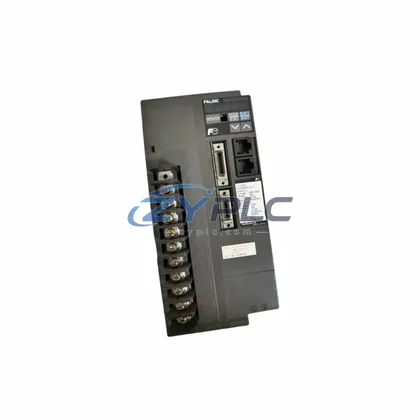
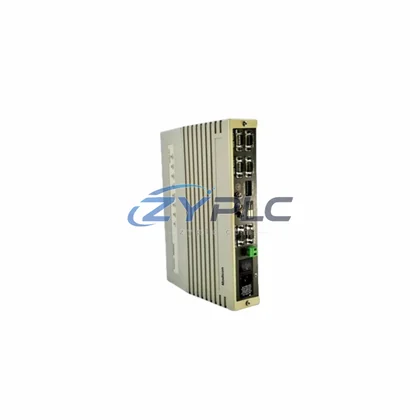
The Schneider Electric LXM05BD34N4 is a high-performance servo drive from the Lexium 05 series, engineered to deliver precise motor control with a strong focus on energy efficiency and production line optimization. Rated at 3.4 A continuous output current and designed for three-phase 200–240 V AC supply networks, this drive module enables factories to significantly reduce idle operating load, minimize reactive power losses, and maintain tight control over servo motor dynamics across demanding industrial cycles.
In modern manufacturing environments where equipment uptime and replacement lead time directly affect production continuity, the LXM05BD34N4 provides a measurable advantage. Its integrated DC bus architecture allows energy regenerated during motor deceleration to be shared across multiple axes — reducing the net draw from the supply network and lowering heat dissipation within the control cabinet. When paired with a Lexium 05 power supply module (LXM05AP), the system forms a coordinated drive bus that dynamically balances load across axes, smoothing peak current demand and extending the service life of upstream components including line reactors and input fuses.
Product Specification Table
| Parameter |
Specification |
| Model / SKU |
LXM05BD34N4 |
| Series |
Lexium 05 |
| Brand |
Schneider Electric |
| Continuous Output Current |
3.4 A |
| Supply Voltage |
3-phase 200–240 V AC, 50/60 Hz |
| Drive Topology |
Shared DC Bus (Multi-axis energy recovery) |
| Motor Compatibility |
BSH / BMH Brushless Servo Motors (Schneider Electric) |
| Control Interface |
CANopen / Modbus RTU / Pulse-Direction |
| Compatible Systems |
Modicon M340, M580, SoMachine Motion, LMC058 |
| Application Environment |
Packaging, Printing, Textile, Assembly, Conveyor |
| Energy Recovery |
DC bus regeneration shared across drive axes |
| Protection Class |
IP20 (cabinet installation) |
| Operating Temperature |
0–40 °C (up to 50 °C with derating) |
| Value |
Reduced peak demand, regenerative braking, low standby loss |
| Warranty |
warranty and condition confirmed before quote | Tested & Verified before shipment |
| RFQ Status |
RFQ Available — Shipment arranged after confirmation |
System Compatibility and Application
The LXM05BD34N4 does not operate in isolation — its energy efficiency is fully realized when integrated into a coordinated automation architecture. In a typical high-throughput production cell, the drive connects to a Schneider Electric BSH0703P servo motor via a dedicated power and encoder cable, delivering closed-loop torque and velocity control with sub-millisecond response times. The motion controller — typically a Schneider Electric LMC058 Logic Motion Controller or a Modicon M580 PAC — sends real-time position and speed references over CANopen or SoMachine Motion network, ensuring that each axis executes its trajectory with minimal overshoot and zero unnecessary dwell time.
On the power monitoring side, integrating a Schneider Electric PowerLogic PM5350 power meter upstream of the drive panel allows plant engineers to capture real-time kWh consumption, power factor, and harmonic distortion data at the drive group level. This data feeds into energy dashboards and helps identify axes that are drawing disproportionate power relative to their mechanical output — a key indicator of mechanical wear or misalignment that would otherwise go undetected until a fault occurs.
For I/O coordination, the LXM05BD34N4 integrates with Schneider Electric TM3 expansion I/O modules mounted on the same DIN rail as the Modicon controller, enabling fast digital handshaking between the servo axis and upstream/downstream conveyor segments. This tight I/O coupling eliminates inter-station latency and allows the line PLC to dynamically adjust servo velocity profiles based on real-time sensor feedback — for example, slowing a pick-and-place axis when a vision system detects a misaligned part, rather than completing a full cycle and generating a reject.
The Schneider Electric Lexium 05 series also supports multi-axis configurations where a single LXM05AP power supply module feeds multiple LXM05B drive modules through a shared DC bus bar. In a three-axis gantry or a four-axis palletizer, this topology means that when one axis decelerates and regenerates energy, that energy is immediately available to an accelerating axis — reducing the total energy drawn from the AC supply by up to 30% compared to individual single-axis drive installations. Complementing this, a Schneider Electric Altivar Process ATV630 variable speed drive can be deployed on auxiliary motor loads such as pneumatic compressors or cooling fans within the same panel, bringing those loads under the same maintenance planning umbrella.
Communication transparency is maintained through Modbus TCP/IP gateways that bridge the servo network data to the plant SCADA or MES layer, where Schneider Electric EcoStruxure Machine Advisor aggregates drive health metrics, runtime hours, and energy KPIs across the entire production line. This end-to-end visibility — from the LXM05BD34N4 drive level up to the enterprise dashboard — is what transforms a component-level efficiency gain into a measurable plant-wide energy reduction.
Maintenance and Replacement Notes
In packaging lines running 24/7, the LXM05BD34N4 contributes to operational stability through several mechanisms. First, its velocity feed-forward algorithm reduces the torque demand during constant-speed phases, lowering the RMS current drawn from the DC bus and reducing I²R losses in both the drive and the motor windings. Second, the drive’s automatic standby function reduces the holding current to the servo motor during machine idle periods — such as product changeovers or upstream stoppages — without fully de-energizing the axis, allowing instant restart without the energy spike associated with a cold start.
In textile and printing applications where web tension control is critical, the LXM05BD34N4’s torque control mode allows the drive to maintain a precise, programmable tension setpoint across the material web. This eliminates the unplanned downtime associated with over-tensioning — a common problem with older AC induction motor drives running open-loop — and reduces material waste caused by web breaks, which themselves carry a significant hidden energy cost in terms of restart cycles and scrap.
Predictive maintenance is another dimension of maintenance planning. By monitoring the drive’s internal temperature, DC bus voltage ripple, and motor encoder feedback quality through the SoMachine Motion diagnostic interface, maintenance teams can detect bearing degradation, coupling misalignment, or encoder signal deterioration weeks before they cause an unplanned stoppage. Unplanned stoppages are among the highest-cost energy events in a production environment — not because of the energy consumed during the stoppage, but because of the energy-intensive restart sequences, scrap generation, and compressed-air purges required to bring the line back to steady-state production.
All units supplied by ZYPLC undergo a full functional test prior to shipment, including DC bus charge/discharge verification, encoder signal integrity check, and a loaded run test at rated current. Each LXM05BD34N4 is shipped with a warranty and condition confirmed before quote covering both parts and labor for defects in materials and workmanship. Shipment timing is confirmed after RFQ review, testing, and export packing.
Product Sourcing FAQ
Q1: How much energy can the LXM05BD34N4 save compared to a standard AC drive on the same application?
In servo-controlled applications with frequent acceleration/deceleration cycles — such as pick-and-place or indexing conveyors — the LXM05BD34N4’s regenerative DC bus sharing can reduce net operating load by Actual operating results depend on the installed system, load profile, and commissioning parameters. Actual savings depend on cycle time, inertia ratio, and the number of axes sharing the DC bus.
Q2: Is the LXM05BD34N4 compatible with existing Schneider Electric Lexium 05 installations?
Yes. The LXM05BD34N4 is a direct plug-in replacement for other LXM05B-series drives of the same current rating within an existing Lexium 05 multi-axis system. It shares the same DC bus connector, CANopen node addressing, and SoMachine Motion parameter structure, allowing configuration to be restored from a backup file without re-commissioning the axis from scratch.
Q3: What is the recommended replacement or upgrade path if the LXM05BD34N4 is being used in a legacy system?
For systems requiring higher power density or EtherCAT communication, the Schneider Electric Lexium 32 series (e.g., LXM32MD18N4) offers a migration path with backward-compatible motor wiring and an expanded communication option card slot. ZYPLC can advise on cross-reference compatibility and supply both legacy and current-generation Lexium drives from stock.
Q4: What does the warranty and condition confirmed before quote cover, and what is the testing process before shipment?
Every LXM05BD34N4 unit supplied by ZYPLC is tested for DC bus integrity, output phase balance, encoder interface functionality, and communication port response before dispatch. The warranty and condition confirmed before quote covers manufacturing defects and component failures under normal operating conditions. Units that fail during the warranty period are replaced or repaired at no charge, with priority handling to minimize customer downtime.