Siemens 6DP1360-8BA DCS Module for Teleperm M: Compatibility and Replacement Notes
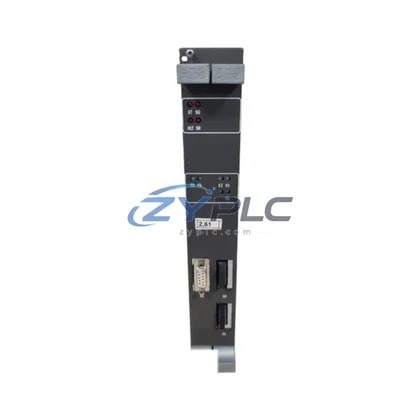
The Siemens 6DP1360-8BA, designated as the FUM360 Function Module, is a purpose-engineered distributed control system (DCS) component designed to operate within the Teleperm M control platform. Rather than functioning as a standalone unit, the 6DP1360-8BA is conceived as an integral node within a layered automation hierarchy — one that bridges the gap between field-level signal acquisition and supervisory control logic. Its role within the Teleperm M architecture is to execute function-block-based process control tasks, enabling deterministic signal processing, loop control, and interlock management across complex industrial environments.
In a fully realized Teleperm M system, the 6DP1360-8BA operates in close coordination with the central processing units of the AS230 or AS235 automation stations, which serve as the primary control layer. These automation stations rely on function modules such as the 6DP1360-8BA to distribute computational load across the rack, ensuring that time-critical control loops are executed with minimal latency. The module slots into the Teleperm M subrack — typically a 19-inch rack assembly — alongside power supply modules such as the 6DP1610-8AA, which provides the regulated DC voltage rails required for stable module operation. Proper power architecture is foundational: voltage fluctuations at the rack level can compromise the deterministic behavior that process industries demand.
At the I/O layer, the 6DP1360-8BA interfaces with analog and digital input/output modules within the Teleperm M family, including signal conditioning modules that normalize field signals from thermocouples, RTDs, pressure transmitters, and flow meters into standardized process values. These I/O modules feed real-time data into the function module’s control algorithms, enabling closed-loop PID regulation, cascade control, and ratio control strategies. The integrity of this signal chain — from field instrument through I/O module to the 6DP1360-8BA — is critical to maintaining process stability in applications such as boiler control, reactor temperature management, and compressor surge protection.
From a network and communication perspective, the Teleperm M architecture employs the SINEC H1 industrial Ethernet backbone and the TELEPERM bus for inter-module and inter-station communication. The 6DP1360-8BA participates in this communication fabric by exchanging process data, setpoints, and status information with peer modules and the operator station layer. Communication gateways within the Teleperm M system — such as the CS275 bus coupler — enable the platform to interface with higher-level SCADA systems or modern DCS platforms during migration projects, preserving the operational value of legacy Teleperm M installations while extending their connectivity.
At the human-machine interface layer, operator stations running TELEPERM M OS software present process graphics, trend displays, and alarm management screens that draw their data from modules like the 6DP1360-8BA. The quality and reliability of the data produced by the function module directly determines the accuracy of operator displays and the responsiveness of alarm annunciation. In high-stakes environments such as power generation, chemical processing, and oil and gas facilities, this data fidelity is non-negotiable.
Redundancy is a defining characteristic of well-engineered Teleperm M installations. The 6DP1360-8BA can be deployed in redundant configurations where a standby module mirrors the active module’s state, enabling bumpless transfer in the event of a hardware fault. This redundancy architecture, combined with the hot-swap capability of the Teleperm M subrack, minimizes unplanned downtime and supports the high-availability requirements of continuous process industries. Complementary modules such as the 6DP1370-8BA and 6DP1380-8BA may serve adjacent functional roles within the same redundant control loop, ensuring that no single point of failure can compromise the integrity of the control system.
From a maintenance and lifecycle perspective, the 6DP1360-8BA offers significant advantages for facilities managing aging Teleperm M installations. Its form factor and firmware compatibility with the existing subrack and backplane eliminate the need for costly re-engineering during module replacement. Maintenance engineers can swap the module, restore configuration parameters from the engineering station, and return the control loop to service within a single maintenance window. This maintainability, combined with our warranty terms confirmed during quotation and system integration support, makes the 6DP1360-8BA a reliable choice for both planned upgrades and emergency replacements.
Product Specification Table
| Parameter |
Specification |
| Manufacturer |
Siemens |
| Part Number / SKU |
6DP1360-8BA |
| Module Designation |
FUM360 Function Module |
| System Role |
Distributed Function Execution Module — Teleperm M DCS |
| Compatible Platform |
Siemens Teleperm M (AS230 / AS235 Automation Stations) |
| Control Architecture Layer |
Control Layer / Process Automation Layer |
| Mounting |
Teleperm M 19-inch Subrack (Backplane Bus) |
| Supply Voltage |
24 V DC (via rack power supply, e.g. 6DP1610-8AA) |
| Communication Interface |
Teleperm M Internal Bus / SINEC H1 (via gateway) |
| Control Functions |
PID Control, Cascade Control, Interlock Logic, Function Block Execution |
| Signal Compatibility |
Analog & Digital I/O via Teleperm M I/O Modules |
| Redundancy Support |
Yes — Active/Standby Module Redundancy |
| Operating Temperature |
0°C to +60°C |
| Relative Humidity |
5% to 95% (non-condensing) |
| Installation Environment |
Industrial Control Cabinet / DCS Rack Room |
| Country of Origin |
Germany |
| Warranty |
warranty terms confirmed during quotation (ZYPLC) |
| system integration |
Supported — Engineering & Commissioning Guidance Available |
System Compatibility Notes
A complete Teleperm M control system built around the 6DP1360-8BA typically incorporates a carefully selected set of complementary modules and components. The AS235 automation station serves as the central processing unit, orchestrating the execution of function blocks distributed across modules like the 6DP1360-8BA. Power integrity is maintained by the 6DP1610-8AA power supply module, which delivers clean, regulated DC power to all modules within the subrack. Analog input modules such as the 6DP1232-8AA condition signals from field transmitters before passing them to the function module for processing, while digital output modules relay control commands to field actuators and solenoid valves.
For systems requiring communication with modern SCADA platforms or migration to SIMATIC PCS 7, the CS275 bus coupler and associated communication processors provide the necessary protocol bridging. In redundant architectures, a companion 6DP1370-8BA or 6DP1380-8BA module may be installed in the adjacent slot to provide hot-standby capability. The Teleperm M operator station, running TELEPERM M OS, provides the HMI layer, presenting process data sourced from the 6DP1360-8BA to control room operators. Terminal modules and marshalling panels within the control cabinet complete the signal path from field instruments to the DCS rack, ensuring a clean, documented wiring architecture that simplifies both commissioning and long-term maintenance.
Industrial Application Notes
The Siemens 6DP1360-8BA finds application across a broad spectrum of process industries where the Teleperm M platform has been deployed. In power generation facilities — including coal-fired, gas turbine, and combined-cycle plants — the module supports boiler combustion control, turbine governor interfacing, and auxiliary system automation. Its deterministic execution of PID and cascade control loops makes it well-suited to the tight process tolerances required in these environments.
In the petrochemical and refining sector, the 6DP1360-8BA is commonly found in distillation column control, reactor temperature and pressure management, and compressor anti-surge control systems. The module’s ability to execute complex function block sequences within the Teleperm M architecture enables the implementation of advanced process control strategies without requiring a full DCS migration. Water and wastewater treatment facilities rely on the module for pump sequencing, chemical dosing control, and filtration process management, where reliable long-term operation and minimal maintenance intervention are paramount.
Mining and metallurgical operations benefit from the module’s robustness in electrically noisy environments, where it supports ore processing control, smelter temperature regulation, and conveyor system automation. In the pharmaceutical and food processing industries, the 6DP1360-8BA contributes to batch process control and clean-in-place (CIP) sequence management, where process repeatability and audit trail integrity are regulatory requirements. Across all these applications, the module’s compatibility with the existing Teleperm M infrastructure allows facilities to extend the operational life of their control systems while maintaining process performance and safety standards.
Product Compatibility FAQ
Q1: Is the 6DP1360-8BA compatible with both AS230 and AS235 automation stations, and can it be used in a mixed-module subrack?
Yes. The 6DP1360-8BA is designed for use within the Teleperm M subrack architecture and is compatible with both the AS230 and AS235 automation stations. It can coexist in a mixed-module subrack alongside other Teleperm M function modules, I/O modules, and communication processors, provided that the subrack backplane and power supply are correctly specified for the total module load. Our engineering team can assist with rack configuration validation as part of our system integration support service.
Q2: What steps are required to commission the 6DP1360-8BA as a replacement module in an existing Teleperm M system?
Commissioning a replacement 6DP1360-8BA involves inserting the module into the correct subrack slot, restoring the function block configuration from the Teleperm M engineering station (typically using the STEP M or equivalent toolset), and verifying loop integrity through a structured loop check procedure. In redundant configurations, the standby module must be synchronized with the active module before the system is returned to automatic control. Our warranty terms confirmed during quotation covers the module hardware, and our system integration support can provide commissioning guidance to minimize downtime during the replacement process.
Q3: How does the warranty terms confirmed during quotation apply to the 6DP1360-8BA, and what long-term support options are available for Teleperm M installations?
All 6DP1360-8BA modules supplied by ZYPLC are covered by a warranty terms confirmed during quotation against manufacturing defects and functional failures under normal operating conditions. In the event of a warranty claim, we provide a replacement module or repair service with priority turnaround to minimize process disruption. For long-term support, we maintain a dedicated inventory of Teleperm M spare parts, enabling rapid response to both planned maintenance and emergency replacement requirements. Our system integration service extends beyond the warranty period, offering ongoing technical consultation for system architecture reviews, module compatibility assessments, and migration planning.