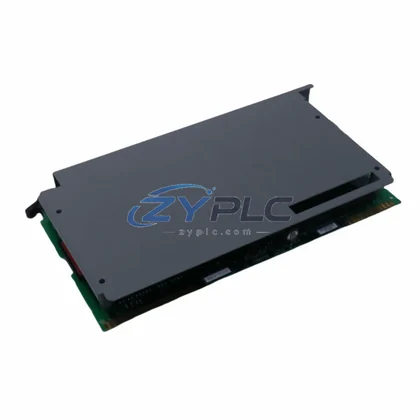
The Siemens LDZ10500424.040 is a precision analog input module engineered for deployment within the Teleperm M Distributed Control System (DCS) architecture — one of Siemens’ most enduring and field-proven process automation platforms. Rather than functioning as a standalone component, this module occupies a critical position within the I/O layer of a multi-tier control hierarchy, where it serves as the primary interface between field instrumentation and the central processing infrastructure. Understanding its role requires examining the full system stack: from field sensors and transmitters at the lowest layer, through the I/O acquisition tier, up to the controller and supervisory levels, and ultimately to the human-machine interface and enterprise integration layers.
In a typical Teleperm M installation, the LDZ10500424.040 is rack-mounted alongside companion modules including the LDZ10500423 digital input module, LDZ10500425 analog output module, and LDZ10500426 digital output module, all sharing a common backplane bus that ensures synchronized data acquisition and deterministic signal delivery to the central processing unit. The module accepts standard 4–20 mA and voltage-based analog signals from field devices such as pressure transmitters, temperature sensors, flow meters, and level gauges, converting them into digital representations that the Teleperm M CPU — typically the AS 230 or AS 235 automation station — can process in real time.
System consistency is one of the defining advantages of deploying the LDZ10500424.040 within a native Teleperm M environment. Because the module is designed to Siemens’ original hardware specifications, it integrates without protocol translation overhead, firmware compatibility issues, or signal conditioning mismatches that can arise when third-party I/O modules are substituted. The backplane communication protocol, timing synchronization, and diagnostic reporting all conform to the Teleperm M system standard, ensuring that the AS 230 or AS 235 controller receives clean, timestamped analog data without additional engineering intervention.
Product Specification Table
| Parameter |
Specification |
| Part Number / SKU |
LDZ10500424.040 |
| Brand |
Siemens |
| Series / Platform |
Teleperm M DCS |
| Module Type |
Analog Input Module |
| System Role |
I/O Layer — Field Signal Acquisition |
| Signal Input Type |
Analog (4–20 mA / Voltage, inferred from series standard) |
| Communication Interface |
Teleperm M Backplane Bus |
| Compatible Controllers |
AS 230, AS 235 Automation Stations |
| Installation Method |
Rack-mount, Teleperm M subrack |
| Operating Environment |
Industrial control cabinet, standard DIN rail subrack |
| Country of Origin |
Germany |
| Product Category |
Industrial Automation > DCS > Analog I/O Modules |
| Warranty |
Warranty and support terms confirmed before quote (ZYPLC Standard) |
| system integration |
Supported — native Teleperm M architecture compatibility |
System Compatibility Notes
Effective deployment of the LDZ10500424.040 depends on its coordination with the broader Teleperm M system architecture. At the controller layer, the AS 230 or AS 235 automation station serves as the central processing node, executing control logic and issuing setpoints to output modules based on the analog values delivered by the LDZ10500424.040. The controller communicates with the I/O layer via the Teleperm M backplane, a high-speed parallel bus that supports deterministic, cycle-synchronized data exchange across all installed modules.
At the power layer, the Teleperm M subrack relies on dedicated power supply modules — such as the LDZ10500401 or equivalent Siemens rack power units — to deliver stable 24 VDC to all installed I/O modules including the LDZ10500424.040. Power quality directly affects analog signal accuracy; any ripple or transient on the supply rail can introduce measurement error at the ADC stage of the input module. For this reason, Siemens-specified power supply modules with integrated filtering are strongly recommended over generic alternatives.
At the network and supervisory layer, the Teleperm M system typically interfaces with a SINEC H1 or PROFIBUS-based communication network, connecting the automation stations to operator workstations running the Teleperm M OS (Operating System) or, in modernized installations, to SIMATIC WinCC or PCS 7 supervisory platforms via gateway modules. The LDZ10500424.040’s data, once processed by the AS 230 or AS 235, is made available to these supervisory systems for trending, alarming, and historical logging — enabling operators to monitor process variables in real time from the HMI layer.
For redundancy-critical applications, the Teleperm M architecture supports controller redundancy through paired AS 235 stations operating in hot-standby mode. In such configurations, the LDZ10500424.040 feeds analog data to both the primary and standby controllers simultaneously via the shared backplane, ensuring that a controller failover event does not result in any loss of process visibility. This redundancy architecture is particularly important in power generation, chemical processing, and oil and gas applications where continuous process monitoring is a safety requirement.
At the field termination layer, the LDZ10500424.040 connects to field instruments via terminal modules or marshalling cabinets, where individual signal cables from pressure transmitters, thermocouple transmitters, flow computers, and level sensors are terminated and routed to the module’s input channels. Proper cable shielding, grounding, and termination practices at this layer are essential to maintaining signal integrity across the full analog input chain.
Industrial Application Notes
Power Generation and Utilities: In thermal power plants and combined-cycle facilities, the LDZ10500424.040 is deployed to monitor boiler drum pressure, steam temperature, feedwater flow, and turbine bearing temperatures. The Teleperm M DCS has a long-established presence in power generation, and the LDZ10500424.040 supports ongoing operations at plants where full system replacement is not economically justified. Its native compatibility with the AS 235 controller and SINEC H1 network ensures that analog process data is delivered to the operator workstation without latency or signal conditioning loss.
Chemical and Petrochemical Processing: Continuous process plants in the chemical and petrochemical sectors rely on high-density analog I/O for reactor temperature profiling, pressure differential monitoring across distillation columns, and flow measurement in feed and product streams. The LDZ10500424.040 supports these applications by providing reliable multi-channel analog acquisition within the Teleperm M subrack, reducing the number of individual field wiring runs required and simplifying cabinet layout in space-constrained control rooms.
Water and Wastewater Treatment: Municipal water treatment facilities and industrial effluent treatment plants use the Teleperm M DCS to manage aeration, dosing, filtration, and sludge handling processes. The LDZ10500424.040 acquires analog signals from dissolved oxygen sensors, pH transmitters, turbidity meters, and flow meters, feeding this data to the AS 230 controller for closed-loop process regulation. The module’s long-term availability through specialist suppliers ensures that water utilities can maintain their existing DCS infrastructure without costly platform migrations.
Metallurgy and Mining: In smelting, refining, and mineral processing operations, the Teleperm M DCS controls furnace temperature profiles, conveyor load monitoring, and reagent dosing. The LDZ10500424.040 provides the analog input capability required to monitor thermocouple-based temperature signals and 4–20 mA transmitter outputs from process instrumentation, supporting the high-temperature and high-vibration environments typical of metallurgical facilities.
Product Compatibility FAQ
Q1: Is the LDZ10500424.040 compatible with both the AS 230 and AS 235 automation stations, and can it be used in a redundant controller configuration?
Yes. The LDZ10500424.040 is designed for the Teleperm M subrack backplane and is compatible with both the AS 230 and AS 235 automation stations. In redundant AS 235 configurations operating in hot-standby mode, the module feeds analog data to both the primary and standby controllers via the shared backplane bus, supporting seamless controller failover without process data interruption. No additional hardware or firmware modification is required to enable this redundancy behavior — it is inherent to the Teleperm M architecture.
Q2: Can the LDZ10500424.040 be installed in an existing Teleperm M subrack alongside other I/O modules without system reconfiguration?
In most cases, yes. The LDZ10500424.040 occupies a standard slot in the Teleperm M subrack and communicates via the backplane bus using the native Teleperm M I/O protocol. Provided that the subrack has an available slot and the AS 230 or AS 235 controller’s I/O configuration database is updated to recognize the new module address, installation can be completed during a planned maintenance window without requiring a full system restart. It is recommended to verify the existing subrack slot assignments and controller configuration files before installation to avoid address conflicts.
Q3: What does the Warranty and support terms confirmed before quote cover, and what support is available for long-term maintenance of Teleperm M components?
All LDZ10500424.040 modules supplied by ZYPLC are Warranty terms are confirmed during quotation. This warranty covers module replacement or repair at no additional cost within the warranty period. For long-term maintenance, ZYPLC supports RFQ-based sourcing of Teleperm M I/O modules, power supply units, and controller components to support ongoing spare parts requirements. Customers are encouraged to contact our technical team to discuss multi-unit procurement, incoming inspection requirements, and long-term supply agreements that ensure continued availability of critical DCS components.