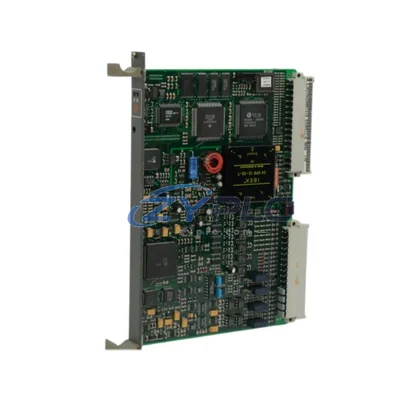
ABB BAMU-01C 3AUA0000054712 PROFIBUS DP Board for ACS880: Compatibility and Replacement Notes
In modern industrial automation, the reliability of a drive system depends not only on the performance of the drive itself, but on the seamless integration of every communication and control layer within the architecture. The ABB BAMU-01C 3AUA0000054712 is a PROFIBUS DP option board engineered specifically for the ACS880 industrial drive series, enabling deterministic fieldbus communication between the drive and the supervisory control layer. When deployed within a layered automation system, this option board becomes a critical node that connects the execution layer — where the ACS880 drive controls motors, pumps, compressors, or conveyors — to the control layer managed by a PLC or DCS platform.
The BAMU-01C slots directly into the option slot of the ACS880 drive, establishing a PROFIBUS DP slave interface that allows the host controller to issue speed references, torque commands, and control words while simultaneously reading back actual values, fault codes, and status words in real time. This bidirectional data exchange is fundamental to closed-loop process control, where the controller must continuously monitor drive feedback to maintain process stability. In applications such as variable-speed pump control in water treatment, fan speed regulation in HVAC systems, or conveyor synchronization in packaging lines, the latency and determinism of PROFIBUS DP communication directly affects process quality and system uptime.
Within the ACS880 platform ecosystem, the BAMU-01C operates alongside other option modules and system components. A typical ACS880 cabinet installation may include the ACS880-01 single drive unit, the ZPOW-01 power supply option, the RDCO-04 optical communication module for fiber-based control, and the BAMU-01C for PROFIBUS DP fieldbus connectivity. The drive’s control unit — typically the ZCU-12 or ZCU-14 — manages the option board communication through the drive’s internal option slot bus, ensuring that fieldbus data is processed with minimal latency and synchronized with the drive’s internal control cycle. For multi-drive systems, the ACS880-07 cabinet drive or ACS880-17 regenerative drive may also utilize the BAMU-01C to maintain consistent fieldbus architecture across all drive nodes on the same PROFIBUS segment.
From a system architecture perspective, the BAMU-01C enables the drive to participate as a standard PROFIBUS DP slave device, fully compatible with GSD file-based configuration in engineering tools such as Siemens TIA Portal, Step 7, or ABB’s own Drive Composer Pro. This compatibility ensures that the drive can be integrated into existing PROFIBUS networks managed by Siemens S7-300, S7-400, or S7-1500 PLCs, as well as ABB AC500 controllers or other PROFIBUS DP master devices. The option board supports standard PPO (Parameter Process data Object) types, allowing engineers to configure the cyclic data exchange profile to match the specific control requirements of the application.
In redundant control architectures, the BAMU-01C supports the drive’s participation in systems where the PROFIBUS master may switch between primary and backup controllers. The drive’s ability to maintain its last valid control state during a brief communication interruption — configurable through the drive’s communication fault response parameters — is essential for process continuity in critical applications such as petrochemical feed pumps, power plant auxiliary drives, or mining conveyor systems. Engineers can configure the drive’s response to PROFIBUS communication loss to include coast stop, ramp stop, or continued operation at the last speed reference, depending on the safety requirements of the application.
For system commissioning, the BAMU-01C is recognized automatically by the ACS880 drive firmware upon installation, and the PROFIBUS node address is set via the drive’s control panel or through the Drive Composer Pro software. The GSD file provided by ABB ensures accurate configuration of the PROFIBUS master, and the option board’s diagnostic LEDs provide immediate visual feedback on communication status, bus activity, and fault conditions. This simplifies troubleshooting during commissioning and reduces the time required to establish a stable fieldbus connection.
Long-term maintenance of systems incorporating the BAMU-01C benefits from ABB’s standardized option board form factor, which allows field replacement without requiring drive reconfiguration. The drive stores the option board configuration in its non-volatile memory, so a replacement BAMU-01C will resume normal operation after the drive performs its automatic option board recognition sequence. This design philosophy reduces mean time to repair (MTTR) and supports the maintenance strategies of facilities that operate on tight production schedules. Combined with a Warranty and support terms confirmed before quote covering manufacturing defects and functional performance, the BAMU-01C represents a reliable long-term investment for any ACS880-based drive system.
Product Specification Table
| Parameter |
Specification |
| System Role |
PROFIBUS DP Slave Option Board for ACS880 Drive |
| Compatible Drive Series |
ABB ACS880 (single drives, cabinet drives, regenerative drives) |
| Fieldbus Protocol |
PROFIBUS DP (EN 50170 / IEC 61158) |
| Transmission Speed |
9.6 kbps to 12 Mbps (auto-detected) |
| Node Address Setting |
Via drive control panel or Drive Composer Pro software |
| PPO Types Supported |
PPO1, PPO2, PPO3, PPO4, PPO5 |
| Cyclic Data |
Control Word / Status Word + Speed Reference / Actual Value |
| Installation |
Option slot 1 or 2 of ACS880 control unit (ZCU-12 / ZCU-14) |
| Power Supply |
Supplied internally by drive option slot bus |
| Operating Temperature |
-10°C to +55°C |
| Storage Temperature |
-40°C to +70°C |
| Humidity |
5–95% RH, non-condensing |
| Connector Type |
9-pin D-sub (DB9) female, standard PROFIBUS connector |
| GSD File |
Provided by ABB for TIA Portal, Step 7, and third-party masters |
| Diagnostic LEDs |
Bus activity, communication status, fault indication |
| Origin |
Finland |
| Warranty |
Warranty and support terms confirmed before quote (manufacturing defects and functional performance) |
System Compatibility Notes
The BAMU-01C achieves its full value when considered as part of a coordinated control system rather than as a standalone component. In a typical ACS880-based automation cell, the drive system architecture spans multiple layers: the supervisory control layer (PLC or DCS), the drive control layer (ACS880 with ZCU-14 control unit), the option and communication layer (BAMU-01C for PROFIBUS DP), the power and protection layer (ACH580 or ACS580 for auxiliary drives, with appropriate circuit breakers and fuses), and the motor and load layer (ABB M3BP or M3AA motors).
Within this architecture, the BAMU-01C interfaces directly with the PROFIBUS DP master — typically a Siemens S7-1500 PLC with a CM 1542-5 PROFIBUS communication module, or an ABB AC500 PLC with a PROFIBUS DP master module. The cyclic data exchange between the master and the BAMU-01C slave occurs at the configured bus cycle time, typically 1–10 ms, ensuring that speed references and control commands reach the drive with deterministic timing. For multi-drive systems, multiple ACS880 drives each equipped with a BAMU-01C can be daisy-chained on the same PROFIBUS segment, with each drive assigned a unique node address. The ZPOW-01 auxiliary power supply option within the ACS880 cabinet ensures that the drive’s control electronics and option boards remain powered during main power interruptions, supporting controlled shutdown sequences and fault logging.
For HMI integration, the PROFIBUS DP network can be extended to include ABB CP600 operator panels or Siemens SIMATIC HMI panels connected to the same PLC that manages the BAMU-01C-equipped drives. This allows operators to monitor drive speed, current, power, and fault status in real time from the HMI, with data routed through the PLC’s PROFIBUS master interface. In larger systems, the PROFIBUS segment may also include ABB RETA-02 Ethernet adapter modules on other drives, allowing a mixed communication architecture where some drives use PROFIBUS DP via BAMU-01C and others use EtherNet/IP or Modbus TCP via RETA-02, all managed by the same supervisory controller.
Terminal modules such as the ABB NTAC-02 pulse encoder interface or NSAN-711 signal adapter may be installed alongside the BAMU-01C in the ACS880’s option slots to provide additional feedback signals — such as encoder speed feedback or analog process values — that complement the PROFIBUS DP control data. This multi-option configuration maximizes the drive’s integration capability within complex control architectures without requiring external signal conditioning hardware.
Industrial Application Notes
The ABB BAMU-01C 3AUA0000054712 finds application across a wide range of industrial sectors where PROFIBUS DP remains the established fieldbus standard for drive communication.
In power generation and utilities, ACS880 drives equipped with BAMU-01C option boards control boiler feed pumps, cooling water pumps, and induced draft fans in thermal power plants. The PROFIBUS DP interface allows the plant’s DCS — typically an ABB System 800xA or Siemens PCS 7 — to issue speed setpoints and monitor drive status as part of the plant’s overall process control strategy. The drive’s ability to respond to PROFIBUS control commands within milliseconds is essential for maintaining boiler drum level and condenser vacuum within tight process limits.
In petrochemical and refinery applications, ACS880 drives with BAMU-01C boards control compressor anti-surge bypass valves, crude oil transfer pumps, and product blending systems. The PROFIBUS DP network provides the deterministic communication required for coordinated control of multiple drives in a single process unit, with the DCS managing the overall process while the drives execute speed and torque commands with high precision.
In mining and minerals processing, ACS880 drives equipped with BAMU-01C option boards control conveyor drives, crusher motors, and slurry pump systems. The robust PROFIBUS DP communication ensures reliable drive control even in electrically noisy environments typical of mining operations, where variable frequency drives, large motors, and long cable runs can introduce significant electromagnetic interference.
In water and wastewater treatment, the BAMU-01C enables ACS880 drives to participate in SCADA-controlled pump stations, where the PROFIBUS DP master (typically a Siemens S7-300 or S7-400 PLC) manages multiple pump drives based on flow demand signals. The drive’s maintenance planning features, accessible through PROFIBUS DP parameter write commands, allow the SCADA system to implement operational-efficiency strategies such as pump curve optimization and sleep/wake cycling.
In packaging and material handling, ACS880 drives with BAMU-01C boards provide coordinated speed control for multi-axis conveyor systems, where precise speed synchronization between drives is maintained through PROFIBUS DP cyclic data exchange managed by the line PLC.
Product Compatibility FAQ
Q1: Is the ABB BAMU-01C 3AUA0000054712 compatible with all ACS880 drive variants, and can it coexist with other option boards in the same drive?
The BAMU-01C is compatible with ACS880 single drives (ACS880-01), cabinet drives (ACS880-07), and regenerative drives (ACS880-17) that use the ZCU-12 or ZCU-14 control unit. The ACS880 control unit provides two option slots, allowing the BAMU-01C to be installed in slot 1 or slot 2 alongside another option board — such as the NTAC-02 pulse encoder interface or an NSAN-711 signal adapter — without conflict. Engineers should consult the ACS880 firmware release notes to confirm option board compatibility with the specific firmware version installed on the drive.
Q2: How is the BAMU-01C configured within a PROFIBUS DP network managed by a Siemens TIA Portal project, and what data exchange profile should be selected for standard speed control applications?
Configuration begins with importing the ABB-provided GSD file into the TIA Portal hardware catalog. The BAMU-01C slave is then added to the PROFIBUS DP network in the TIA Portal network view and assigned the same node address as set on the drive. For standard speed control applications, PPO Type 2 is recommended, providing a control word, speed reference, status word, and actual speed value in the cyclic data exchange. Additional process data words can be configured using PPO Type 4 or PPO Type 5 for applications requiring torque reference, power monitoring, or additional status information. The system integration capability of the BAMU-01C ensures that the drive’s full parameter set remains accessible through acyclic PROFIBUS DP services (DP-V1), allowing the PLC to read and write drive parameters for remote commissioning and diagnostics.
Q3: What is covered under the Warranty and support terms confirmed before quote for the BAMU-01C, and what long-term maintenance practices are recommended for systems using this option board?
The Warranty and support terms confirmed before quote covers manufacturing defects and functional performance failures under normal operating conditions. It does not cover damage resulting from incorrect installation, operation outside specified environmental limits, or electrical overstress. For long-term maintenance, it is recommended to keep a spare BAMU-01C in inventory for critical drive systems, as the option board can be replaced in the field without drive reconfiguration — the ACS880 drive stores the option board parameters in its non-volatile memory and restores them automatically upon recognizing a replacement board. Periodic inspection of the PROFIBUS DP cable termination resistors and connector integrity is also recommended, as poor termination is a common cause of intermittent communication faults in aging PROFIBUS installations.