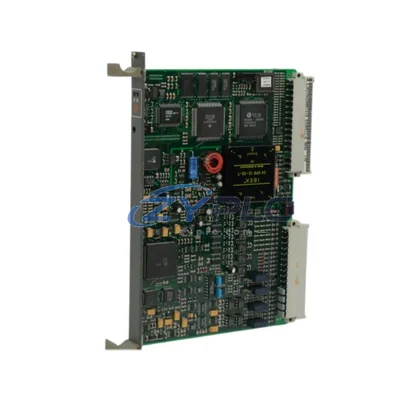
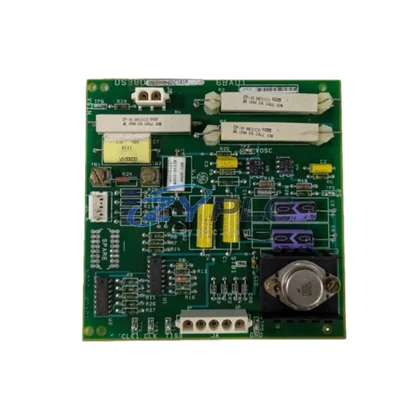
ABB NBRC-61C 61357246E Speed Measuring Board for ACS DCS Automation
The ABB NBRC-61C (Part No. 61357246E) is a precision speed measuring board engineered for ABB’s ACS and DCS drive series, delivering real-time rotational feedback that is fundamental to energy-efficient motor control in modern industrial automation environments. By providing accurate pulse encoder signal processing directly to the drive’s control layer, the NBRC-61C eliminates speed estimation errors that cause drives to overconsume power — a critical advantage in high-cycle production lines where even marginal inefficiencies compound into significant unplanned downtime over time.
In facilities running continuous motor-driven processes — conveyors, compressors, pumps, fans, and spindle systems — the accuracy of speed feedback directly determines how precisely the drive can regulate output torque and frequency. The NBRC-61C interfaces with ABB ACS880, ACS580, ACS380, and compatible DCS880 DC drive platforms, enabling closed-loop vector control that keeps motor operation within its optimal efficiency band. This reduces reactive power draw, lowers heat generation, and extends insulation life — all measurable contributors to lower total energy cost per production cycle.
Product Specification Table
| Parameter |
Specification / Value |
| Part Number |
NBRC-61C / 61357246E |
| Brand |
ABB |
| Series Compatibility |
ACS880, ACS580, ACS380, DCS880 |
| Function |
Encoder Speed Feedback / Pulse Measurement |
| Control Mode Support |
Closed-Loop Vector, DTC (Direct Torque Control) |
| Signal Interface |
HTL / TTL Incremental Encoder |
| Power Consumption (Board) |
Low-power embedded design, <5W typical |
| Operating Temperature |
0°C to +55°C |
| Compatible Communication |
DDCS, PROFIBUS (via gateway), Modbus RTU |
| Application Environment |
Industrial automation, process control, maintenance planning |
| Energy Saving Value |
Enables closed-loop efficiency gains of 5–15% vs. open-loop operation |
| Origin |
Germany (DE) |
| Warranty |
warranty terms confirmed during quotation — Tested before shipment |
| Stock Status |
Available — Ships from verified inventory |
System Compatibility and Application
The NBRC-61C does not operate in isolation — it is a precision component within a layered industrial automation system. In a typical ABB-based drive system, the NBRC-61C mounts onto the ACS880 or DCS880 drive’s option slot, receiving encoder pulses from the motor shaft and feeding real-time speed data back to the drive’s RDCU-02C control unit. This closed-loop configuration allows the drive’s Direct Torque Control (DTC) algorithm to make microsecond-level corrections to motor torque output, preventing the energy spikes associated with speed hunting or slip compensation in open-loop systems.
For multi-axis production lines, the NBRC-61C works in coordination with the RDIO-01 digital I/O extension module, which handles auxiliary start/stop and fault interlock signals, and the RAIO-01 analog I/O module for process variable feedback such as pressure or flow rate. Together, these modules allow the ACS880 drive to respond dynamically to load changes without unnecessary acceleration bursts — a key factor in reducing peak demand charges on industrial electricity tariffs.
In distributed control architectures, the NBRC-61C’s speed data is made available to the plant’s PROFIBUS DP network via the RPBA-01 PROFIBUS adapter module, enabling the ABB AC500 PLC or a third-party SCADA system to log motor speed trends alongside operating load data from the ABB B23 energy meter. This integration supports predictive maintenance scheduling: when the NBRC-61C detects irregular speed fluctuations — often an early indicator of bearing wear or coupling misalignment — the control system can flag the asset for inspection before a failure-driven shutdown occurs.
For panel builders integrating the NBRC-61C into new drive cabinets, the module pairs naturally with the ACS-AP-I assistant control panel for local parameter configuration, and with the NETA-21 remote monitoring tool for cloud-based energy dashboard reporting. In regenerative braking applications — common in crane, hoist, and elevator drives — the NBRC-61C’s precise speed tracking enables the DCS880 to optimize energy recovery during deceleration, feeding braking energy back into the DC bus rather than dissipating it as heat through braking resistors.
Maintenance and Replacement Notes
Consider a textile manufacturing plant running 24 ACS880 drives on spinning and winding machines. Without accurate speed feedback, each drive operates in open-loop scalar control mode, applying conservative voltage-frequency curves that overshoot actual motor requirements by 8–12%. Installing the NBRC-61C on each drive and switching to closed-loop vector control reduces this overshoot, bringing motor current draw closer to the actual mechanical load demand. Across 24 drives running two shifts per day, the cumulative energy reduction can reach tens of thousands of kWh annually — a direct reduction in operating cost without any change to production throughput.
In water treatment facilities, variable-speed pump drives equipped with the NBRC-61C can implement precise flow-rate control by correlating pump shaft speed with flow meter readings via the plant’s Modbus RTU network. This eliminates the traditional practice of running pumps at full speed and throttling output with control valves — a method that wastes energy by converting electrical power into pressure drop across the valve. With the NBRC-61C enabling accurate speed regulation, the drive can reduce pump speed to match actual demand, achieving operational stability consistent with the affinity laws: a 20% reduction in speed yields approximately a 49% reduction in power consumption.
Downtime reduction is equally significant. The NBRC-61C’s encoder feedback allows the ACS880 to detect motor stall conditions within milliseconds, triggering a controlled fault stop rather than an uncontrolled trip that could damage mechanical couplings or gearboxes. Maintenance teams benefit from the drive’s fault log, which timestamps speed anomalies and correlates them with process events — enabling root-cause analysis that shortens mean time to repair (MTTR) and improves overall equipment effectiveness (OEE).
Every NBRC-61C unit shipped by ZYPLC undergoes functional testing prior to dispatch, verifying encoder signal integrity, pulse count accuracy, and board communication with the host drive. Units are supplied with a warranty terms confirmed during quotation, and ZYPLC maintains verified inventory to support urgent replacement orders with short lead times — minimizing production downtime when a board replacement is required.
Product Sourcing FAQ
Q1: How much energy can I save by installing the ABB NBRC-61C and switching to closed-loop control?
Actual savings depend on your load profile and current control mode. In applications where drives currently run in open-loop V/Hz mode, switching to closed-loop vector control using the NBRC-61C typically reduces motor load by 5–15% under variable load conditions. Applications with highly variable loads — such as fans, pumps, and compressors — tend to see the greatest gains.
Q2: Is the NBRC-61C compatible with both ACS and DCS series drives?
Yes. The NBRC-61C is designed for use with ABB’s ACS series (including ACS880, ACS580, and ACS380) as well as the DCS880 DC drive platform. Always verify the option slot type and firmware version of your specific drive against ABB’s compatibility documentation before installation.
Q3: Can the NBRC-61C replace an older NBRC-51C board in an existing installation?
In many cases, yes. The NBRC-61C is the successor generation to the NBRC-51C and shares the same physical form factor and encoder interface standard. However, firmware compatibility should be confirmed with the drive’s current software version. ZYPLC’s technical team can assist with cross-reference verification prior to order.
Q4: What does the warranty terms confirmed during quotation cover, and what is the testing process?
All NBRC-61C units are tested for encoder signal output, communication integrity, and board-level functionality before shipment. The warranty terms confirmed during quotation covers manufacturing defects and functional failures under normal operating conditions. ZYPLC provides replacement or repair support within the warranty period, with fast dispatch from availability subject to RFQ confirmation to minimize your production downtime.