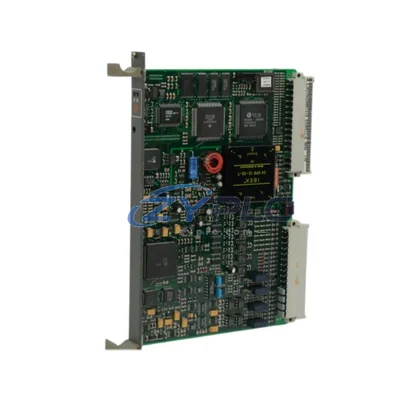
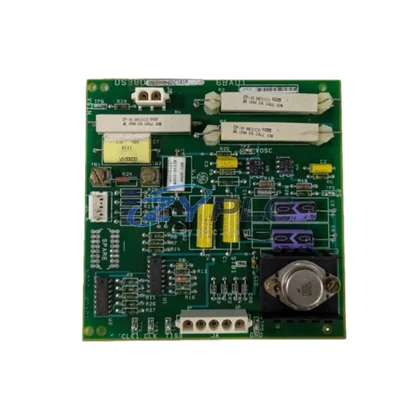
ABB NINT-41C: Industrial Data Link for ACS800 Drive Systems
The ABB NINT-41C is a high-performance industrial network interface board engineered for seamless integration of ABB ACS800 series AC drives into modern smart factory communication architectures. As industrial automation continues to evolve toward fully connected production environments, the NINT-41C serves as a critical bridge between field-level drive hardware and upper-level control, monitoring, and diagnostic systems. Whether your facility relies on DDCS fiber-optic communication, conventional fieldbus topologies, or hybrid network designs, the NINT-41C delivers the protocol flexibility, signal integrity, and real-time data throughput that demanding industrial applications require.
In a typical smart factory data flow, signals originate at the field device level — variable frequency drives, servo controllers, and motor protection relays — and must be reliably transmitted upward through the automation hierarchy. The NINT-41C plugs directly into the ACS800 drive’s option slot, enabling the drive to participate as a fully addressable node on the plant-wide communication network. From there, process data including speed references, torque feedback, fault codes, and energy consumption metrics can be continuously streamed to PLC controllers, SCADA platforms, and HMI terminals without manual polling or data loss.
Compatibility & Integration Notes
| Attribute |
Specification |
| SKU |
NINT-41C |
| Brand |
ABB |
| Compatible Series |
ACS800 |
| Primary Protocol |
DDCS (Distributed Drives Communication System) |
| Secondary Protocol Support |
Fieldbus (via compatible adapter modules) |
| Communication Interface |
Fiber-optic DDCS channel |
| Network Compatibility |
ABB DriveWindow, AC500 PLC, PROFIBUS, DeviceNet (via gateway) |
| System Application |
Drive-to-PLC, Drive-to-SCADA, Multi-drive coordination |
| Transmission Capability |
Real-time cyclic and acyclic data exchange |
| Mounting |
Option slot installation on ACS800 drive |
| Origin |
Finland |
| Warranty |
Warranty and support terms confirmed before quote |
| Availability |
Available — Tested & Inspected |
Connected Automation Data Flow
The NINT-41C operates at the heart of a layered industrial communication architecture. At the field level, the ACS800 drive — equipped with the NINT-41C — connects via DDCS fiber-optic links to an ABB RDCO-03 DDCS Communication Module, which aggregates drive data from multiple axes and forwards it upstream. This aggregated data stream is then received by an ABB AC500 PLC (such as the PM573 or PM591 CPU module), which executes closed-loop control logic and issues speed and torque commands back to the drive in real time.
For facilities running mixed-protocol environments, the NINT-41C’s data can be bridged through an ABB FPBA-01 PROFIBUS Adapter or an FENA-21 Ethernet Adapter, enabling the ACS800 to communicate with Siemens S7-series PLCs, Rockwell ControlLogix systems, or any PROFIBUS DP / EtherNet/IP master. At the supervisory level, SCADA platforms such as Wonderware InTouch or Ignition by Inductive Automation receive live drive parameters — including output frequency, DC bus voltage, motor current, and active fault registers — via OPC-UA or Modbus TCP gateways.
HMI terminals, such as the ABB CP600 series or third-party Weintek and Siemens TP panels, display real-time drive status and allow operators to issue start/stop commands, adjust setpoints, and acknowledge alarms without leaving the control room. Remote I/O modules — for example, the ABB CI854 PROFIBUS DP Interface — extend the network reach to distributed field cabinets, collecting analog sensor signals from pressure transmitters, flow meters, and temperature probes and feeding them into the same data backbone that the NINT-41C supports.
In multi-drive applications such as coordinated conveyor systems, winding lines, or pump stations, the NINT-41C enables master-follower drive topologies over the DDCS network. A master ACS800 drive broadcasts speed references and synchronization signals to follower drives, all of which report back their actual values through the same fiber-optic ring. This architecture eliminates analog signal degradation, reduces wiring complexity, and provides deterministic communication latency well below 5 ms — a critical requirement for tension-controlled winding and positioning applications.
Edge computing gateways, such as the ABB Edge Controller or third-party devices like the Moxa MGate series, can tap into the DDCS data stream and forward selected parameters to cloud-based analytics platforms, enabling predictive maintenance algorithms to monitor bearing temperature trends, vibration signatures, and energy efficiency KPIs across the entire drive fleet.
Solving Data Isolation in Industrial Sites
One of the most persistent challenges in legacy industrial facilities is protocol fragmentation — drives, PLCs, sensors, and SCADA systems that speak different communication languages and cannot exchange data without costly custom integration work. The ABB NINT-41C directly addresses this problem by providing a standardized DDCS interface that integrates the ACS800 drive into the plant’s existing communication infrastructure without requiring hardware replacement or extensive reprogramming.
Data silos — isolated islands of process information that cannot be accessed by upstream systems — are eliminated when the NINT-41C is deployed. Drive parameters that were previously readable only through a local keypad or a dedicated laptop connection become available network-wide, enabling SCADA operators to monitor drive health, energy consumption, and fault history from a central control room. This transparency is essential for production line optimization, where even a single unplanned drive fault can halt an entire manufacturing cell.
Remote diagnostics become practical with the NINT-41C in place. Maintenance engineers can access live drive data, review fault logs, and perform parameter adjustments from remote HMI stations or via VPN-connected engineering workstations — reducing mean time to repair (MTTR) and eliminating the need for on-site intervention for routine diagnostic tasks. For multi-site operations, this capability translates directly into reduced travel costs and faster fault resolution.
System scalability is another key advantage. As production capacity grows, additional ACS800 drives equipped with NINT-41C boards can be added to the DDCS ring without disrupting existing network nodes. The fiber-optic topology supports up to 12 drives per ring in standard configurations, and multiple rings can be connected through the AC500 PLC’s communication modules, providing a clear expansion path as automation requirements evolve.
All units supplied by ZYPLC undergo functional testing prior to shipment, verifying communication link establishment, parameter read/write integrity, and fault reporting accuracy. Each NINT-41C is Warranty terms are confirmed during quotation.
Industrial Connectivity FAQ
Q1: What is the communication latency of the NINT-41C over a DDCS fiber-optic network?
The DDCS protocol used by the NINT-41C supports deterministic cyclic communication with update intervals as low as 2 ms in standard configurations. This makes it suitable for high-speed coordinated drive applications where synchronization accuracy is critical, such as multi-axis winding lines and high-speed conveyor systems.
Q2: Is the NINT-41C compatible with third-party PLCs and SCADA systems?
The NINT-41C natively supports ABB’s DDCS protocol, which is optimized for ABB AC500 PLCs and DriveWindow software. For integration with third-party systems such as Siemens, Rockwell, or Schneider PLCs, a protocol gateway — such as the ABB FPBA-01 PROFIBUS adapter or FENA-21 Ethernet adapter — is required to translate DDCS data into PROFIBUS DP, EtherNet/IP, or Modbus TCP.
Q3: How does the NINT-41C support network stability in electrically noisy industrial environments?
The NINT-41C uses fiber-optic physical layer communication, which provides complete galvanic isolation and immunity to electromagnetic interference (EMI) from variable frequency drives, welding equipment, and high-voltage switchgear. This makes it significantly more reliable than copper-based fieldbus alternatives in environments with high electrical noise.
Q4: What does the warranty and support terms confirmed before quote cover, and how is pre-shipment testing performed?
Every NINT-41C supplied by ZYPLC is functionally tested to verify DDCS link establishment, cyclic data exchange, and fault reporting before dispatch. The warranty and support terms confirmed before quote covers hardware defects and communication failures under normal operating conditions. Our technical team provides post-sale support for installation guidance and network configuration assistance.