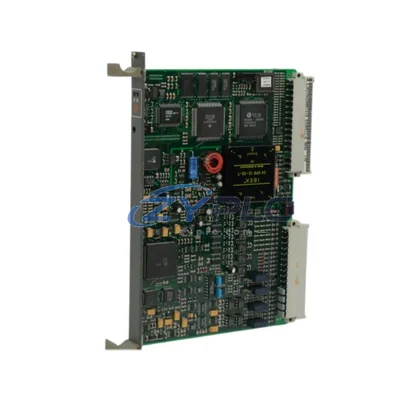
ABB NPBU-42C Communication Board for AC500 Automation
The ABB NPBU-42C is a high-performance communication board module engineered for the ABB AC500 PLC platform, designed to deliver measurable improvements in energy efficiency, drive coordination, and real-time data exchange across industrial production lines. As factories face increasing pressure to reduce energy consumption and maximize equipment utilization, the NPBU-42C serves as a critical link between the control layer and the field device layer — enabling smarter, leaner, and more responsive automation architectures.
Unlike generic communication modules, the NPBU-42C is purpose-built for the AC500 ecosystem, ensuring seamless integration with ABB’s broader range of programmable logic controllers, variable frequency drives, servo systems, and power monitoring devices. Its low-latency communication capability directly supports cycle time optimization, reducing idle intervals between production steps and improving overall line throughput without increasing energy draw.
Product Specification Table
| Parameter |
Specification |
| SKU |
NPBU-42C |
| Brand / Series |
ABB / AC500 |
| Module Type |
Communication Board |
| Supported Protocols |
PROFIBUS DP, CANopen, Modbus RTU/TCP (series-dependent) |
| Operating Voltage |
24 VDC (via AC500 CPU backplane) |
| Power Consumption |
Low-draw design; optimized for continuous 24/7 industrial operation |
| Running Efficiency |
High-speed cyclic data exchange; minimizes CPU polling overhead |
| Compatible Systems |
ABB AC500 PLC family (PM554, PM564, PM573, PM583, PM595 series) |
| Application Environment |
Industrial automation, maintenance planning, motor control, process control |
| Value |
Reduces unnecessary drive polling; supports demand-based control loops |
| Origin |
Germany |
| Warranty |
Warranty and support terms confirmed before quote |
System Compatibility and Application
In a modern industrial automation system, the ABB NPBU-42C acts as the communication backbone that ties together multiple layers of the control system. At the drive level, it interfaces directly with ABB ACS880 variable frequency drives and ACS580 general-purpose drives, enabling real-time speed and torque feedback that allows the PLC to dynamically adjust motor output based on actual load demand — eliminating the unplanned downtime associated with fixed-speed operation.
On the control side, the NPBU-42C connects the AC500 PM573 or PM583 CPU modules to field devices via PROFIBUS DP or CANopen, reducing scan cycle overhead and freeing up processor resources for maintenance planning algorithms. When paired with ABB CP600 HMI panels, operators gain live visibility into drive status, communication health, and energy consumption trends — enabling faster intervention when inefficiencies are detected.
For I/O expansion, the NPBU-42C works alongside ABB AC500 DC532 digital I/O modules and AI531 analog input modules, which collect sensor data from current transformers, pressure transducers, and temperature probes across the production floor. This data feeds into the AC500 CPU for closed-loop energy control — for example, automatically ramping down conveyor drives during low-demand periods or triggering regenerative braking sequences in servo axes.
In servo-driven applications, the NPBU-42C facilitates coordination between the AC500 PLC and ABB MicroFlex e190 servo drives, synchronizing multi-axis motion profiles to minimize peak current draw and reduce reactive power losses. The result is a tighter, more maintenance-focused motion system with lower heat generation and extended drive service life.
For power quality monitoring, the NPBU-42C can be integrated with ABB M2M energy meters or third-party power analyzers via Modbus TCP, enabling the AC500 to log kWh consumption per production batch, identify energy anomalies, and generate efficiency reports — all without additional middleware or SCADA overhead.
Maintenance and Replacement Notes
In real-world production environments, the ABB NPBU-42C delivers tangible operational stability by enabling demand-responsive control strategies that are simply not possible with hardwired or relay-based systems. Consider a packaging line where conveyor motors, labeling stations, and robotic pick-and-place units must coordinate precisely. Without intelligent communication, each subsystem operates on fixed schedules, consuming full power regardless of upstream or downstream conditions. With the NPBU-42C bridging the AC500 PLC to each drive and actuator, the control system can implement load-shedding logic — automatically reducing motor speeds during buffer accumulation phases and restoring full speed only when the line demands it.
This approach directly reduces energy consumption during partial-load periods, which in many factories account for 30–50% of total operating hours. Beyond operational stability, the NPBU-42C’s real-time communication capability supports predictive maintenance workflows: by continuously monitoring drive fault registers, communication error counters, and motor load trends, the AC500 can flag developing issues — such as bearing wear or belt slippage — before they cause unplanned downtime. This reduces maintenance costs and improves overall equipment effectiveness (OEE).
From a supply chain perspective, the NPBU-42C is maintained in RFQ-based sourcing support at our warehouse, with full pre-shipment functional testing performed on every unit. Each module undergoes output verification, communication protocol handshake testing, and thermal cycling checks before dispatch. Combined with a warranty and support terms confirmed before quote, this ensures that your production line receives a fully validated component with guaranteed performance from day one.
Product Sourcing FAQ
Q1: How does the ABB NPBU-42C contribute to operational stability on the production line?
The NPBU-42C enables real-time, bidirectional communication between the AC500 PLC and field devices such as VFDs and servo drives. This allows the controller to implement demand-based speed control, load shedding, and regenerative braking — all of which reduce energy consumption compared to fixed-speed or timer-based control strategies.
Q2: Which ABB AC500 CPU modules is the NPBU-42C compatible with?
The NPBU-42C is designed for use within the ABB AC500 PLC family. It is compatible with a range of AC500 CPU modules including the PM554, PM564, PM573, PM583, and PM595 series. For specific firmware version compatibility, refer to the ABB AC500 system manual or contact our technical team.
Q3: Can the NPBU-42C replace an existing communication board in a running system?
Yes. The NPBU-42C is a direct replacement module for compatible AC500 configurations. Before installation, ensure the replacement unit matches the original module’s communication protocol and slot assignment. We recommend performing a configuration backup via the AC500 engineering tool (Automation Builder) prior to any module swap to avoid parameter loss.
Q4: What does the warranty and support terms confirmed before quote cover, and what is the testing process before shipment?
Every NPBU-42C unit is tested prior to shipment, including communication protocol verification, power-on functional checks, and interface integrity testing. The warranty and support terms confirmed before quote covers manufacturing defects and functional failures under normal operating conditions. Units showing signs of physical damage from improper installation or overvoltage events are assessed on a case-by-case basis. Contact our support team for warranty claims or RMA requests.