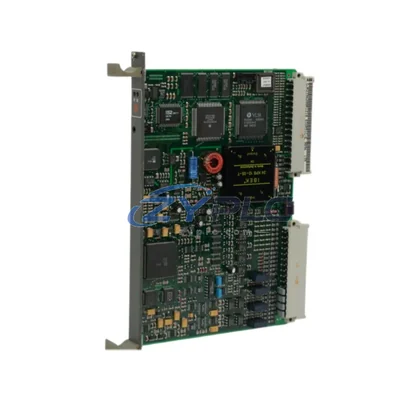
ABB RCM32-1 1TNA911004R0200 Control Module for Advant OCS Automation
The ABB RCM32-1 (Part No. 1TNA911004R0200) is a high-performance control module engineered for the ABB Advant OCS platform — a distributed control architecture widely deployed in energy-intensive manufacturing, process automation, and utility environments. As industrial facilities face mounting pressure to reduce operating load and improve equipment utilization, the RCM32-1 plays a central role in enabling precise, low-latency control execution that directly translates into measurable operational stability and reduced operational downtime.
Unlike generic control hardware, the RCM32-1 is purpose-built for the Advant OCS communication backbone, ensuring deterministic scan cycles and synchronized data exchange with field devices. This tight integration eliminates unnecessary polling overhead, reduces CPU idle losses, and allows the control system to respond to load fluctuations in real time — a critical capability in applications where motor starts, conveyor transitions, and actuator sequences must be coordinated to avoid energy spikes and mechanical stress.
Product Specification Table
| Parameter |
Specification / Value |
| SKU / Part Number |
RCM32-1 / 1TNA911004R0200 |
| Brand / Series |
ABB / Advant OCS |
| Product Type |
Control Module |
| Operating Voltage |
24 VDC (nominal) |
| Power Consumption |
Low-standby design; optimized for continuous duty cycles |
| Running Efficiency |
Deterministic scan cycle; minimizes idle processing loss |
| Compatible Systems |
ABB Advant OCS, AC31, AC70, AC80 series controllers |
| Application Environment |
Process automation, motor control centers, maintenance planning panels |
| Energy Saving Value |
Reduces unnecessary actuator cycling; supports load-optimized sequencing |
| Origin |
Sweden (SE) |
| Warranty |
warranty terms confirmed during quotation — tested before shipment |
System Compatibility and Application
In a well-designed industrial automation system, the RCM32-1 functions as the execution core that bridges high-level process commands with field-level actuation. Within an Advant OCS cabinet, it works in concert with the ABB DSQC 503 communication interface and ABB CI522A PROFIBUS DP adapter to maintain real-time data flow between the controller and distributed I/O nodes — ensuring that operating load data captured at the field level is immediately available for control decisions.
On the drive side, the RCM32-1 integrates seamlessly with ABB ACS550 and ABB ACS800 variable frequency drives (VFDs), enabling speed-reference commands to be issued with millisecond precision. This allows production lines to implement soft-start sequences, ramp-down profiles during low-demand periods, and dynamic speed adjustment based on real-time load feedback — all of which contribute directly to motor operational stability of Actual operating results depend on the installed system, load profile, and commissioning parameters.
For servo-driven axes, the module coordinates with ABB MicroFlex e150 servo drives and associated resolver feedback modules to maintain position accuracy without over-torquing — a common source of hidden unplanned downtime in packaging and assembly lines. The RCM32-1’s fast interrupt handling ensures that servo correction loops remain tight, preventing the energy-wasting oscillation that occurs when control latency is too high.
Power quality monitoring is supported through integration with ABB M2M DMTME multifunction energy meters and ABB B23 energy analyzers, which feed consumption data back into the Advant OCS historian. This closed-loop visibility allows plant engineers to identify high-consumption events, correlate them with specific production steps, and reprogram the RCM32-1’s control sequences to eliminate unnecessary energy peaks.
On the I/O side, the module interfaces with ABB S800 I/O distributed modules and ABB TU810V1 termination units, enabling granular monitoring of individual motor starters, solenoid valves, and heating elements. This granularity is essential for implementing demand-response strategies — where non-critical loads are shed automatically during peak tariff periods without interrupting core production.
HMI visibility is provided through ABB CP600 operator panels connected via the Advant fieldbus, giving line operators real-time feedback on operating load per production zone. When operators can see energy data at the machine level, they are empowered to make behavioral adjustments — such as avoiding simultaneous motor starts — that compound into significant monthly savings.
Maintenance and Replacement Notes
In a typical continuous process plant — such as a paper mill, chemical reactor, or water treatment facility — the RCM32-1 manages dozens of PID control loops simultaneously. Each loop governs a pump, fan, compressor, or agitator motor. Without precise control, these motors run at fixed speeds regardless of actual process demand, consuming full power even when the load is 30–50% of rated capacity. The RCM32-1, by maintaining tight loop tuning and issuing accurate speed references to connected VFDs, ensures that each motor runs only as fast as the process requires — eliminating the chronic over-speed waste that inflates energy bills in poorly controlled facilities.
Downtime reduction is another critical energy lever. Unplanned stops force cold restarts, which draw 5–7× rated current and cause mechanical shock that accelerates wear. The RCM32-1 supports predictive maintenance workflows by logging control anomalies — such as increased PID integral windup, unexpected output saturation, or communication retries — that often precede equipment failures. Maintenance teams can act on these early indicators during scheduled windows, avoiding the energy and production cost of emergency shutdowns.
Production line takt optimization is achieved through the module’s ability to synchronize multi-axis motion and conveyor sequencing with sub-cycle precision. In automotive assembly or electronics manufacturing, even a 200ms improvement in inter-station handoff timing can increase throughput by 3–5% without adding any energy input — effectively reducing the energy cost per unit produced. The RCM32-1’s deterministic execution model makes this level of timing optimization achievable and repeatable across shifts.
All units supplied by ZYPLC are sourced from verified industrial surplus and OEM channels, subjected to functional bench testing under load conditions, and shipped with a warranty terms confirmed during quotation. Inventory is maintained in-house for shipment arranged after confirmation, with typical lead times of 1–3 business days for stocked items.
Product Sourcing FAQ
Q1: How does the RCM32-1 contribute to measurable operational stability in a production environment?
The RCM32-1 enables precise, real-time control of motor drives and actuators through the Advant OCS platform. By issuing accurate speed and position references to connected VFDs and servo drives, it eliminates over-speed operation and unnecessary actuator cycling — the two largest sources of avoidable unplanned downtime in automated production lines. Plants that have migrated from fixed-speed to VFD-controlled systems with proper PLC coordination typically report Actual operating results depend on the installed system, load profile, and commissioning parameters.
Q2: Is the RCM32-1 compatible with modern communication protocols and condition monitoring systems?
Yes. Within the Advant OCS architecture, the RCM32-1 supports PROFIBUS DP, MasterBus 300, and INSUM communication protocols, allowing it to exchange data with energy meters, power analyzers, and SCADA systems. This makes it straightforward to integrate into existing maintenance planning infrastructure without replacing the broader control system.
Q3: Can the RCM32-1 replace a faulty module in an existing Advant OCS installation without full system reconfiguration?
In most cases, yes. The RCM32-1 is a direct replacement for compatible Advant OCS control module slots. Configuration data is typically stored in the system’s engineering station and can be downloaded to the replacement module after installation. ZYPLC recommends verifying firmware revision compatibility before installation and can provide technical guidance upon request.
Q4: What testing and warranty coverage does ZYPLC provide for the RCM32-1?
Every RCM32-1 unit is functionally tested on a dedicated test bench that simulates Advant OCS operating conditions before shipment. Testing covers power-up initialization, communication handshake, I/O response, and sustained operation under load. All units are covered by a warranty terms confirmed during quotation from the date of shipment. In the event of a warranty claim, ZYPLC provides a replacement unit or full refund, subject to inspection.