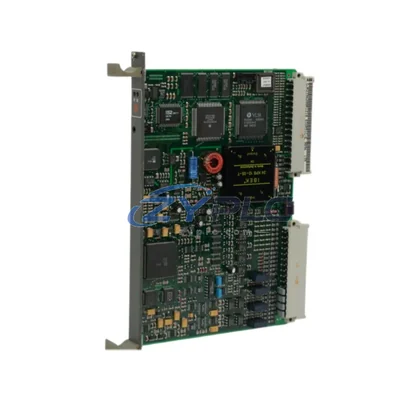
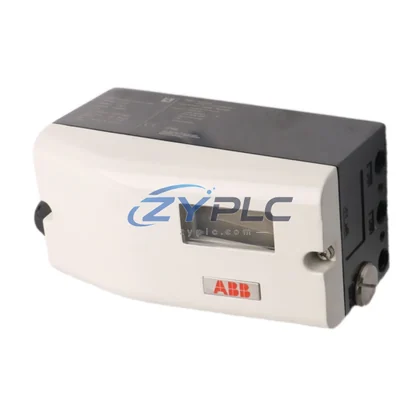
ABB RMBA-01 Industrial Network Interface for ACS Series Systems: Bridging the Industrial Data Link in Smart Factory Environments
The ABB RMBA-01 is a dedicated Modbus RTU communication adapter module engineered for seamless integration of ABB ACS series variable frequency drives into industrial automation networks. As manufacturing sites evolve toward fully connected smart factory architectures, the RMBA-01 serves as a critical data link node — enabling real-time signal exchange between field-level devices and upper-level control and monitoring systems. Whether deployed in a discrete manufacturing line, a process plant, or a building automation environment, this compact adapter eliminates communication barriers and delivers transparent, low-latency data flow across the entire automation hierarchy.
Designed to plug directly into the option slot of ABB ACS355, ACS550, ACS580, and ACS800 series drives, the RMBA-01 converts the drive’s internal data bus into a standard Modbus RTU protocol over RS-485 physical layer. This allows any Modbus master — including PLCs, SCADA servers, DCS controllers, and HMI panels — to read drive parameters, monitor operational status, issue speed and torque commands, and receive fault diagnostics in real time. The result is a fully transparent drive network that supports both operational efficiency and predictive maintenance strategies.
Compatibility & Integration Notes
| Parameter |
Specification |
| Communication Protocol |
Modbus RTU |
| Physical Interface |
RS-485 (2-wire, half-duplex) |
| Baud Rate |
1200 – 19200 bps (configurable) |
| Network Topology |
Multi-drop bus, up to 32 nodes |
| Compatible Drive Series |
ACS355, ACS550, ACS580, ACS800 |
| Data Access |
Drive parameters, status words, control words, fault codes |
| Network Compatibility |
Modbus master PLCs, SCADA, DCS, HMI, edge gateways |
| System Application |
Motor control, pump/fan automation, conveyor systems, HVAC |
| Installation |
Direct plug-in to ACS drive option slot (no external power required) |
| Warranty |
warranty terms confirmed during quotation | Pre-shipment functional test included |
Connected Automation Data Flow
In a typical smart factory deployment, the ABB RMBA-01 sits at the intersection of the field device layer and the control network layer. At the field level, sensors — including temperature transmitters, pressure transducers, and flow meters — feed process data into the ACS series drive, which regulates motor speed and torque in response. The RMBA-01 then exposes this operational data to the Modbus RTU network, where a Siemens S7-1200 PLC or Allen-Bradley MicroLogix 1100 acts as the Modbus master, polling drive registers at configurable scan intervals.
Upstream from the PLC, an ABB AC500 controller or a Schneider Electric Modicon M340 aggregates data from multiple drive nodes across the RS-485 bus. This data is then forwarded via an Anybus Communicator Modbus RTU to EtherNet/IP gateway or a Moxa MGate MB3170 serial-to-Ethernet converter, bridging the legacy serial network into the plant’s Ethernet backbone. At the SCADA layer, platforms such as Wonderware InTouch or Ignition by Inductive Automation subscribe to real-time drive data — including output frequency, motor current, DC bus voltage, and active fault codes — enabling operators to monitor and control the entire drive fleet from a centralized HMI dashboard.
For remote diagnostics and predictive maintenance, an ABB Ability Edge gateway or a compatible Advantech WISE-5231 industrial IoT gateway can be integrated into the same Modbus segment, forwarding drive telemetry to cloud analytics platforms. This end-to-end data chain — from the RMBA-01 adapter through the RS-485 bus, across the Ethernet backbone, and up to the cloud — forms the backbone of a fully connected, data-driven production environment. The ABB RPBA-01 PROFIBUS adapter and ABB RCAN-01 CANopen adapter serve as protocol-specific alternatives within the same ACS drive option ecosystem, allowing system architects to select the fieldbus standard that best matches their existing network infrastructure.
Solving Data Isolation in Industrial Sites
One of the most persistent challenges in industrial automation is the coexistence of legacy serial devices and modern Ethernet-based control systems. Many production sites operate ACS series drives that were installed years before Ethernet fieldbus became standard, leaving them isolated from the plant’s data infrastructure. The ABB RMBA-01 directly addresses this data isolation problem by providing a standards-compliant Modbus RTU interface that any modern control system can communicate with — without requiring drive replacement or costly rewiring.
Protocol fragmentation is another common pain point. A single production line may include drives communicating over Modbus RTU, remote I/O modules on PROFIBUS, and HMI panels connected via EtherNet/IP. The RMBA-01 resolves the drive’s side of this equation by standardizing its communication to Modbus RTU, allowing a protocol gateway device to handle the translation to higher-level networks. This approach supports incremental system expansion: as new drives are added to the line, each one equipped with an RMBA-01 adapter joins the existing Modbus segment without disrupting the network architecture.
For remote monitoring and alarm management, the RMBA-01 enables SCADA systems to receive drive fault codes and warning states in real time, triggering automated alarm notifications and reducing mean time to repair. Production line transparency improves significantly when every drive on the floor is visible to the control room — operators can identify underperforming motors, track energy consumption trends, and schedule preventive maintenance based on actual operating hours rather than fixed intervals. The RMBA-01 thus transforms isolated drive assets into active participants in the plant’s digital infrastructure.
Industrial Connectivity FAQ
Q1: What is the typical communication latency of the ABB RMBA-01 on a Modbus RTU network?
The RMBA-01 supports baud rates from 1200 to 19200 bps. At 19200 bps with a standard Modbus RTU frame, typical poll-response latency is under 10 ms per node, making it suitable for real-time motor control and status monitoring applications. Network latency increases with the number of nodes on the RS-485 bus and the polling interval configured in the Modbus master.
Q2: Is the RMBA-01 compatible with all ABB ACS series drives?
The RMBA-01 is compatible with ABB ACS355, ACS550, ACS580, and ACS800 series drives that feature an option slot for fieldbus adapter modules. Compatibility should be verified against the specific drive firmware version and option slot type. For ACS880 series drives, ABB offers the FMBA-01 Modbus adapter as the recommended alternative.
Q3: How does the RMBA-01 support system expansion as new drives are added to the network?
The RS-485 physical layer supports up to 32 nodes on a single bus segment without repeaters. Each additional ACS drive equipped with an RMBA-01 is assigned a unique Modbus slave address (1–247) and joins the existing network without requiring changes to the bus wiring or the Modbus master configuration — only a new polling entry in the master’s register map is needed. For larger networks, RS-485 repeaters can extend the bus to support additional nodes.
Q4: What quality assurance and warranty coverage is provided with the RMBA-01?
Every ABB RMBA-01 unit supplied by ZYPLC undergoes a pre-shipment functional test to verify communication integrity and parameter access before dispatch. All units are covered by a warranty terms confirmed during quotation against manufacturing defects and communication failures. Availability is confirmed via RFQ for shipment arranged after confirmation, with global shipping options to support urgent project timelines. For technical support or order inquiries, contact our team directly.