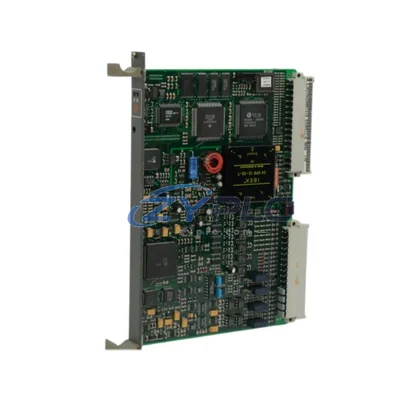
ABB SDCS-PIN-4B 3ADT316300R1510: Power Interface for SDCS DC Drive Control Systems
The ABB SDCS-PIN-4B (part number 3ADT316300R1510) is a dedicated power interface board engineered for integration within ABB’s SDCS series DC drive control architecture. Rather than functioning as a standalone component, the SDCS-PIN-4B occupies a critical position in the layered automation hierarchy — bridging the control layer and the power conversion layer to ensure stable, coordinated operation across the entire drive system. In multi-axis or high-availability production environments, the integrity of this interface directly determines the reliability of motor control, signal fidelity, and system response time.
Designed to operate within ABB’s DCS800 and SDCS platform ecosystem, this board manages the interface between the main control electronics and the power section, handling gate pulse distribution, feedback signal conditioning, and protective interlock logic. Its role in the signal flow is non-negotiable: without a properly functioning power interface board, the control processor cannot reliably command the thyristor or IGBT bridge, and the drive cannot respond accurately to speed or torque references from the supervisory control layer.
Product Specification Table
| Parameter |
Specification |
| System Role |
Power Interface Board — Control-to-Power Section Bridge |
| Part Number |
3ADT316300R1510 |
| Compatible Platform |
ABB SDCS / DCS800 DC Drive Series |
| Function |
Gate Pulse Distribution, Feedback Signal Conditioning, Protective Interlock |
| Electrical Interface |
Low-voltage control signals to high-voltage power section |
| Communication Capability |
Internal drive bus; compatible with SDCS-CON-4 control board |
| Installation Environment |
Drive cabinet, DIN rail or direct board mount within SDCS chassis |
| Origin |
Germany (ABB Manufacturing) |
| Condition |
Tested, Verified Functional |
| Warranty |
— Covers functional defects under normal operating conditions |
System Compatibility Notes
The SDCS-PIN-4B does not operate in isolation. Its value is fully realized only when considered within the broader SDCS control system architecture. At the control layer, the SDCS-CON-4 main control board generates the speed and torque reference signals that are passed downstream. The SDCS-PIN-4B receives these signals and translates them into gate firing commands for the power bridge, ensuring precise timing and phase alignment. Alongside it, the SDCS-FEX-2 field excitation board manages the motor field current, working in parallel to maintain the correct flux level for torque production.
On the I/O layer, the SDCS-IOB-3 I/O expansion board provides the digital and analog signal interfaces that feed process feedback — speed encoder signals, current feedback, and external interlock states — back into the control loop. The SDCS-PIN-4B acts as the conduit ensuring these signals are correctly routed to the power section without noise or timing errors. For applications requiring fieldbus connectivity, the SDCS-COM-8 communication module enables PROFIBUS DP or DeviceNet integration, allowing the DCS800 drive to receive setpoints and report status to a SIMATIC S7 or Allen-Bradley ControlLogix PLC at the supervisory layer.
At the power layer, the SDCS-PIN-4B interfaces directly with the thyristor bridge assembly, coordinating with the SDCS-DSL-4 diagnostic and signal board to monitor firing angles and detect fault conditions before they propagate to the motor or the mechanical load. In redundant drive architectures, a standby SDCS-PIN-4B is often held in inventory alongside a spare SDCS-CON-4 and SDCS-FEX-2 to enable rapid board-swap recovery without requiring full drive replacement. For HMI integration, the drive system connects to an ABB CP600 or compatible operator panel, providing real-time visibility into drive status, fault history, and parameter configuration. Terminal modules such as the ABB NTAC-02 pulse encoder interface or external relay output modules complete the signal chain from the drive to field devices, ensuring that the SDCS-PIN-4B’s output commands are faithfully executed at the actuator level.
Industrial Application Notes
The SDCS-PIN-4B finds application across a wide range of heavy industrial sectors where DC drive technology remains the preferred solution for high-torque, variable-speed motor control. In steel and metals processing, rolling mill main drives rely on SDCS-series boards to maintain precise speed synchronization across multiple motor stands — the power interface board’s gate pulse accuracy directly affects strip thickness consistency and surface quality. In paper and pulp manufacturing, winder and unwinder drives use the SDCS platform to control tension across the web, where any instability in the power interface layer translates immediately into web breaks and production loss.
In mining and mineral processing, conveyor and hoist drives operating in harsh environments depend on the SDCS-PIN-4B’s robust design to maintain reliable operation under high ambient temperatures, vibration, and dust ingress. The board’s protective interlock logic provides an additional layer of safety, preventing gate misfires that could damage the power bridge under fault conditions. For water and wastewater treatment facilities, pump drives using the SDCS platform benefit from the board’s stable signal conditioning, which ensures smooth speed ramps and prevents water hammer in large-diameter pipelines. In chemical and petrochemical process plants, where continuous operation is critical, the availability of a tested, warranted SDCS-PIN-4B as a spare part is a key element of the maintenance strategy, reducing mean time to repair (MTTR) and supporting compliance with process safety management requirements.
Across all these applications, the provided with each SDCS-PIN-4B 3ADT316300R1510 unit ensures that engineering and maintenance teams can deploy the board with confidence, knowing that functional defects will be addressed without additional cost during the warranty period.
Product Compatibility FAQ
Q1: Is the SDCS-PIN-4B 3ADT316300R1510 compatible with both DCS800 and older SDCS-series drives?
The SDCS-PIN-4B is designed for the SDCS control platform, which forms the basis of the DCS800 drive family. Compatibility depends on the specific drive frame size and firmware revision. It is recommended to cross-reference the drive’s hardware manual and confirm the board revision against the drive’s bill of materials before installation. Our technical team can assist with compatibility verification prior to shipment.
Q2: Can this board be installed without recalibrating the entire drive system?
In most cases, a direct board replacement on a like-for-like basis does not require full drive recalibration, provided the replacement board is of the same revision and the drive parameters are backed up prior to the swap. However, it is best practice to perform a functional test — including a no-load run and a current loop autotune — after installation to confirm that the gate firing angles and feedback signal scaling are within specification. The covers functional defects, so any board that fails to perform correctly after proper installation will be addressed under warranty.
Q3: What is the recommended spare parts strategy for SDCS-based drive systems to minimize downtime?
For critical production lines, the recommended approach is to maintain at minimum one spare SDCS-PIN-4B, one SDCS-CON-4 control board, and one SDCS-FEX-2 field excitation board per drive type in the facility. These three boards account for the majority of drive-level failures that require board replacement rather than full drive exchange. Storing tested, warranted spares — rather than untested surplus boards — significantly reduces the risk of installing a faulty spare during an emergency, which can extend downtime rather than reduce it. All units supplied by ZYPLC are tested and covered by a to support this strategy.