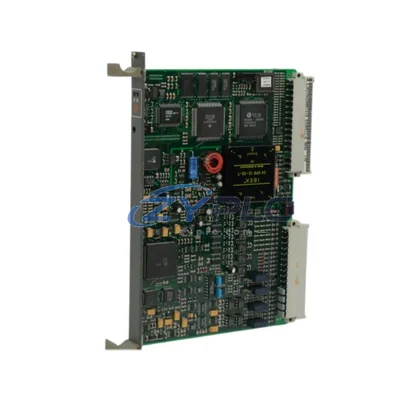
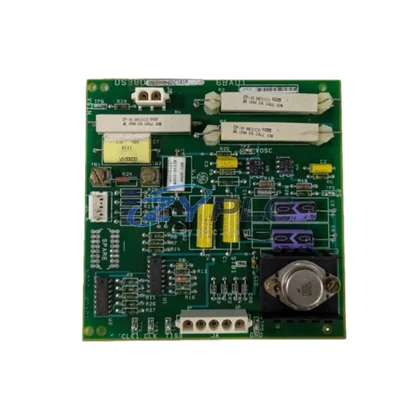
ABB SNAT634PAC Pulse Amplifier for SNAT Series: Control System Coordination and Drive-Layer Integration
The ABB SNAT634PAC Pulse Amplifier Board occupies a critical position within the SNAT Series drive control architecture, serving as the interface layer between the main control board and the power electronics stage. In any well-engineered industrial automation system, signal integrity at the gate-drive level determines the reliability of the entire drive train. The SNAT634PAC ensures that firing pulses are accurately amplified, isolated, and delivered to the IGBT or thyristor bridge with the timing precision required for stable motor control across variable load conditions.
Understanding the SNAT634PAC requires viewing it not as a standalone component, but as a functional node within a layered control hierarchy. From the control layer — where the NAMC-11 or NAMC-12 main control board generates speed and torque references — signals pass through the I/O and signal conditioning layer before reaching the pulse amplifier stage. The SNAT634PAC receives these low-level gate signals and amplifies them to the voltage and current levels required to switch the power semiconductors in the SNAT Series inverter bridge. Any degradation in this signal path directly impacts drive performance, making the SNAT634PAC a high-priority component in both commissioning and long-term maintenance planning.
Product Specification Table
| Parameter |
Specification |
| Part Number |
SNAT634PAC |
| Brand |
ABB |
| Series |
SNAT (ACS Series Drive Platform) |
| Product Type |
Pulse Amplifier Board |
| System Role |
Gate Drive Signal Amplification & Isolation |
| Target Layer |
Power Electronics / Drive I/O Interface Layer |
| Compatible Drives |
ABB SNAT Series AC/DC Drive Systems |
| Electrical Interface |
Low-voltage gate signal input; amplified isolated output to IGBT/thyristor bridge |
| Isolation |
Galvanic isolation between control and power circuits |
| Mounting |
PCB board, rack/drive chassis integrated |
| Operating Environment |
Industrial control cabinet, IEC standard ambient conditions |
| Origin |
Finland (ABB Drives manufacturing) |
| Warranty |
— functional and electrical integrity guaranteed |
| Availability |
RFQ Available, tested, and shipment arranged after confirmation |
System Compatibility Notes
The SNAT634PAC does not operate in isolation — its performance is directly tied to the health and configuration of every other board and module within the SNAT Series drive cabinet. At the control layer, the NAMC-11 or NAMC-12 main control board generates the speed reference and torque command signals that ultimately drive the pulse generation logic. These signals are processed and conditioned before being passed to the SNAT634PAC for amplification.
On the power supply side, the SNAT4031C power supply board provides the regulated DC voltages required for both the control electronics and the gate drive circuits. A fault or ripple in this supply directly affects the SNAT634PAC’s output quality, which is why power layer integrity is always verified during drive commissioning. In redundant or high-availability architectures, dual power supply configurations using SNAT4030C modules are common, ensuring that a single power board failure does not interrupt gate drive operation.
The I/O layer, typically implemented through SNAT7600 I/O extension boards or SDCS-IOB-3 analog I/O boards, feeds process feedback signals — encoder pulses, current feedback, and temperature monitoring — back into the control loop. The SNAT634PAC’s pulse output must be synchronized with this feedback to maintain closed-loop drive stability. In multi-drive systems, the RDCO-01 or RDCO-02 DDCS communication adapter enables fiber-optic communication between the drive and the master controller, ensuring that pulse timing across multiple drives remains coordinated.
At the human-machine interface layer, ABB ACS800 or ACS600 series control panels provide real-time parameter monitoring and fault diagnostics. Engineers use these panels to verify that the SNAT634PAC is delivering correct gate signals by monitoring drive output current waveforms and switching frequency parameters. For larger installations, ABB AC500 PLC systems with PM573 or PM591 CPU modules serve as the supervisory control layer, issuing speed and torque setpoints to the drive system via PROFIBUS or Modbus RTU.
The execution layer — motors, contactors, and mechanical loads — depends entirely on the quality of the gate pulses delivered by the SNAT634PAC. In applications where precise torque control is required, such as winding machines or hoists, even minor pulse timing errors can cause current spikes that damage the IGBT bridge. Maintaining a healthy SNAT634PAC is therefore not just a board-level concern but a system-level reliability requirement.
Industrial Application Notes
The SNAT634PAC finds application across a wide range of industrial sectors where ABB SNAT Series drives are deployed as part of larger automation architectures.
In steel and metals processing, SNAT Series drives control rolling mill main drives and coiler/uncoiler systems. The SNAT634PAC’s role in maintaining precise firing angle control is critical for consistent strip tension and speed regulation across multi-stand mill configurations. Any pulse amplifier degradation in this environment manifests as torque ripple, which directly affects product quality.
In petrochemical and refinery applications, SNAT Series drives power large compressor and pump systems operating continuously at high load. The SNAT634PAC must maintain reliable gate drive output under elevated ambient temperatures and in environments with high electromagnetic interference. Drives in these applications are often configured with redundant control boards, making the SNAT634PAC a key component in the redundancy architecture.
In water and wastewater treatment plants, SNAT Series drives control high-power pump motors that must operate reliably 24/7. Maintenance teams in these facilities typically maintain a stock of critical drive boards — including the SNAT634PAC — to minimize downtime during unplanned failures. The provided with each SNAT634PAC unit supports the procurement and maintenance planning requirements of utility operators.
In mining and mineral processing, SNAT Series drives are used in conveyor systems, crushers, and grinding mills. The harsh operating environment — dust, vibration, and wide temperature swings — places significant stress on drive electronics. The SNAT634PAC’s galvanic isolation between control and power circuits provides an important protection layer in these conditions, preventing control board damage from power-side transients.
In paper and pulp manufacturing, multi-drive systems controlling section drives on paper machines require precise speed synchronization. The SNAT634PAC’s consistent pulse amplification performance is essential for maintaining the tight speed ratios required between drive sections, directly affecting paper quality and machine runnability.
Product Compatibility FAQ
Q1: Is the SNAT634PAC compatible with all variants of the ABB SNAT Series drive platform, and how do I confirm compatibility before installation?
The SNAT634PAC is designed for use within the ABB SNAT Series drive family, which includes drives used in ACS600 and related platforms that share the SNAT board architecture. Compatibility is confirmed by cross-referencing the drive’s hardware revision documentation and the board slot designation in the drive’s wiring diagram. In most SNAT Series cabinets, the pulse amplifier board slot is clearly labeled, and the SNAT634PAC’s connector layout matches the standard gate drive interface. If you are replacing a failed board, the part number on the original board is the most reliable confirmation of compatibility. Our technical team can assist with cross-referencing if the original board label is damaged or missing.
Q2: What commissioning steps are required after installing the SNAT634PAC, and how do I verify that the gate drive signals are functioning correctly?
After physical installation, the drive should be powered up in a controlled sequence with the motor disconnected if possible. The first verification step is to confirm that the drive’s control power supply — typically the SNAT4031C or equivalent — is providing correct voltages to the SNAT634PAC. Next, using the drive’s diagnostic panel or a connected PLC, initiate a low-speed test run and monitor output current waveforms for symmetry and absence of harmonic distortion. Any asymmetry in the phase currents typically indicates a gate drive issue on one or more phases. The drive’s fault log should also be checked for gate drive fault codes, which are specific to the SNAT Series diagnostic system. Full commissioning documentation is available from ABB’s drive service manuals for the relevant platform.
Q3: What does the cover for the SNAT634PAC, and what is the process for warranty claims or long-term spare parts support?
The covers functional and electrical integrity of the SNAT634PAC board from the date of shipment. This includes failure due to manufacturing defects, component failure under normal operating conditions, and any functional non-conformance identified during installation and commissioning. The warranty does not cover damage resulting from incorrect installation, overvoltage events caused by external system faults, or physical damage during handling. For warranty claims, contact our support team with the RFQ reference and a description of the fault. For long-term spare parts planning, we recommend maintaining at least one SNAT634PAC in your critical spares inventory, particularly for drives that are no longer in active production. Our team can advise on multi-unit procurement quotation and extended support agreements for legacy SNAT Series installations.