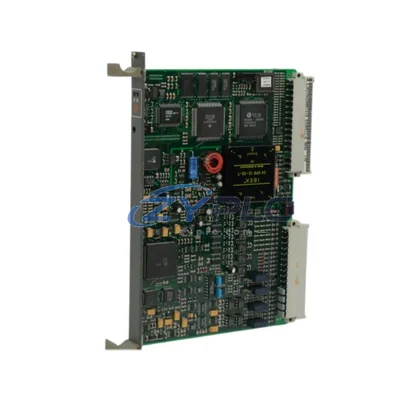
Advantest R6244 DC Source Monitor for R6240
The Advantest R6244 DC Voltage/Current Source Monitor Module is a precision measurement and sourcing instrument engineered to operate as an integral component within the R6240 modular test system architecture. Rather than functioning as a standalone unit, the R6244 is designed from the ground up to participate in a coordinated, multi-layer control and measurement environment — one where signal integrity, synchronization, and system-level coherence are paramount. In semiconductor characterization, device validation, and parametric test applications, the R6244 delivers the sourcing accuracy and measurement resolution required to support high-throughput, multi-channel test strategies without compromising data fidelity or system stability.
Understanding the R6244 requires understanding the architecture it inhabits. The R6240 mainframe provides the backplane infrastructure, timing coordination, and inter-module communication that allow individual source/monitor modules to operate in concert. Within this framework, the R6244 occupies the measurement and sourcing layer — responsible for applying precise DC voltages and currents to device-under-test (DUT) nodes while simultaneously monitoring the resulting electrical response. This dual-function capability reduces the need for separate sourcing and measurement instruments, simplifying rack layout, reducing cable complexity, and improving signal path integrity across the entire test system.
Product Specification Table
| Parameter |
Specification |
| System Role |
DC Voltage/Current Source Monitor Module |
| Compatible Mainframe |
Advantest R6240 Series |
| Sourcing Modes |
Voltage Source / Current Source |
| Measurement Modes |
Voltage Measurement / Current Measurement |
| Output Voltage Range |
±100 V (typical, range-dependent) |
| Output Current Range |
±100 mA (typical, range-dependent) |
| Measurement Resolution |
Sub-μV / sub-nA (range-dependent) |
| Communication Interface |
GPIB (IEEE-488) via R6240 mainframe backplane |
| Installation |
Plug-in module for R6240 mainframe chassis |
| Operating Environment |
Laboratory / controlled industrial environment |
| Origin |
Japan |
| Warranty |
Warranty and support terms confirmed before quote (ZYPLC) |
System Compatibility Notes
The R6244 achieves its full potential when deployed alongside complementary modules and instruments within the R6240 ecosystem. A complete parametric test station built around the R6240 mainframe typically integrates multiple R6244 modules in parallel — each assigned to a specific DUT pin group — enabling simultaneous multi-channel sourcing and measurement without cross-channel interference. The R6241 and R6242 modules, which offer alternative voltage and current ranges, are frequently co-installed in the same chassis to extend the system’s overall dynamic range and accommodate diverse device specifications within a single test session.
At the control layer, the R6240 mainframe communicates with a host workstation or test controller via GPIB (IEEE-488), a protocol well-suited to the deterministic, command-response communication patterns required in parametric test environments. The R6243 and R6245 modules extend the system’s sourcing and measurement capabilities into additional ranges, while the R6246 provides specialized functions for leakage and ultra-low current measurement — a critical requirement in advanced semiconductor node characterization. Together, these modules form a cohesive source/monitor array that can be orchestrated by a single software environment, reducing programming complexity and improving test repeatability.
Beyond the source/monitor layer, the R6244-based system interfaces with switching matrices and multiplexers to route signals to large pin-count devices. Relay-based switching modules, compatible with the R6240 architecture, allow a single set of R6244 channels to address hundreds of DUT nodes sequentially, dramatically improving system utilization and reducing per-pin hardware cost. At the human-machine interface layer, dedicated test software running on the host controller provides real-time visualization of sourced and measured values, enabling engineers to monitor system behavior, detect anomalies, and adjust test parameters without interrupting the measurement sequence.
Power integrity within the R6240 chassis is maintained by the mainframe’s internal power distribution architecture, which isolates module power rails to prevent cross-module noise coupling. This design ensures that high-current sourcing operations on one R6244 channel do not degrade the measurement accuracy of adjacent channels — a critical consideration in high-density, multi-channel test configurations. The result is a system architecture that scales gracefully from single-device characterization to high-volume production test, with consistent performance across all operating conditions.
Industrial Application Notes
The Advantest R6244, as part of the R6240 system architecture, finds application across a broad spectrum of industries and test disciplines. In semiconductor manufacturing, R6244-equipped test stations are deployed at wafer probe and final test stages to characterize transistor parameters, leakage currents, breakdown voltages, and threshold characteristics across large device populations. The module’s precision sourcing and measurement capabilities make it equally suitable for characterizing passive components, discrete semiconductors, and complex integrated circuits.
In power electronics development and validation, the R6244 supports the characterization of MOSFETs, IGBTs, and power diodes under controlled DC bias conditions — providing the accurate I-V curve data required for device modeling and reliability assessment. In research and development environments, the module’s fine resolution and wide dynamic range support exploratory measurements on novel materials and emerging device technologies, where measurement uncertainty must be minimized to extract meaningful physical insights.
For organizations operating in regulated industries — including aerospace, defense, and medical device manufacturing — the R6244’s traceable measurement capability and stable, repeatable performance support compliance with IEC, MIL-STD, and ISO test standards. The Warranty and support terms confirmed before quote provided by ZYPLC ensures that deployed systems remain within calibration and operational specification throughout the warranty period, reducing the risk of measurement drift and supporting audit-ready documentation of test system performance.
In production environments where uptime is critical, the modular architecture of the R6240 system provides a significant maintenance advantage. Individual R6244 modules can be removed and replaced without disturbing adjacent modules or reconfiguring the mainframe, minimizing mean time to repair (MTTR) and reducing the impact of module-level failures on overall system availability. ZYPLC supports RFQ-based sourcing of R6244 modules and compatible R6240 series components to support rapid replacement and minimize production disruption.
Product Compatibility FAQ
Q1: Is the R6244 compatible with all R6240 mainframe configurations, and can it be mixed with other R6240 series modules in the same chassis?
The R6244 is designed as a plug-in module for the R6240 mainframe and is fully compatible with the standard R6240 chassis backplane. It can be installed alongside other R6240 series modules — including the R6241, R6242, R6243, R6245, and R6246 — in any slot combination supported by the mainframe. Mixed-module configurations are standard practice in multi-range parametric test systems, and the R6240 mainframe’s backplane architecture ensures that all installed modules share a common timing and communication reference, maintaining synchronization across the entire source/monitor array. system integration between modules is managed at the mainframe level, requiring no additional hardware configuration by the end user.
Q2: What are the installation and commissioning requirements for the R6244 in an existing R6240 system?
Installing the R6244 into an R6240 mainframe requires powering down the chassis, inserting the module into an available slot, and securing it with the standard front-panel fasteners. No internal jumper or DIP switch configuration is required for basic operation. After power-up, the host controller software should be used to verify module identification and perform a self-test sequence. For systems requiring traceable calibration, ZYPLC recommends performing a full system calibration after any module change. The Warranty and support terms confirmed before quote covers defects in materials and workmanship; warranty service is coordinated through ZYPLC’s technical support team at plc.sales@zyplc.com.
Q3: How does ZYPLC support long-term maintenance and spare parts availability for R6244-based systems?
ZYPLC maintains a dedicated inventory of R6244 modules and compatible R6240 series components to support both replacement sourcing after RFQ confirmation needs and planned maintenance programs. For organizations operating R6240-based test systems in production environments, ZYPLC offers pre-qualified spare module programs that ensure tested, warranty-covered replacements are available on short notice. All modules supplied by ZYPLC are covered by a Warranty and support terms confirmed before quote and are tested prior to shipment to verify conformance to Advantest specifications. Long-term support inquiries, including multi-unit procurement and system-level compatibility assessments, can be directed to ZYPLC’s technical sales team at +86 19859288691 or plc.sales@zyplc.com.