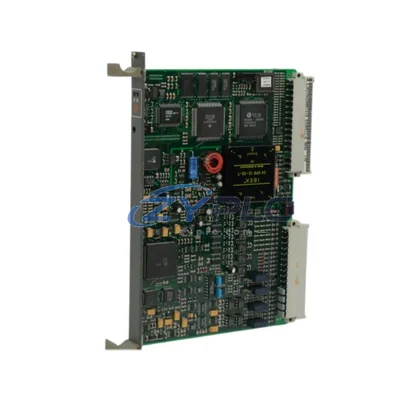
Allen-Bradley 1336-L4 42336-200-51 Interface Card for 1336 PLUS Automation
In modern industrial production environments, energy efficiency is no longer a secondary consideration — it is a core operational metric. The Allen-Bradley 1336-L4 (Part No. 42336-200-51) encoder interface card is engineered to deliver precise closed-loop feedback within the 1336 PLUS AC drive platform, enabling factories to achieve tighter motor control, reduce unplanned downtime risk, and extend the operational lifespan of drive systems. Whether deployed in continuous process lines, packaging machinery, or material handling conveyors, this interface card plays a critical role in translating encoder signals into actionable speed and torque data that the drive can act upon in real time.
By providing accurate shaft position and velocity feedback to the 1336 PLUS drive, the 1336-L4 eliminates the speed drift and torque inefficiencies that are common in open-loop drive configurations. This translates directly into measurable operational stability: motors run at precisely the speed demanded by the process, not at a fixed or over-estimated setpoint. In facilities where multiple drives operate simultaneously — such as those using the Allen-Bradley 1336 PLUS II series alongside legacy 1336 PLUS units — the 1336-L4 ensures consistent closed-loop performance across the entire drive fleet, reducing aggregate power draw during partial-load cycles.
Product Specification Table
| Parameter |
Specification / Value |
| SKU / Part Number |
1336-L4 / 42336-200-51 |
| Compatible Drive Platform |
Allen-Bradley 1336 PLUS, 1336 PLUS II |
| Card Type |
Encoder Interface Card (Closed-Loop Feedback) |
| Feedback Signal |
Incremental Encoder (TTL-compatible) |
| Operating Voltage |
5 VDC (encoder supply via drive backplane) |
| Power Consumption |
Low-draw auxiliary card; minimal parasitic load on drive bus |
| Drive Efficiency Improvement |
Enables closed-loop vector control; reduces motor slip losses |
| Compatible Control Platforms |
Allen-Bradley PLC-5, SLC 500, ControlLogix (via drive I/O) |
| Application Environments |
Conveyors, pumps, compressors, packaging lines, HVAC drives |
| Maintenance Value |
Eliminates open-loop speed error; reduces over-speed unplanned downtime |
| Condition |
Tested, inspected, fully functional |
| Warranty |
warranty terms confirmed during quotation |
| Origin |
USA (Allen-Bradley / Rockwell Automation) |
System Compatibility and Application
The 1336-L4 does not operate in isolation — it is a precision component within a broader industrial automation system. In a typical production line deployment, the card interfaces directly with the 1336 PLUS drive’s option card slot, receiving encoder pulses from a motor-mounted incremental encoder and feeding real-time velocity data back to the drive’s closed-loop vector control algorithm. This feedback loop is what separates energy-efficient variable speed operation from wasteful fixed-speed or poorly tuned open-loop control.
Upstream of the drive, condition monitoring begins at the power distribution level. Devices such as the Allen-Bradley PowerMonitor 1000 or PowerMonitor 5000 capture real-time kWh consumption, power factor, and harmonic distortion data — metrics that become far more meaningful when the drive is operating in closed-loop mode with the 1336-L4 installed. The combination of accurate drive feedback and power monitoring creates a complete energy audit trail for each motor circuit.
On the control side, the 1336 PLUS drive communicates with upstream controllers — typically an Allen-Bradley SLC 5/04 or SLC 5/05 processor — via the 1336-GM1 Remote I/O communication module or a 1336-GM6 DeviceNet adapter. These communication options allow the PLC to issue speed references, read drive status, and log fault codes without manual intervention. When the 1336-L4 is active, the drive’s speed regulation is tight enough that the PLC’s PID loop — if used for process control — converges faster and with less integral windup, further reducing energy-wasting oscillation in the controlled process.
For facilities that have migrated portions of their control infrastructure to the ControlLogix platform, the 1336 PLUS drive with the 1336-L4 installed can be integrated via a 1756-DNB DeviceNet Bridge module, allowing Logix-based programs to manage legacy drives alongside newer PowerFlex 700 or PowerFlex 755 units within a unified drive management strategy. This hybrid architecture is common in phased modernization projects where full drive replacement is deferred, and the 1336-L4 extends the productive life of existing 1336 PLUS hardware by maintaining closed-loop performance parity with newer platforms.
At the I/O level, discrete feedback from the drive — including run status, fault relay, and at-speed signals — is typically wired to a 1746-IB16 SLC input module or equivalent digital input card, enabling the PLC to make real-time decisions about line speed adjustments, load shedding, or scheduled maintenance windows based on actual drive operating state rather than assumed conditions.
Maintenance and Replacement Notes
The practical energy impact of the 1336-L4 becomes most visible in applications where motor load varies significantly over the production cycle. Consider a conveyor system where product accumulation causes periodic load spikes: without closed-loop feedback, the drive may over-compensate by increasing output frequency beyond what the load actually requires, wasting energy as heat in the motor windings. With the 1336-L4 providing continuous shaft speed feedback, the 1336 PLUS drive adjusts its output voltage and frequency in real time to match actual load demand — a process that can help restore stable operation when a compatible replacement is required.
In pump and compressor applications, the benefits are even more pronounced. Closed-loop speed control via the 1336-L4 allows the drive to maintain precise flow or pressure setpoints without the hunting behavior that characterizes poorly tuned open-loop systems. This stability reduces mechanical stress on pump impellers and compressor valves, extending mean time between failures (MTBF) and reducing unplanned downtime — a direct contribution to overall equipment effectiveness (OEE).
From a maintenance perspective, the 1336-L4 enables predictive maintenance strategies by providing the drive with the data it needs to detect encoder signal degradation, motor bearing wear (via speed ripple analysis), and coupling misalignment — all of which manifest as anomalies in the encoder feedback signal before they cause catastrophic failures. Maintenance teams can schedule interventions during planned downtime windows rather than responding to emergency breakdowns, reducing both repair costs and production losses.
All units supplied are fully tested prior to shipment, with functional verification of encoder signal processing, option card communication with the drive backplane, and closed-loop response validation. Each unit is backed by a warranty terms confirmed during quotation, and availability confirmed by RFQ availability ensures minimal lead time for maintenance replacements or new installations. Our inventory is maintained to support urgent MRO (Maintenance, Repair, and Operations) requirements, with same-day shipping available for verified orders.
Product Sourcing FAQ
Q1: How does the 1336-L4 contribute to operational stability compared to open-loop drive operation?
The 1336-L4 enables closed-loop vector control on the 1336 PLUS drive by providing continuous encoder feedback. This allows the drive to regulate motor speed with high precision, eliminating the over-frequency operation common in open-loop configurations. In variable-load applications such as conveyors, pumps, and fans, this precision can help restore stable operation when a compatible replacement is required.
Q2: Is the 1336-L4 compatible with both the original 1336 PLUS and the 1336 PLUS II drive series?
Yes. The 1336-L4 (42336-200-51) is designed for use with Allen-Bradley 1336 PLUS and 1336 PLUS II AC drives. It installs in the drive’s option card slot and is recognized by the drive firmware without additional configuration hardware. Compatibility should be verified against the specific drive catalog number and firmware revision prior to installation.
Q3: What is the recommended replacement or upgrade path if the 1336 PLUS drive platform is being phased out?
For facilities transitioning away from the 1336 PLUS platform, the PowerFlex 700 or PowerFlex 755 drives offer modern closed-loop feedback options with enhanced condition monitoring and EtherNet/IP connectivity. However, for sites where full drive replacement is not yet budgeted, the 1336-L4 provides a cost-effective means of maintaining closed-loop performance on existing hardware, deferring capital expenditure while preserving energy efficiency.
Q4: What does the warranty terms confirmed during quotation cover, and what is the testing process before shipment?
Each 1336-L4 unit undergoes functional testing that includes encoder signal input verification, backplane communication validation, and closed-loop response confirmation on a compatible 1336 PLUS drive test bench. The warranty terms confirmed during quotation covers defects in materials and workmanship under normal operating conditions. Units that fail during the warranty period are replaced or repaired at no charge, with priority processing to minimize production impact.