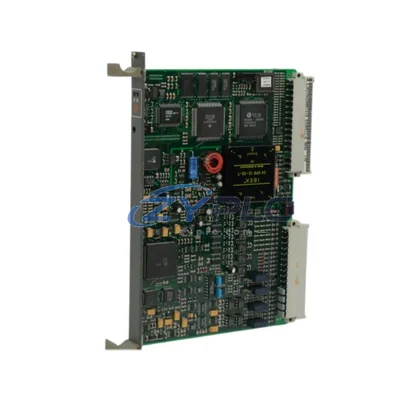
Allen-Bradley 1440-SPD02-01RB Industrial Network Interface for Dynamix Systems: Precision Speed Data Across the Smart Factory Data Link
The Allen-Bradley 1440-SPD02-01RB is a high-performance speed measurement module engineered for the Dynamix condition monitoring platform. Designed to capture real-time rotational speed signals from field-level sensors and transmit structured data across EtherNet/IP networks, this module serves as a critical node in the industrial data chain — bridging physical machine behavior with digital control and monitoring systems. Whether deployed in rotating machinery, conveyor drives, turbine monitoring, or motor protection applications, the 1440-SPD02-01RB delivers the signal integrity and protocol compatibility that modern smart factory architectures demand.
In today’s connected manufacturing environment, speed data is not merely a measurement — it is a trigger for control decisions, a source for predictive maintenance algorithms, and a key input for SCADA dashboards and HMI visualization. The 1440-SPD02-01RB is purpose-built to fulfill this role with precision, reliability, and seamless integration across Rockwell Automation’s Connected Enterprise ecosystem.
Compatibility & Integration Notes
| Parameter |
Specification |
| SKU / Part Number |
1440-SPD02-01RB |
| Brand / Manufacturer |
Allen-Bradley (Rockwell Automation) |
| Series |
Dynamix Condition Monitoring |
| Communication Protocol |
EtherNet/IP |
| Interface Type |
RJ45 Ethernet, Backplane (1440 Series Chassis) |
| Measurement Function |
Speed / Frequency Measurement (Tachometer Input) |
| Input Channels |
2 Speed Input Channels |
| Signal Compatibility |
Proximity Probes, Magnetic Pickups, Encoders, TTL Signals |
| Network Compatibility |
Rockwell ControlLogix, CompactLogix, Studio 5000, FactoryTalk |
| SCADA / HMI Integration |
FactoryTalk View, FactoryTalk Historian, Wonderware, Ignition SCADA |
| Gateway Function |
Field Sensor → EtherNet/IP → PLC / DCS / SCADA |
| System Application |
Rotating Machinery, Motor Protection, Conveyor Monitoring, Turbine Control |
| Product Category |
Industrial Condition Monitoring / Speed Measurement Module |
| Origin |
United States |
| Warranty |
warranty terms confirmed during quotation |
| Availability |
RFQ Available — Global Shipping |
Connected Automation Data Flow
The 1440-SPD02-01RB operates at the intersection of physical sensing and digital intelligence. In a typical smart factory deployment, speed signals from proximity probes or magnetic pickups mounted on rotating shafts are fed directly into the module’s dual input channels. The module conditions these raw signals, calculates real-time RPM values, and transmits structured data packets over EtherNet/IP to upstream control and monitoring systems.
Within a Rockwell Automation architecture, the 1440-SPD02-01RB is typically housed in a 1440-CHASSIS (Dynamix 1444 or 1440 series chassis), sharing backplane communication with companion modules such as the 1440-VST02-01RA vibration measurement module and the 1440-TEC00-04RB temperature and dynamic measurement module. This modular co-location allows a single chassis to aggregate multi-parameter condition data — speed, vibration, temperature — and deliver it as a unified EtherNet/IP data stream to a ControlLogix L8x or CompactLogix 5380 PLC controller.
At the PLC layer, the speed data from the 1440-SPD02-01RB is processed within Studio 5000 Logix Designer ladder logic or function block programs. Speed thresholds trigger alarm outputs, interlock sequences, or drive speed reference adjustments via PowerFlex 755 or PowerFlex 527 variable frequency drives connected on the same EtherNet/IP segment. This closed-loop integration — from sensor to module to PLC to drive — enables real-time speed regulation and over-speed protection without relying on external gateways or protocol converters.
For SCADA and HMI visualization, the speed data flows upstream through the EtherNet/IP network to FactoryTalk View SE HMI servers, where operators monitor real-time RPM trends, set alarm thresholds, and acknowledge fault conditions. Simultaneously, FactoryTalk Historian archives time-stamped speed records for long-term trend analysis, predictive maintenance scheduling, and compliance reporting. In multi-site deployments, FactoryTalk AssetCentre provides centralized asset management and remote diagnostic access to the 1440-SPD02-01RB configuration parameters.
For facilities integrating third-party SCADA platforms such as Ignition by Inductive Automation or Wonderware System Platform, the EtherNet/IP data from the 1440-SPD02-01RB is accessible via OPC-UA or EtherNet/IP drivers, enabling seamless cross-platform data aggregation without additional protocol conversion hardware. Remote I/O nodes such as the 1734 POINT I/O or 1756 ControlLogix I/O modules can be co-deployed on the same network segment to extend digital and analog I/O capacity alongside the speed measurement function.
Solving Data Isolation in Industrial Sites
One of the most persistent challenges in industrial automation is data isolation — the condition where critical machine parameters such as rotational speed remain trapped at the field device level, invisible to control systems, maintenance teams, and management dashboards. The 1440-SPD02-01RB directly addresses this problem by converting raw tachometer signals into EtherNet/IP-native data objects that are immediately consumable by any Rockwell-compatible controller, historian, or SCADA platform.
Protocol Unification: Legacy speed monitoring systems often rely on analog 4–20 mA outputs or proprietary serial protocols that require dedicated signal conditioners or protocol converters before data can reach a modern PLC or DCS. The 1440-SPD02-01RB eliminates this conversion layer by natively speaking EtherNet/IP — the dominant industrial Ethernet protocol in North American and global manufacturing — ensuring that speed data is available as structured, tagged process variables from the moment the module is commissioned.
Production Line Transparency: In high-speed packaging, paper mill, or steel rolling applications, real-time speed synchronization between multiple drive axes is critical for product quality and equipment safety. By feeding accurate RPM data from the 1440-SPD02-01RB into the PLC’s motion coordination logic, operators gain full visibility into line speed ratios, enabling immediate detection of speed deviations that could indicate belt slip, coupling wear, or bearing degradation — long before a catastrophic failure occurs.
Remote Monitoring and Diagnostics: With EtherNet/IP connectivity, the 1440-SPD02-01RB supports remote configuration and diagnostic access through FactoryTalk AssetCentre or Studio 5000 online monitoring. Maintenance engineers can review module health, input signal quality, and alarm history from a central control room or even a remote workstation — reducing the need for on-site inspections and enabling faster fault resolution.
System Scalability: The modular architecture of the Dynamix 1440 platform allows additional measurement modules to be added to the chassis as monitoring requirements expand. A facility that begins with speed monitoring can progressively add vibration, temperature, and dynamic pressure measurement modules — all sharing the same EtherNet/IP backplane and network infrastructure — without redesigning the communication architecture.
All units supplied by ZYPLC undergo pre-shipment functional testing to verify channel integrity, EtherNet/IP communication, and configuration parameter retention. Each 1440-SPD02-01RB is backed by a warranty terms confirmed during quotation covering manufacturing defects and functional failures, with global shipping available to support international project timelines.
Industrial Connectivity FAQ
Q1: What communication protocol does the Allen-Bradley 1440-SPD02-01RB use, and is it compatible with third-party SCADA systems?
The 1440-SPD02-01RB communicates exclusively over EtherNet/IP, the CIP-based industrial Ethernet protocol developed by Rockwell Automation and ODVA. It is natively compatible with all Rockwell ControlLogix and CompactLogix PLC platforms. For third-party SCADA systems such as Ignition, Wonderware, or Siemens WinCC, EtherNet/IP driver support or OPC-UA bridging enables full data integration without additional hardware gateways.
Q2: What is the typical communication latency for speed data transmission over EtherNet/IP?
In a standard EtherNet/IP implicit messaging (I/O) configuration, the 1440-SPD02-01RB delivers speed data to the PLC controller with a requested packet interval (RPI) as low as 10 ms, depending on network load and controller scan time. This latency is well within the requirements for real-time speed monitoring, over-speed protection, and drive speed reference feedback in most industrial applications.
Q3: Can the 1440-SPD02-01RB be expanded with additional measurement channels or modules?
Yes. The Dynamix 1440 platform is fully modular. Additional speed, vibration, temperature, or dynamic measurement modules can be installed in the same chassis and share the EtherNet/IP backplane connection. This allows a single network node to support multi-parameter condition monitoring across multiple machine measurement points, with all data accessible through a single EtherNet/IP connection to the host PLC or SCADA system.
Q4: What warranty and pre-shipment testing does ZYPLC provide for the 1440-SPD02-01RB?
Every 1440-SPD02-01RB supplied by ZYPLC is covered by a warranty terms confirmed during quotation against manufacturing defects and functional failures from the date of shipment. Prior to dispatch, each unit undergoes functional verification including EtherNet/IP communication testing, input channel signal conditioning checks, and configuration parameter validation. Global shipping is available with full export documentation support for international projects.