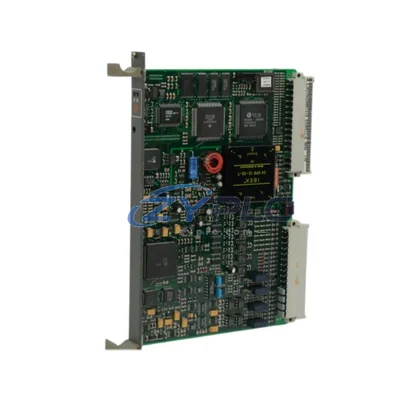
Allen-Bradley 1440-VST02-01RA XM120: Industrial Data Link for Smart Factory Vibration Monitoring
The Allen-Bradley 1440-VST02-01RA, part of the Rockwell Automation XM120 Dynamic Measurement Module series, is a precision-engineered industrial vibration monitoring device designed to serve as a critical data node in modern smart factory architectures. Operating within the Integrated Architecture framework of Rockwell Automation, this module bridges the gap between rotating machinery, field-level sensors, PLC controllers, and upper-level SCADA/HMI systems — delivering real-time dynamic measurement data across the entire industrial network with exceptional reliability and protocol compatibility.
In today’s connected manufacturing environment, the ability to continuously monitor machine health, detect anomalies early, and transmit actionable data upstream is no longer optional — it is the foundation of predictive maintenance and operational transparency. The 1440-VST02-01RA fulfills this role by capturing high-resolution vibration signals from accelerometers and velocity transducers mounted on motors, pumps, compressors, fans, and gearboxes, then converting those raw signals into structured digital data that flows seamlessly through the plant network.
Compatibility & Integration Notes
| Parameter |
Specification |
| SKU / Part Number |
1440-VST02-01RA |
| Series |
XM120 Dynamic Measurement Module |
| Brand |
Allen-Bradley / Rockwell Automation |
| Communication Protocol |
CIP (Common Industrial Protocol) / EtherNet/IP |
| Network Interface |
DIN Rail Backplane, XM Bus |
| Input Channels |
2 Dynamic (AC) Input Channels |
| Measurement Type |
Vibration, Velocity, Acceleration, Displacement |
| SCADA / HMI Compatibility |
FactoryTalk View, RSView, Wonderware, Ignition SCADA |
| PLC Integration |
ControlLogix, CompactLogix, GuardLogix via EtherNet/IP |
| Network Compatibility |
EtherNet/IP, DeviceNet (via gateway), Modbus TCP (via gateway) |
| System Application |
Predictive Maintenance, Condition Monitoring, Smart Factory IIoT |
| Power Supply |
24V DC (via XM Power Supply Module) |
| Operating Temperature |
0°C to 60°C |
| Origin |
USA |
| Warranty |
warranty terms confirmed during quotation |
| Stock Status |
RFQ Available — Global Shipping Available |
Connected Automation Data Flow
The 1440-VST02-01RA sits at the heart of a layered industrial data architecture. At the field level, piezoelectric accelerometers and velocity transducers mounted on rotating equipment feed raw vibration signals into the XM120 module’s two dynamic AC input channels. The module performs onboard signal conditioning, FFT spectrum analysis, and alarm threshold evaluation — transforming raw analog waveforms into structured CIP data objects before they ever reach the network.
These processed data packets travel via the XM Bus backplane to an Allen-Bradley 1440-XMOD000-04RJ XM Expansion Module or directly to an Allen-Bradley 1440-ACNR12-04RJ XM-440 Master Relay Module, which acts as the network gateway, aggregating data from multiple XM-series modules and publishing it onto the plant’s EtherNet/IP network. From there, a Rockwell Automation ControlLogix L7x or CompactLogix 5380 PLC controller receives the structured vibration data via CIP messaging, executing ladder logic routines that trigger alarms, adjust drive speeds, or initiate safe shutdowns when vibration thresholds are exceeded.
Upstream, FactoryTalk View SE HMI servers poll the ControlLogix controller via EtherNet/IP, rendering real-time vibration trend charts, alarm banners, and machine health dashboards on operator workstations across the plant floor. For facilities running third-party SCADA platforms such as Ignition by Inductive Automation or Wonderware System Platform, an Allen-Bradley 1783-ETAP EtherNet/IP Tap or a dedicated Moxa MGate MB3480 Modbus-to-EtherNet/IP gateway can bridge protocol boundaries, ensuring the 1440-VST02-01RA’s data reaches every level of the control hierarchy without data loss or latency spikes.
Variable frequency drives such as the Allen-Bradley PowerFlex 755 can receive speed-correction commands derived from the XM120’s vibration analysis, enabling closed-loop vibration control where the drive automatically reduces motor speed when abnormal vibration signatures are detected — a capability that dramatically extends bearing and seal life in high-cycle applications. Edge computing nodes, such as the Rockwell Automation Logix Edge or third-party Advantech UNO-2484G industrial edge gateway, can subscribe to the EtherNet/IP data stream and forward time-series vibration records to cloud-based IIoT platforms for long-term trend analysis, digital twin modeling, and AI-driven predictive maintenance algorithms.
The entire data chain — from sensor signal to cloud analytics — is anchored by the 1440-VST02-01RA‘s onboard intelligence, which ensures that only pre-processed, alarm-evaluated, and timestamped data enters the network, minimizing bandwidth consumption and controller scan-time overhead while maximizing the actionability of every data point transmitted.
Solving Data Isolation in Industrial Sites
One of the most persistent challenges in legacy manufacturing environments is data isolation — islands of machinery that generate valuable operational data but have no reliable path to transmit it to control systems, historians, or maintenance platforms. The Allen-Bradley 1440-VST02-01RA directly addresses this problem by providing a standards-based, CIP-native interface that integrates with existing Rockwell Automation infrastructure without requiring custom programming or proprietary middleware.
For plants where older equipment communicates over DeviceNet or Modbus RTU, the XM120 module’s data can be bridged through protocol conversion gateways, eliminating the need to replace functional legacy hardware simply to achieve network visibility. This approach preserves capital investment while extending the operational lifespan of existing assets — a critical consideration in industries where equipment replacement cycles span decades.
Remote monitoring and diagnostics represent another area where the 1440-VST02-01RA delivers measurable value. By publishing vibration data onto the EtherNet/IP network, maintenance engineers can access real-time machine health information from any networked workstation, tablet, or remote desktop session — eliminating the need for technicians to physically approach hazardous rotating equipment for routine condition checks. Alarm escalation logic in the ControlLogix PLC can automatically generate email notifications, SMS alerts, or SCADA alarm records when vibration levels exceed configurable thresholds, enabling proactive maintenance scheduling before catastrophic failures occur.
Production line transparency is further enhanced by the module’s ability to log historical vibration trends via FactoryTalk Historian or third-party OPC-UA data historians, providing quality engineers and plant managers with the longitudinal data needed to correlate machine health trends with product quality metrics, energy consumption patterns, and overall equipment effectiveness (OEE) scores. As production demands evolve, the XM-series modular architecture allows additional measurement modules — including temperature, speed, and process variable monitors — to be added to the same DIN rail backplane without disrupting existing network configurations, providing a scalable path to comprehensive machine health monitoring across the entire facility.
Industrial Connectivity FAQ
Q1: What communication protocols does the Allen-Bradley 1440-VST02-01RA support, and is it compatible with non-Rockwell SCADA systems?
The 1440-VST02-01RA communicates natively via CIP (Common Industrial Protocol) over the XM Bus backplane, with EtherNet/IP network connectivity provided through the XM-440 Master Relay Module. It is fully compatible with any SCADA or HMI platform that supports EtherNet/IP or OPC-DA/OPC-UA data access, including Ignition, Wonderware, and Siemens WinCC. For Modbus TCP or DeviceNet environments, protocol conversion gateways can be deployed without modifying the XM120 module’s configuration.
Q2: How does the module handle network latency and ensure real-time data delivery in high-speed vibration monitoring applications?
The 1440-VST02-01RA performs onboard signal processing and alarm evaluation at the module level, meaning that time-critical alarm responses — such as relay trips or drive speed commands — are executed locally without depending on network round-trip times. Processed data is published to the EtherNet/IP network at configurable update rates, and the CIP protocol’s deterministic communication model ensures consistent, low-jitter data delivery to ControlLogix controllers and SCADA servers even in high-traffic network environments.
Q3: Can the XM120 system be expanded to monitor additional machines without replacing existing hardware?
Yes. The XM-series modular architecture supports up to 16 modules per XM-440 Master Relay Module backplane, allowing additional 1440-VST02-01RA dynamic measurement modules, temperature monitors, speed sensors, and process variable modules to be added incrementally as monitoring requirements expand. Each new module is automatically recognized by the master relay module and its data is immediately available on the EtherNet/IP network, requiring only a configuration update in the ControlLogix controller’s I/O tree — no rewiring or network reconfiguration is needed.
Q4: What pre-shipment testing and warranty coverage is provided with the 1440-VST02-01RA?
Every Allen-Bradley 1440-VST02-01RA unit supplied by ZYPLC undergoes functional verification testing prior to shipment, including power-on self-test validation, channel input verification, and CIP communication confirmation. All units are covered by a warranty terms confirmed during quotation against manufacturing defects and operational failures under normal industrial operating conditions. Availability is confirmed via RFQ for shipment arranged after confirmation with global shipping support, and our technical team provides pre-sales configuration guidance and post-sales integration support to ensure successful deployment in your specific application.