Allen-Bradley 1756-RMC10: Industrial Data Link and Smart Factory Connectivity for ControlLogix Redundancy Systems
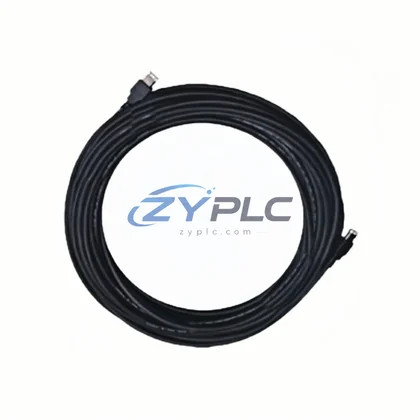
The Allen-Bradley 1756-RMC10 is a dedicated Redundancy Module Cable engineered for high-availability ControlLogix chassis architectures. In modern smart factory environments where uninterrupted data flow between field devices, PLC controllers, remote I/O modules, HMI panels, SCADA systems, variable frequency drives, and edge gateways is mission-critical, the 1756-RMC10 serves as the physical backbone that ensures seamless chassis-to-chassis synchronization. Its role extends beyond a simple cable — it is the communication lifeline that keeps redundant ControlLogix 1756-RM2 Redundancy Modules in continuous lockstep, guaranteeing that any primary controller failure triggers an instantaneous, bumpless switchover with zero data loss across the entire automation network.
In a typical ControlLogix redundancy deployment, the 1756-RMC10 connects the primary and secondary 1756-RM2 modules housed in separate 1756 chassis. This dual-chassis architecture allows the system to maintain real-time synchronization of all controller tags, I/O states, and communication statuses. When integrated with EtherNet/IP-based networks, the redundancy pair communicates upstream to SCADA platforms such as Rockwell’s FactoryTalk View SE and FactoryTalk Historian, ensuring that process data — from signal acquisition at the sensor level all the way to enterprise MES dashboards — remains continuous and accurate even during a controller switchover event.
Compatibility & Integration Notes
| Parameter |
Specification |
| SKU / Part Number |
1756-RMC10 |
| Brand |
Allen-Bradley / Rockwell Automation |
| Series |
ControlLogix 1756 |
| Product Type |
Redundancy Module Cable |
| Compatible Module |
1756-RM2, 1756-RM2K Redundancy Modules |
| Communication Protocol |
EtherNet/IP, ControlNet, DH+ (via gateway) |
| Interface Type |
Fiber Optic / Dedicated Redundancy Link |
| Network Compatibility |
ControlLogix Redundancy System, PlantPAx DCS |
| System Application |
SCADA, HMI, MES, DCS, Smart Factory Automation |
| Transmission Capability |
Real-time controller state synchronization |
| Origin |
USA |
| Warranty |
Warranty and support terms confirmed before quote |
| Availability |
Confirmed via RFQ before quotation |
| Shipping |
DHL / FedEx Global Express |
Connected Automation Data Flow
Understanding the 1756-RMC10’s role requires tracing the full industrial data chain from the plant floor upward. At the field level, sensors and actuators — including pressure transmitters, flow meters, and proximity switches — feed analog and digital signals into 1756-series I/O modules such as the 1756-IB16 digital input module and the 1756-OF8 analog output module. These I/O modules reside in the same ControlLogix chassis as the primary 1756-L85E controller, which processes all logic and communicates upstream via EtherNet/IP.
The 1756-RMC10 cable connects the primary chassis to the secondary redundancy chassis, where a mirrored 1756-L85E controller and a secondary 1756-RM2 module maintain a continuously synchronized shadow of the primary’s execution state. This synchronization occurs at the scan cycle level, meaning that every tag value, timer accumulator, counter value, and I/O status is replicated in real time. Should the primary controller experience a fault, the 1756-RM2 modules — linked by the 1756-RMC10 — execute a bumpless transfer of control to the secondary chassis within milliseconds, with no disruption to field devices or upstream SCADA communications.
At the network layer, both chassis connect to a managed industrial Ethernet switch — such as the Stratix 5700 — which routes EtherNet/IP traffic to the plant’s SCADA server running FactoryTalk View SE. HMI panels, including PanelView Plus 7 terminals on the production floor, display live process data sourced from the active controller. Remote I/O adapters such as the 1734-AENT POINT I/O EtherNet/IP adapter extend the I/O network to distributed field panels, while PowerFlex 755 variable frequency drives receive speed and torque commands via EtherNet/IP from the ControlLogix controller. The 1756-RMC10 ensures that all of these downstream and upstream connections remain uninterrupted regardless of which chassis holds primary control.
For facilities integrating legacy fieldbus devices, a 1788-EN2PAR EtherNet/IP-to-ControlNet linking device or a 1756-DNB DeviceNet Scanner module can bridge older protocols into the ControlLogix backplane, with the redundancy system — anchored by the 1756-RMC10 — ensuring that protocol gateway functions are also covered by the redundancy architecture. Edge gateways running FactoryTalk Edge Manager can further aggregate data from the redundant ControlLogix system and push it to cloud-based analytics platforms, completing the data chain from sensor to enterprise.
Solving Data Isolation in Industrial Sites
One of the most persistent challenges in industrial automation is data isolation — the condition where field devices, controllers, and supervisory systems operate in silos, unable to share real-time information across protocol boundaries or network segments. The 1756-RMC10, as part of a fully configured ControlLogix redundancy system, directly addresses several dimensions of this problem.
First, it eliminates the single point of failure that would otherwise create a data blackout during controller maintenance or unexpected faults. In facilities running continuous processes — chemical plants, oil and gas pipelines, water treatment facilities, and pharmaceutical manufacturing lines — even a brief controller outage can result in lost production data, alarm flooding, and unsafe process states. The redundancy architecture enabled by the 1756-RMC10 ensures that SCADA historians continue to receive uninterrupted data streams, alarm management systems maintain accurate state awareness, and HMI operators see no disruption in their process displays.
Second, the 1756-RMC10 supports production line transparency by ensuring that all data collected at the field level — from energy meters, quality sensors, and machine vision systems — is continuously available to MES and ERP systems via the always-active ControlLogix controller pair. This transparency is foundational to lean manufacturing initiatives, OEE (Overall Equipment Effectiveness) tracking, and predictive maintenance programs that rely on unbroken time-series data.
Third, for facilities expanding their automation footprint, the ControlLogix redundancy architecture scales horizontally. Additional I/O chassis, remote adapter nodes, and communication modules can be added to the network without disrupting the redundancy pair, provided the 1756-RMC10 and associated 1756-RM2 modules are correctly configured. This scalability makes the 1756-RMC10 a long-term investment in network infrastructure rather than a point solution.
All units supplied by ZYPLC undergo pre-shipment functional verification, including continuity testing and compatibility checks against the target 1756-RM2 firmware version. Each 1756-RMC10 ships with a warranty and support terms confirmed before quote covering manufacturing defects and communication failures under normal operating conditions.
Industrial Connectivity FAQ
Q1: What is the communication latency introduced by the 1756-RMC10 redundancy link?
The 1756-RMC10 operates as a dedicated point-to-point fiber link between the two 1756-RM2 modules. Synchronization latency is determined by the ControlLogix redundancy firmware and is typically sub-millisecond for tag synchronization, with switchover times configurable down to approximately 10ms depending on the chassis scan rate and network load. This latency is transparent to EtherNet/IP devices and SCADA clients.
Q2: Is the 1756-RMC10 compatible with all ControlLogix redundancy module revisions?
The 1756-RMC10 is designed for use with the 1756-RM2 and 1756-RM2K redundancy modules. Compatibility with specific firmware revisions should be verified against Rockwell Automation’s Knowledgebase. ZYPLC’s technical team can assist with firmware compatibility checks prior to shipment upon request.
Q3: How does the redundancy system maintain network stability during a switchover event?
During a switchover, the 1756-RM2 modules coordinate the transfer of primary control using the synchronization data maintained over the 1756-RMC10 link. EtherNet/IP connections from SCADA servers, HMI panels, and remote I/O adapters are re-established by the secondary controller within the configured connection timeout window, typically without triggering I/O faults or SCADA communication alarms when properly configured.
Q4: What does the warranty and support terms confirmed before quote from ZYPLC cover for the 1756-RMC10?
ZYPLC’s warranty and support terms confirmed before quote covers manufacturing defects, fiber connector integrity, and communication link failures under normal industrial operating conditions. Each unit is tested prior to shipment. Warranty claims are processed via plc.sales@zyplc.com, and replacement units are dispatched via DHL or FedEx express to minimize downtime.
—