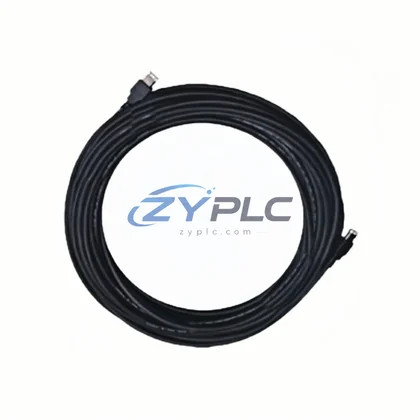
Bently Nevada CB2W100-015 Interconnect Cable for 3300 Series Automation
In modern industrial facilities where uptime and energy efficiency are inseparable goals, the signal integrity of every monitoring cable directly impacts how well a plant can detect, respond to, and prevent energy-wasting mechanical faults. The Bently Nevada CB2W100-015 is a precision-engineered interconnect cable purpose-built for the Bently Nevada 3300 Series vibration monitoring platform — one of the most widely deployed continuous machinery protection systems in rotating equipment environments worldwide.
When a turbine, compressor, pump, or motor operates with even marginal shaft misalignment or bearing degradation, it draws excess current, generates unnecessary heat, and accelerates wear — all of which translate directly into elevated energy consumption and unplanned maintenance costs. The CB2W100-015 cable ensures that the 3300 Series monitor receives clean, low-noise vibration and position signals from proximity probes, enabling the control system to detect these inefficiencies at the earliest possible stage. Early detection means corrective action can be taken before a minor imbalance becomes a catastrophic failure that forces an emergency shutdown and days of lost production.
Paired with the Bently Nevada 3300/16-15-01-01-00-00-00 proximity transducer and the 3300/55-01-01-00 extension cable, the CB2W100-015 forms a complete signal chain from the machine shaft to the monitoring rack. This chain feeds real-time displacement data into the 3500/42M proximitor I/O module, which in turn communicates with the 3500/22M transient data interface to log waveform data for trend analysis. When this data is surfaced through the System 1 asset performance management software, maintenance engineers gain a continuous picture of machine health that supports both predictive maintenance scheduling and maintenance planning decisions.
From a drive and control perspective, the CB2W100-015 integrates naturally into automation architectures where a Rockwell Automation Allen-Bradley PowerFlex 755 variable frequency drive or a Siemens SINAMICS S120 drive system is used to regulate motor speed. When the 3300 Series monitor detects rising vibration amplitudes — often a symptom of resonance at a fixed operating speed — the signal can be used to trigger a speed adjustment through the VFD, shifting the motor away from a resonance band and reducing both mechanical stress and energy draw simultaneously. This closed-loop interaction between vibration monitoring and drive control is one of the most effective maintenance planning strategies available in rotating equipment management.
For facilities running Emerson DeltaV or Honeywell Experion PKS distributed control systems, the 3300 Series rack communicates via Modbus RTU or 4–20 mA analog outputs, allowing vibration alarm states to be integrated directly into the plant-wide control logic. This means that when the CB2W100-015 cable is maintaining signal fidelity across the monitoring chain, the DCS can automatically reduce load on a machine showing early-stage bearing wear, preventing the energy spike that typically accompanies a bearing failure event. The 3500/20 rack power supply module ensures stable power delivery to all I/O cards, and the 3500/92 communication gateway enables seamless data export to historian platforms for long-term energy consumption trending.
In high-density motor control centers where space and cable routing are constrained, the CB2W100-015’s compact form factor and robust shielding reduce the risk of signal interference from adjacent Schneider Electric Altivar drive panels or ABB ACS880 inverter cabinets. Proper shielding in the signal cable is not merely a reliability consideration — it is an energy efficiency consideration, because corrupted vibration signals can cause false alarms that trigger unnecessary shutdowns or, worse, mask real faults that allow a machine to continue operating in an energy-inefficient state until failure.
ZYPLC maintains RFQ-based sourcing support of the CB2W100-015 and all associated 3300 Series components. Every unit undergoes outgoing inspection and functional testing before shipment, and all products are covered by a warranty and support terms confirmed before quote. Export shipping options are available after RFQ confirmation, with typical lead times of 3–7 business days for RFQ-confirmed items.
Product Specification Table
| Parameter |
Specification / Value |
| Part Number |
CB2W100-015 |
| Brand |
Bently Nevada |
| Series |
3300 Series |
| Product Type |
Interconnect Cable |
| Cable Length |
15 ft (approx. 4.6 m) |
| Signal Type |
Low-level vibration / proximity probe signal |
| Compatible Systems |
Bently Nevada 3300 Series, 3500 Series monitoring racks |
| Application Environment |
Rotating machinery, turbines, compressors, pumps, motors |
| Shielding |
Double-shielded for EMI/RFI noise rejection |
| Maintenance Value |
Enables early fault detection → reduces excess current draw and unplanned downtime |
| Communication Compatibility |
Modbus RTU, 4–20 mA analog output via 3300/3500 rack |
| Warranty |
12 Months |
| Availability |
Confirmed via RFQ before quotation |
System Compatibility and Application
The CB2W100-015 sits at the front end of a layered industrial automation system. At the sensing layer, it connects a Bently Nevada 3300 XL 8mm proximity transducer to the signal conditioning electronics inside the monitoring rack, transmitting shaft displacement data with minimal signal loss. This data feeds into the Bently Nevada 3500/40M proximitor I/O module, which processes the raw signal and generates both analog outputs and relay trip signals.
At the control layer, the 3500 rack’s relay outputs can be wired directly to the enable circuit of a Rockwell Automation PowerFlex 755T drive, allowing the drive to perform a controlled ramp-down when vibration thresholds are exceeded — a far more maintenance-focused response than a hard trip that requires a full restart cycle. For servo-driven applications such as precision positioning stages on CNC machinery, the vibration data from the 3300 Series can inform the tuning parameters of a Siemens SIMOTICS S-1FK7 servo motor controller, reducing hunting and oscillation that waste energy without contributing to useful work.
At the data layer, the Bently Nevada System 1 v8 software aggregates vibration trends, speed data, and process variables from multiple machines simultaneously. When integrated with a Yokogawa WT5000 precision power analyzer monitoring the electrical input to the motor, engineers can correlate mechanical vibration signatures with power consumption spikes, identifying exactly which fault modes are costing the most energy. This correlation capability transforms the CB2W100-015 from a simple cable into a critical link in a plant-wide energy intelligence system.
For I/O expansion and remote monitoring in distributed plant layouts, the Bently Nevada 3500/92 communication gateway enables the monitoring rack to publish data to OPC-UA servers, making vibration and energy data available to Emerson DeltaV DCS historians and MES platforms without additional hardware. The result is a fully connected condition monitoring loop — from the proximity probe tip, through the CB2W100-015 cable, through the 3300/3500 rack, and up to the enterprise maintenance planning dashboard.
Maintenance and Replacement Notes
In a typical petrochemical plant running multiple centrifugal compressor trains, each compressor is driven by a large induction motor consuming hundreds of kilowatts continuously. A single compressor operating with a developing bearing fault may draw 3–8% more current than a healthy machine — an energy penalty that accumulates to tens of thousands of dollars annually before the fault becomes severe enough to trigger a conventional vibration alarm. The CB2W100-015, as part of a properly configured 3300 Series monitoring system, enables alarm setpoints to be placed at much earlier stages of fault development, allowing maintenance to be scheduled during planned downtime rather than emergency response.
In automotive stamping lines, where large servo presses and transfer systems operate at high cycle rates, vibration monitoring of the drive spindles and transfer bar guides ensures that mechanical looseness — which causes energy-wasting impact loads — is detected before it progresses to component failure. The clean signal delivered by the CB2W100-015 allows the 3300 Series monitor to distinguish between normal press impact signatures and abnormal looseness signatures, reducing false maintenance calls while ensuring real faults are never missed.
In power generation facilities, the CB2W100-015 is commonly used on steam turbine shaft monitoring systems where the cost of an unplanned trip is measured not just in repair costs but in lost generation revenue and grid stability penalties. By maintaining signal integrity across the full operating temperature range of the turbine hall environment, the cable ensures that the protection system remains reliable during the high-load summer peak periods when energy efficiency and availability are most critical.
Across all these applications, the common thread is that signal quality at the cable level determines the quality of the decisions made at every layer above it — from the relay trip logic in the monitoring rack to the maintenance planning algorithms in the asset management software. Investing in the correct, OEM-specified interconnect cable is therefore not a minor procurement decision but a foundational element of any serious industrial maintenance planning program.
Product Sourcing FAQ
Q1: How does the CB2W100-015 contribute to operational stability in a rotating machinery application?
By ensuring low-noise, high-fidelity signal transmission from proximity probes to the 3300 Series monitor, the CB2W100-015 enables earlier detection of mechanical faults such as imbalance, misalignment, and bearing wear. These faults cause motors and drives to consume excess energy. Early detection allows corrective action before energy penalties become significant, and before a fault escalates to a failure that requires a full production shutdown.
Q2: Is the CB2W100-015 compatible with both the 3300 Series and the 3500 Series monitoring racks?
The CB2W100-015 is designed primarily for the 3300 Series platform. Compatibility with 3500 Series racks depends on the specific I/O module and transducer configuration. ZYPLC’s technical team can confirm compatibility for your specific rack and probe combination before shipment — contact us at plc.sales@zyplc.com or +86 19859288691.
Q3: What is the recommended replacement interval, and how is the cable tested before shipment?
There is no fixed replacement interval for the CB2W100-015 under normal operating conditions, but inspection is recommended during scheduled maintenance outages, particularly in high-vibration or high-temperature environments. Every CB2W100-015 unit shipped by ZYPLC undergoes continuity, insulation resistance, and shielding integrity testing before dispatch. Warranty terms are confirmed during quotation.
Q4: Can this cable be used as a direct replacement for a damaged OEM cable on an existing 3300 Series installation?
Yes. The CB2W100-015 is an OEM-specification interconnect cable and is a direct replacement for existing installations. No reconfiguration of the monitoring rack or transducer is required. Ensure the cable routing avoids high-voltage conductors and that the shield termination follows Bently Nevada’s grounding guidelines to maintain signal integrity and maximize the condition monitoring effectiveness of the system.