Bently Nevada CB2W100-112: Industrial Data Link for 3500 Series Vibration Monitoring Networks
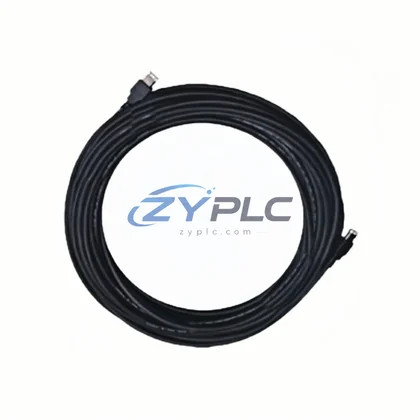
The Bently Nevada CB2W100-112 Interconnect Cable is a precision-engineered signal transmission component designed to serve as the physical backbone of the 3500 Series machinery protection and condition monitoring architecture. In modern smart factory environments, reliable signal integrity between field-mounted transducers and the centralized monitoring rack is not optional — it is the foundation upon which real-time diagnostics, predictive maintenance, and plant-wide SCADA visibility are built. The CB2W100-112 fulfills this role with consistent, low-noise signal transmission that supports uninterrupted data flow from rotating machinery sensors to the 3500 rack’s processing modules.
Within a typical industrial automation topology, the CB2W100-112 connects proximity probes, velocity sensors, and accelerometers mounted on turbines, compressors, pumps, and motors directly to the Bently Nevada 3500/25 Keyphasor Module or the 3500/42M Proximitor/Seismic Monitor. These rack-mounted modules digitize the raw analog signals and pass structured vibration data upstream through the 3500/20 Rack Interface Module (RIM), which bridges the monitoring rack to plant-level Ethernet or serial communication networks. From there, data flows into SCADA platforms such as GE System 1 or third-party OPC-DA/OPC-UA servers, enabling operators to visualize shaft displacement, bearing temperature trends, and alarm states on HMI dashboards in real time.
The CB2W100-112 is not simply a passive conductor — it is a calibrated component matched to the impedance and signal conditioning requirements of the 3500 Series ecosystem. Using non-specified or generic cabling in its place introduces ground loops, signal attenuation, and EMI susceptibility that can corrupt vibration waveform data, trigger false alarms, or — more critically — mask genuine machinery faults. In high-stakes applications such as gas turbine protection or centrifugal compressor monitoring, this distinction directly impacts plant safety and uptime.
Compatibility & Integration Notes
| Parameter |
Specification |
| SKU / Part Number |
CB2W100-112 |
| Brand |
Bently Nevada |
| Compatible Series |
3500 Series Machinery Protection System |
| Product Type |
Interconnect Cable / Signal Transmission Component |
| Protocol Support |
Analog Signal (4–20 mA / Voltage), compatible with OPC-UA/DA via 3500 RIM gateway |
| Interface Type |
Multi-pin connector, rack-to-transducer signal path |
| Communication Role |
Field sensor to monitoring rack signal bridge |
| Network Compatibility |
Integrates with Ethernet-based SCADA, Modbus RTU, and OPC server environments via 3500 RIM |
| System Application |
Turbine, compressor, pump, and motor vibration monitoring; predictive maintenance; machinery protection |
| Origin |
United States |
| Warranty |
Warranty and support terms confirmed before quote |
| Availability |
Confirmed via RFQ before quotation |
Connected Automation Data Flow
Understanding how the CB2W100-112 fits into the broader automation data chain is essential for system integrators and maintenance engineers planning a machinery protection upgrade or greenfield installation. The data journey begins at the field level, where Bently Nevada 3300 XL 8mm Proximity Probes or 330500 Velocity Transducers are mounted on rotating equipment. These sensors generate continuous analog signals proportional to shaft vibration, displacement, or velocity. The CB2W100-112 carries these signals — shielded against electromagnetic interference from nearby VFDs, motor starters, and power cables — into the 3500 rack enclosure.
Inside the rack, the 3500/42M Proximitor/Seismic Monitor conditions and digitizes the incoming signals, applying alarm setpoints configured by the plant’s reliability engineers. The 3500/25 Keyphasor Module simultaneously processes once-per-revolution reference signals, enabling phase-referenced vibration analysis critical for balancing and orbit plot generation. Processed data is then aggregated by the 3500/20 Rack Interface Module, which acts as the protocol gateway between the proprietary 3500 rack backplane and the plant’s industrial Ethernet network.
At the network layer, the RIM communicates with upstream systems via Modbus TCP or OPC-DA, feeding real-time vibration vectors, alarm states, and diagnostic data to GE System 1 Evolution software or compatible SCADA platforms. Plant operators monitoring from a central control room HMI — whether running on Wonderware InTouch, Ignition SCADA, or a custom OPC-UA client — receive live machinery health data with sub-second latency. Remote diagnostic teams can access the same data streams through secure VPN tunnels connected to edge gateways, enabling off-site vibration analysis without dispatching field personnel.
For facilities running mixed automation architectures, the 3500 system’s open protocol support means the CB2W100-112-anchored data chain can coexist with Allen-Bradley ControlLogix PLCs, Siemens S7-300/400 controllers, and distributed I/O nodes from vendors such as Phoenix Contact or Wago, all sharing a common industrial Ethernet backbone. This interoperability is what transforms isolated vibration data into actionable intelligence within a unified smart factory data fabric.
Solving Data Isolation in Industrial Sites
One of the most persistent challenges in industrial facilities is the fragmentation of machinery health data. Vibration monitoring systems, process control PLCs, safety instrumented systems, and energy management platforms often operate as independent silos, each with proprietary protocols and isolated data stores. The result is that a compressor showing early signs of bearing wear may generate alarms in the 3500 rack that never reach the SCADA historian, leaving maintenance planners without the trend data needed to schedule proactive intervention.
The CB2W100-112, as the signal entry point into the 3500 Series architecture, plays a foundational role in breaking down this isolation. By ensuring clean, calibrated signal transmission from field transducers to the monitoring rack, it guarantees that the data digitized by the 3500 modules is accurate and trustworthy. Corrupted or attenuated signals — caused by damaged, mismatched, or improperly shielded cables — introduce noise that can mask real fault signatures or generate nuisance trips that erode operator confidence in the monitoring system.
Once signal integrity is assured at the cable level, the 3500 rack’s RIM module can reliably export structured data to plant historians, MES platforms, and cloud-based predictive maintenance analytics engines. This enables production line transparency: maintenance teams can correlate vibration trends with process variables such as load, temperature, and flow rate, identifying root causes of machinery degradation before they escalate to unplanned downtime. Remote monitoring capabilities further extend this value, allowing reliability engineers to supervise multiple plant sites from a centralized operations center, reducing travel costs and accelerating response times.
System expansion is equally straightforward within the 3500 architecture. Additional monitor modules can be inserted into the rack without disrupting existing signal chains, and the CB2W100-112’s standardized connector interface ensures compatibility across the full range of 3500 Series transducer inputs. This modularity supports phased capital investment strategies, allowing facilities to expand their machinery protection coverage incrementally as budget and operational priorities dictate.
Industrial Connectivity FAQ
Q1: What communication protocols does the Bently Nevada 3500 Series support when integrated with SCADA systems?
The 3500 Series communicates with SCADA and DCS platforms primarily through the 3500/20 Rack Interface Module, which supports Modbus RTU, Modbus TCP/IP, and OPC-DA protocols. Many installations also use OPC-UA bridges for integration with modern IIoT platforms. The CB2W100-112 ensures that field-level analog signals arrive at the RIM with sufficient fidelity to support accurate protocol conversion and data export.
Q2: How does the CB2W100-112 contribute to network stability in high-EMI industrial environments?
The CB2W100-112 is engineered with shielding and impedance characteristics matched to the 3500 Series signal conditioning requirements. In environments with high electromagnetic interference — such as those with large VFDs, arc furnaces, or high-voltage switchgear — proper cable shielding and grounding are critical to preventing signal noise from corrupting vibration measurements. Using the specified Bently Nevada interconnect cable eliminates a common source of measurement uncertainty in these environments.
Q3: Can the 3500 Series monitoring system be expanded without replacing existing CB2W100-112 cabling?
Yes. The 3500 rack architecture is modular by design. Additional monitor modules — such as the 3500/40M Proximitor/Seismic Monitor or the 3500/50 Tachometer Monitor — can be added to the rack, and existing CB2W100-112 cables serving current transducer inputs remain fully compatible. New transducer inputs simply require additional cables of the appropriate type, maintaining a consistent and manageable wiring infrastructure.
Q4: What warranty and quality assurance does ZYPLC provide for the CB2W100-112?
All CB2W100-112 units supplied by ZYPLC carry a warranty and support terms confirmed before quote covering manufacturing defects and functional performance. Each unit undergoes pre-shipment inspection and functional verification before dispatch. Global logistics are handled via DHL and FedEx express services, with tracking provided from warehouse to delivery. For volume orders or urgent requirements, contact our team directly for lead time confirmation and RFQ processing.