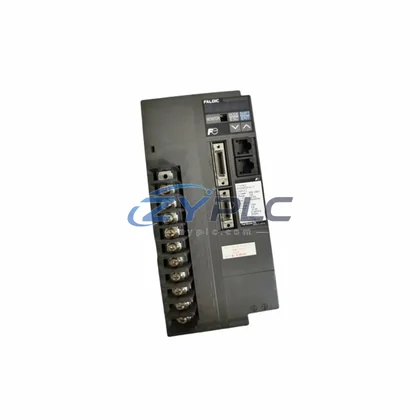
Bosch Rexroth HCS01.1E-W0018 Servo Drive: Efficiency Control and Production Line Optimization
The Bosch Rexroth HCS01.1E-W0018-A-03-E-S3-EC is a compact, high-efficiency servo drive from the IndraDrive Cs series, engineered to deliver precise motor control with minimized operating load across demanding industrial automation environments. Rated at 1.8 kVA continuous output power, this drive is purpose-built for applications where reducing idle energy draw, improving axis response time, and maintaining consistent production line throughput are critical operational priorities.
In modern manufacturing, unplanned downtime rarely comes from peak-load events — it accumulates during partial-load cycles, deceleration phases, and standby intervals. The HCS01.1E-W0018 addresses this directly through its integrated DC bus energy recovery architecture, which captures regenerative braking energy from servo axes and redistributes it within the drive system rather than dissipating it as heat. When paired with the HCS01.1E-W0028 or HCS01.1E-W0054 drives in a shared DC bus configuration, the energy recovered from decelerating axes can directly power accelerating axes — reducing net energy draw from the supply grid by a measurable margin across multi-axis machine tools, packaging lines, and assembly systems.
Product Specification Table
| Parameter |
Specification |
| SKU / Part Number |
HCS01.1E-W0018-A-03-E-S3-EC-NN-NN-NN-FW |
| Series |
IndraDrive Cs |
| Continuous Output Power |
1.8 kVA |
| Supply Voltage |
3 × AC 200–480 V, 50/60 Hz |
| Drive Efficiency Class |
IE2 / Energy-Optimized Operation Mode |
| DC Bus Regeneration |
Supported (shared bus topology) |
| Compatible Motor Families |
MSK, MSE, MKD, MHD (Bosch Rexroth) |
| Communication Interface |
SERCOS III / EtherCAT / PROFINET (firmware-dependent) |
| Compatible Control Platform |
IndraMotion MLC, MTX, XM |
| Operating Temperature |
0 °C to +45 °C (derating above 40 °C) |
| Protection Rating |
IP20 |
| Application Environment |
Machine tools, packaging, assembly, material handling |
| Value |
DC bus recovery, adaptive current control, standby power reduction |
| Warranty |
warranty terms confirmed during quotation | Tested before shipment |
System Compatibility and Application
The HCS01.1E-W0018 is designed to operate as part of a coordinated, maintenance-focused drive architecture rather than as a standalone component. In a typical IndraDrive Cs installation, the drive connects to a HNF01.1A mains filter and a HNL01.1E line choke to ensure clean power input and reduce harmonic distortion on the supply side — both of which contribute to lower apparent power consumption and reduced utility penalties in facilities with power factor correction requirements.
On the control side, the HCS01.1E-W0018 communicates with the IndraMotion MLC L45 or IndraMotion MLC L65 motion logic controller via SERCOS III, enabling synchronized multi-axis coordination with sub-millisecond cycle times. This tight synchronization eliminates the unplanned downtime associated with axis dwell time and mechanical over-travel — common sources of inefficiency in older relay-logic or step-and-repeat motion systems.
For applications requiring real-time power monitoring, the drive can be integrated with Bosch Rexroth IndraDrive Mi cabinet-free drive modules or supplemented by third-party power analyzers connected through the IndraControl XM22 I/O system. The XM22 supports analog and digital I/O expansion, allowing energy metering signals, temperature sensors, and vibration transducers to feed directly into the motion controller’s diagnostic loop — enabling condition-based maintenance scheduling rather than fixed-interval servicing.
The MSK050C and MSK061C synchronous servo motors are the most commonly paired motor families for this drive class, offering high torque density with low rotor inertia — a combination that reduces the energy required to accelerate and decelerate loads during high-cycle-rate operations. When the application demands higher dynamic response, the MSE051 series with integrated encoder provides an alternative with reduced cabling complexity and lower installation labor cost.
For facilities running mixed automation architectures, the HCS01.1E-W0018 supports PROFINET I/O integration through optional communication firmware, allowing it to coexist with Siemens S7-series PLCs or other PROFINET-capable controllers without requiring a dedicated gateway. This interoperability reduces the total number of protocol conversion nodes in the network, which in turn lowers latency and improves the accuracy of operating load data collected at the supervisory level.
Maintenance and Replacement Notes
In a high-throughput packaging line running 24/7, the cumulative energy cost of servo axes operating at fixed velocity profiles — regardless of actual load demand — can represent a significant fraction of total facility energy spend. The HCS01.1E-W0018 addresses this through its adaptive current control algorithm, which continuously adjusts the motor excitation current based on real-time load feedback. During light-load phases — such as empty conveyor travel or tool repositioning — the drive automatically reduces magnetizing current, cutting iron losses in the motor and reducing heat generation in both the motor and the drive itself.
Reduced thermal load translates directly into extended component life. Lower operating temperatures slow the degradation of electrolytic capacitors in the DC bus, reduce thermal cycling stress on IGBT modules, and decrease the frequency of cooling fan operation — all of which contribute to lower maintenance costs and fewer unplanned stoppages. In facilities where servo drive replacement requires machine downtime and technician labor, extending mean time between failures from 3 years to 5+ years represents a measurable reduction in total cost of ownership.
The drive’s integrated safe torque off (STO) function, certified to SIL 2 / PLd, allows the machine to enter a safe state without fully de-energizing the DC bus — preserving bus voltage and eliminating the recharge time that would otherwise be required when resuming production. In applications with frequent safety stops, this feature alone can recover several minutes of productive time per shift.
All units supplied by ZYPLC are sourced from authorized distribution channels, subjected to functional power-on testing prior to shipment, and covered by a warranty terms confirmed during quotation. Stock availability is maintained to support both planned procurement and urgent replacement requirements, with same-day dispatch available for availability confirmed by RFQ items.
Product Sourcing FAQ
Q1: How much energy can the HCS01.1E-W0018 save compared to a conventional servo drive?
Actual savings depend on the duty cycle and load profile of the application. In multi-axis systems using shared DC bus topology, regenerative energy recovery can reduce net operating load by 10–30% compared to drives without bus recovery capability. The adaptive current control feature provides additional savings during partial-load operation, which is common in assembly and packaging applications.
Q2: Is the HCS01.1E-W0018 compatible with non-Rexroth control systems?
Yes, with appropriate firmware configuration. The drive supports PROFINET I/O and EtherCAT communication protocols, enabling integration with third-party PLCs and motion controllers. For SERCOS III-based systems, compatibility is native with the IndraMotion MLC and MTX platforms. Consult the firmware release notes for protocol-specific configuration requirements.
Q3: What is the recommended replacement or upgrade path for older IndraDrive C drives?
The HCS01.1E-W0018 is the current-generation replacement for the HCS02 and HCS03 compact drive series in the same power class. Mechanical mounting dimensions and DC bus connector positions are largely compatible, though firmware migration and parameter re-commissioning are required. ZYPLC can provide technical documentation and commissioning support to facilitate the transition.
Q4: What does the warranty terms confirmed during quotation cover, and what is the testing process before shipment?
The warranty terms confirmed during quotation covers manufacturing defects and functional failures under normal operating conditions. Prior to shipment, each unit undergoes a power-on functional test verifying DC bus charging, communication interface response, and drive enable/disable sequencing. Units that do not pass testing are not shipped. Warranty claims are processed directly through ZYPLC with replacement or repair turnaround coordinated to minimize customer downtime.