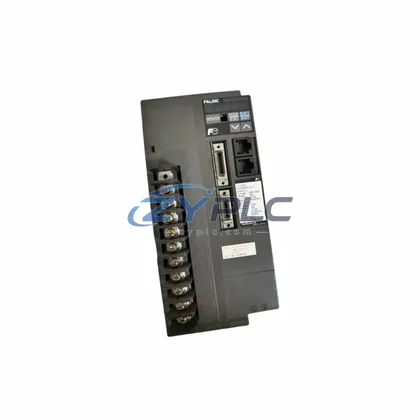
Emerson 9500-8201A Servo Drive for Quantum II: Control System and Upstream–Downstream Coordination
In modern industrial automation, no component operates in isolation. The Emerson 9500-8201A Servo Drive is engineered as a system-compatible motion control module designed to integrate seamlessly within the Quantum II control architecture. Rather than functioning as a standalone drive, the 9500-8201A is conceived as a precision execution node within a layered automation hierarchy — coordinating with upstream controllers, I/O subsystems, communication networks, power distribution modules, and human-machine interfaces to deliver consistent, scalable, and maintainable motion performance across demanding industrial environments.
The Quantum II platform from Emerson is built around a modular, rack-based architecture that supports high-density I/O expansion, redundant CPU configurations, and deterministic communication across distributed control nodes. Within this framework, the 9500-8201A occupies the execution layer, receiving velocity, torque, and position commands from the Quantum II CPU module and translating them into precise motor shaft output. This tight integration between the controller and the drive eliminates latency-induced positioning errors and ensures that motion sequences remain synchronized with process logic across the entire control loop.
Product Specification Table
| Parameter |
Specification |
| System Role |
Servo Drive / Motion Execution Node |
| Compatible Platform |
Emerson Quantum II Control Architecture |
| SKU / Part Number |
9500-8201A |
| Drive Type |
AC Servo Drive |
| Control Interface |
Analog ±10V / Pulse-Direction / Serial Command |
| Communication Capability |
RS-232 / RS-485; compatible with Quantum II backplane bus |
| Feedback Support |
Incremental Encoder, Resolver |
| Operating Voltage |
200–240V AC, Single/Three Phase |
| Protection Class |
IP20 (panel-mount installation) |
| Operating Temperature |
0°C to 55°C |
| Installation Environment |
Control cabinet, DIN rail or rack-mount compatible |
| system integration |
Full system integration with Quantum II CPU and I/O modules |
| Warranty |
warranty terms confirmed during quotation — all units tested prior to shipment |
System Compatibility Notes
The 9500-8201A achieves its full performance potential when deployed within a complete Quantum II system architecture. At the controller layer, the Emerson Quantum II CPU module — such as the 9500-CPU32 or 9500-CPU64 — issues motion commands via the system backplane, providing deterministic scan-cycle coordination between logic execution and drive response. The drive’s command interface supports both analog velocity reference and digital pulse-direction modes, allowing engineers to select the integration method best suited to the application’s precision requirements.
At the I/O layer, Emerson Quantum II digital output modules (such as the 9500-DO16 series) provide discrete control signals for drive enable, fault reset, and mode selection. Analog input modules in the same rack — for example, the 9500-AI08 — can be used to monitor motor current feedback or external process variables, feeding real-time data back into the CPU for closed-loop process adjustment. This tight I/O-to-drive coordination reduces wiring complexity and eliminates the need for external signal conditioning hardware.
Network communication within the Quantum II architecture is handled through dedicated communication gateway modules, such as the Emerson 9500-COMM-ETH Ethernet gateway or the 9500-COMM-PB PROFIBUS DP interface. These modules allow the 9500-8201A’s operational status — including fault codes, speed feedback, and torque output — to be surfaced to SCADA systems, DCS platforms, or remote HMI terminals without requiring additional fieldbus hardware at the drive level. This system integration capability ensures that drive data is available across the full supervisory layer in real time.
Power distribution for the Quantum II rack is managed through the Emerson 9500-PS24 power supply module, which provides regulated 24VDC logic power to all rack-mounted modules including the 9500-8201A’s control board. For applications requiring power redundancy, dual 9500-PS24 modules can be configured in parallel, ensuring that a single power supply failure does not interrupt drive operation or cause unplanned machine downtime. At the motor terminal, Emerson servo motors from the MX or MT series are the recommended mechanical load, as their encoder feedback specifications are factory-matched to the 9500-8201A’s resolver and incremental encoder input circuits.
For human-machine interface integration, the Quantum II architecture supports connection to Emerson’s VT series operator panels or third-party HMI terminals via the system’s RS-485 network. Operators can monitor drive status, adjust speed references, and acknowledge faults directly from the panel without requiring laptop-based commissioning tools during normal production. Terminal block modules — such as the Emerson 9500-TB32 — provide organized field wiring termination points within the control cabinet, reducing installation time and improving long-term maintenance access.
Industrial Application Notes
The Emerson 9500-8201A is deployed across a wide range of industrial sectors where precise motion control and system-level integration are critical operational requirements. In discrete manufacturing environments — including automotive assembly, electronics production, and precision machining — the drive controls servo axes responsible for part positioning, tool actuation, and conveyor indexing. Its deterministic response to CPU commands ensures that multi-axis motion sequences remain synchronized even under variable load conditions.
In the power generation and electrical utility sector, the 9500-8201A is used to control valve actuators, cooling fan drives, and auxiliary equipment drives within substation and power plant control systems. The drive’s compatibility with the Quantum II redundant CPU architecture makes it suitable for applications where continuous availability is a regulatory requirement. In petrochemical and refinery environments, the drive manages pump speed control, compressor auxiliary drives, and agitator systems, where its sealed control board design provides resistance to airborne contaminants common in process plant atmospheres.
Water treatment and municipal utility applications benefit from the 9500-8201A’s ability to maintain precise flow rates through variable-speed pump control, with the Quantum II CPU adjusting drive speed references in response to level sensor inputs processed through the system’s analog I/O modules. In mining and metallurgical operations, the drive is applied to conveyor belt tension control, crusher feed rate management, and hoist auxiliary systems, where its robust electrical design supports operation in environments with significant electrical noise from high-power equipment. Packaging line and food processing applications leverage the drive’s fast command response for high-cycle pick-and-place, labeling, and filling operations where throughput consistency directly impacts production economics.
Product Compatibility FAQ
Q1: Is the Emerson 9500-8201A compatible with both legacy Quantum II racks and current-generation Quantum II backplane configurations?
A: Yes. The 9500-8201A is designed for system integration within the Quantum II backplane architecture and is compatible with both earlier and current-generation rack configurations. Engineers should verify backplane slot assignments and power budget calculations using the Quantum II system configuration guide before installation. Where mixed-generation modules are present in the same rack, firmware version alignment between the CPU module and the drive’s embedded control board is recommended to ensure consistent command interpretation and fault reporting behavior.
Q2: What redundancy options are available when deploying the 9500-8201A in high-availability control architectures?
A: The Quantum II architecture supports CPU redundancy through hot-standby CPU module pairs, where the secondary CPU maintains a synchronized copy of the primary’s logic state and assumes control within one scan cycle in the event of a primary failure. The 9500-8201A receives commands from the active CPU through the backplane bus, meaning that CPU failover is transparent to the drive. For power redundancy, dual 9500-PS24 power supply modules in parallel configuration provide uninterrupted 24VDC logic power. Drive-level redundancy — where two 9500-8201A units are configured in a primary/standby arrangement — requires application-level logic in the CPU to manage output switching and is supported through the Quantum II’s discrete output module interface.
Q3: What does the warranty terms confirmed during quotation cover, and what support is available for commissioning and long-term maintenance?
A: All 9500-8201A units supplied by ZYPLC are covered by a warranty terms confirmed during quotation against manufacturing defects and functional failures under normal operating conditions. Each unit undergoes functional testing prior to shipment to verify drive enable, speed reference response, encoder feedback processing, and fault output behavior. For commissioning support, ZYPLC’s technical team is available to assist with parameter configuration, system integration verification, and fault diagnosis. For long-term maintenance planning, ZYPLC maintains inventory of 9500-8201A units and compatible Quantum II system components to support scheduled replacement programs and emergency spare requirements. Contact: +86 19859288691 | plc.sales@zyplc.com