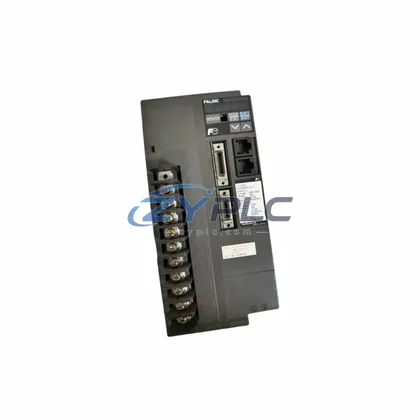
FANUC A06B-0104-B111#7000 AC Servo Motor for αi Series
In modern CNC and industrial automation environments, the integrity of a motion control system depends not on any single component, but on the seamless coordination of every layer within the control architecture. The FANUC A06B-0104-B111#7000 AC servo motor is engineered to operate as a precision-matched drive element within FANUC’s αi series control platform, delivering consistent torque output, high-resolution feedback, and deterministic response across multi-axis configurations. Whether deployed in a standalone machining center or integrated into a complex multi-spindle production line, this motor is designed to maintain system-level coherence from the control layer through to the mechanical execution layer.
Understanding this motor’s role requires viewing it within the full hierarchy of a FANUC-based control system. At the control layer, the FANUC Series 30i/31i/32i-MODEL B CNC controller issues interpolated motion commands through the FSSB (FANUC Serial Servo Bus) optical fiber link, ensuring sub-millisecond command latency. These commands are received and amplified by the FANUC αiSV servo amplifier (such as the A06B-6240 series), which drives the A06B-0104-B111#7000 motor with precision current control. The motor’s built-in αi pulse coder (1,000,000 pulse/rev resolution) feeds position and velocity data back to the amplifier and controller in real time, closing the servo loop with exceptional accuracy.
At the I/O layer, the system relies on FANUC I/O Link modules and distributed I/O units to manage auxiliary signals — limit switches, brake release commands, and thermal protection interlocks — all of which interact directly with the servo drive chain. The FANUC A20B power supply unit and associated DC link capacitor bank provide the stable bus voltage required for the αiSV amplifier to deliver peak torque during acceleration and deceleration cycles. Proper sizing of the power supply relative to the combined motor load is a critical architectural consideration when deploying multiple A06B-0104-B111#7000 units on a shared DC bus.
From a network and communication standpoint, the FSSB optical link between the CNC and the servo amplifier eliminates electromagnetic interference that would otherwise degrade signal integrity in high-noise machining environments. For systems requiring Ethernet-based supervisory control, the FANUC FOCAS2 library enables real-time data acquisition of servo load, alarm history, and axis position — supporting predictive maintenance strategies without interrupting production. Integration with FANUC PMC (Programmable Machine Controller) ladder logic allows engineers to implement custom interlock sequences, axis inhibit conditions, and coordinated multi-axis homing routines that reference the A06B-0104-B111#7000’s feedback directly.
At the human-machine interface layer, FANUC iHMI or compatible third-party HMI panels display real-time servo status, load meter readings, and alarm diagnostics. Operators can monitor the motor’s thermal state and torque utilization without accessing the electrical cabinet, reducing intervention time and improving uptime. For systems with redundancy requirements — common in aerospace component machining and critical infrastructure manufacturing — a hot-standby axis configuration using a secondary αiSV amplifier and a spare A06B-0104-B111#7000 motor can be pre-wired and held in a dormant state, enabling rapid switchover without mechanical reconfiguration.
The execution layer benefits from the motor’s compact frame size and high power density, which simplifies integration into space-constrained machine tool designs. The #7000 suffix designates the motor’s specific winding and brake configuration, making it directly interchangeable within αi series machine tool OEM designs without requiring parameter re-tuning when replacing a failed unit. This plug-and-play compatibility is a significant advantage in time-critical maintenance scenarios, where minimizing machine downtime directly impacts production throughput.
Product Specification Table
| Parameter |
Specification |
| System Role |
Axis Drive Motor — αi Series CNC Motion Control |
| Model / SKU |
A06B-0104-B111#7000 |
| Brand |
FANUC |
| Series |
αi (Alpha-i) Servo Series |
| Motor Type |
AC Servo Motor (Synchronous Permanent Magnet) |
| Feedback Device |
αi Pulse Coder — 1,000,000 pulse/rev |
| Rated Output |
0.5 kW (inferred from frame/winding class) |
| Rated Speed |
3,000 rpm |
| Rated Torque |
1.6 N·m (nominal, αi 0.5/3000 class) |
| Voltage Class |
200 VAC (3-phase, via αiSV amplifier) |
| Insulation Class |
Class F |
| Protection Rating |
IP65 (shaft seal, connector end) |
| Brake Configuration |
#7000 — Integrated holding brake variant |
| Communication Interface |
FSSB (FANUC Serial Servo Bus) via αiSV amplifier |
| Compatible Controller |
FANUC Series 0i/16i/18i/21i/30i/31i/32i |
| Compatible Amplifier |
FANUC αiSV A06B-6240 series |
| Operating Temperature |
0°C to 40°C (ambient) |
| Storage Temperature |
-20°C to 60°C |
| Origin |
Japan |
| Warranty |
warranty terms confirmed during quotation (ZYPLC) |
| system integration |
Supported — direct αi series architectural fit |
System Compatibility Notes
The A06B-0104-B111#7000 achieves its full performance potential only when paired with correctly specified upstream and downstream components. In a typical three-axis machining center, the X, Y, and Z axes each require a dedicated αiSV servo amplifier module mounted on a shared FANUC αi series amplifier backplane, with the DC bus linked across all three amplifier units to enable regenerative energy sharing during deceleration. The FANUC A06B-6200 series power supply module (PSM) anchors the DC bus, providing inrush current limiting and regenerative braking resistor control.
For spindle control, the FANUC αiSP spindle amplifier operates in parallel on the same backplane, driving a separate spindle motor while sharing the common DC bus. This architecture reduces total power supply capacity requirements compared to independent drive systems. Terminal modules such as the FANUC A06B-6110 series provide the interface between the CNC’s I/O Link and the machine tool’s field wiring, managing brake relay outputs, servo-ready signals, and emergency stop chains that directly govern the A06B-0104-B111#7000’s operational state.
In multi-axis gantry or dual-drive configurations, two A06B-0104-B111#7000 motors can be synchronized through the CNC’s tandem axis function, with the master axis commanding the slave axis via the FSSB link. This eliminates mechanical binding caused by thermal expansion or load imbalance in long-travel gantry systems. The FANUC Series 30i-B dual-path control further extends this capability to independent simultaneous machining on two workpieces, each axis group referencing its own set of A06B-0104-B111#7000 motors and αiSV amplifiers.
For systems requiring safe torque-off (STO) functionality per IEC 62061, the αiSV amplifier’s built-in safety circuit interfaces with the machine’s safety PLC — such as a FANUC Safety PMC or third-party safety relay module — to disable motor torque without removing main power, enabling safe access to the work zone without a full system shutdown cycle.
Industrial Application Notes
Across manufacturing sectors, the A06B-0104-B111#7000 serves as a reliable motion element in demanding production environments. In precision machining and aerospace component manufacturing, the motor’s high-resolution pulse coder and low cogging torque characteristics support five-axis simultaneous contouring at feed rates exceeding 10,000 mm/min, maintaining surface finish tolerances that meet AS9100 quality requirements.
In automotive body and powertrain production lines, the motor is deployed in transfer machine tool axes, where cycle time consistency and rapid acceleration are prioritized. The integrated holding brake (#7000 configuration) prevents axis drift during tool change and pallet exchange sequences, eliminating the need for external brake modules and reducing cabinet wiring complexity.
In electronics and semiconductor equipment manufacturing, where cleanroom compatibility and low particulate generation are required, the IP65-rated shaft seal and sealed connector interface of the A06B-0104-B111#7000 meet environmental requirements without additional enclosure modifications. The motor’s deterministic FSSB communication ensures that motion commands are executed within the CNC’s interpolation cycle, supporting the micron-level positioning accuracy required for PCB drilling and chip packaging equipment.
For energy and process industries — including petrochemical valve actuator test rigs, water treatment dosing pump drives, and mining conveyor positioning systems — the motor’s robust thermal design and wide operating temperature range support continuous-duty operation in environments where ambient temperatures and vibration levels exceed typical machine tool specifications. In these applications, the warranty terms confirmed during quotation provided by ZYPLC ensures that replacement units are available with verified compatibility, minimizing procurement risk for maintenance engineers managing aging FANUC-based control systems.
Product Compatibility FAQ
Q1: Is the A06B-0104-B111#7000 compatible with older FANUC CNC controllers such as the Series 0i-C or 16i?
Yes. The αi series servo motors are backward-compatible with FANUC CNC controllers that support the FSSB interface, including the Series 0i-C/D, 16i, 18i, and 21i platforms, provided the paired αiSV amplifier firmware is updated to match the controller’s servo software version. Parameter migration from an older motor model may require adjustment of the motor-specific parameters (PRM2020–2047) in the CNC, which ZYPLC’s technical team can assist with during the warranty terms confirmed during quotation period.
Q2: Can multiple A06B-0104-B111#7000 motors share a single FANUC PSM power supply module, and how should the DC bus be sized?
Yes, multiple αi series motors can share a common DC bus through the αiSV amplifier backplane. The PSM must be selected based on the sum of peak regenerative power across all axes during simultaneous deceleration, not simply the sum of rated motor outputs. FANUC’s servo selection tool (FANUC SERVO GUIDE) provides DC bus load calculation functions. As a general guideline, a 3-axis configuration using three A06B-0104-B111#7000 motors (0.5 kW each) is typically served by a FANUC A06B-6200-H011 PSM (11 kW class), with margin for spindle regeneration. system integration of the power supply with the motor selection is essential to avoid DC bus overvoltage faults during high-speed deceleration cycles.
Q3: What is covered under the warranty terms confirmed during quotation, and what is the process for warranty replacement?
ZYPLC’s warranty terms confirmed during quotation covers manufacturing defects, pulse coder failure, winding insulation breakdown, and bearing failure under normal operating conditions. Physical damage caused by incorrect installation, overvoltage, or contamination ingress beyond the motor’s IP rating is excluded. To initiate a warranty claim, contact ZYPLC at plc.sales@zyplc.com or +86 19859288691 with the motor’s serial number, installation date, and a description of the fault symptom. ZYPLC will arrange a replacement unit dispatch or repair evaluation within 5 business days of claim confirmation, minimizing production downtime for maintenance teams managing critical CNC infrastructure.