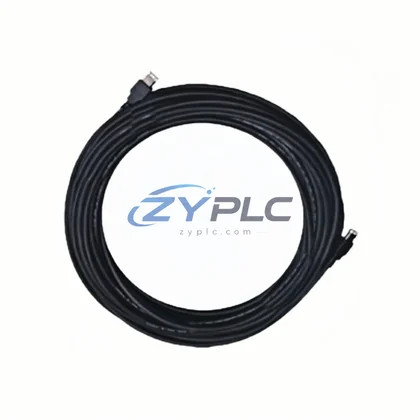
The Fujikura 1886-455368-11 (full SKU: 52 FT 1886-455368-11 716-140139-313 2800/3000 156403 17E181W412G1) is a precision-engineered RF coaxial cable assembly designed for high-frequency signal transmission in industrial telecom and automation environments. As factories and network infrastructure operators push toward leaner energy profiles, the quality of signal interconnects becomes a critical — yet often overlooked — factor in overall system efficiency. A poorly shielded or high-loss cable assembly forces amplifiers, transceivers, and control units to compensate with higher output power, directly increasing energy consumption across the signal chain.
The Fujikura 1886-455368-11 addresses this challenge with ultra-low insertion loss, robust shielding integrity, and a 52-foot run length optimized for rack-to-rack or cabinet-to-antenna routing in demanding industrial deployments. Whether integrated into a base station controller, a distributed antenna system (DAS), or a factory-floor wireless backbone, this cable assembly ensures that signal energy reaches its destination with minimal dissipation — reducing the burden on upstream RF power amplifiers and downstream low-noise amplifiers (LNAs).
Product Specification Table
| Parameter |
Specification / Value |
| SKU |
1886-455368-11 / 716-140139-313 |
| Cable Length |
52 FT (approx. 15.85 m) |
| Product Type |
RF Coaxial Cable Assembly |
| Series Reference |
2800/3000 Telecom Series |
| Insertion Loss Profile |
Low-loss design — minimizes RF power waste |
| Shielding Effectiveness |
High-coverage braid + foil — reduces EMI interference |
| Compatible Systems |
Base station controllers, DAS, industrial wireless backbones, RF test benches |
| Application Environment |
Industrial telecom, factory automation RF links, outdoor/indoor antenna runs |
| Maintenance Value |
Reduces amplifier compensation load; lowers system-wide RF power draw |
| Origin |
Japan (Fujikura) |
| Availability |
RFQ Available — shipment arranged after outgoing test |
| Warranty |
|
System Compatibility and Application
In modern industrial automation, RF coaxial cable assemblies like the Fujikura 1886-455368-11 are rarely standalone components — they are integral links within a broader industrial control architecture. Consider a typical smart factory deployment: a Siemens S7-1500 PLC series controller manages production line sequencing and communicates equipment status via PROFINET. Wireless I/O nodes — often connected through RF links using assemblies in the 2800/3000 Telecom Series — relay real-time sensor data back to the control layer without the latency or installation cost of hardwired runs.
Within the drive layer, a Yaskawa GA700 variable frequency drive (VFD) regulates motor speed on conveyor and pump systems, with its control signals routed through shielded coaxial interconnects to prevent EMI-induced faults that would otherwise trigger unnecessary drive resets and energy spikes. Similarly, a Mitsubishi FR-A800 inverter series drive, when paired with low-loss RF cable assemblies for its remote monitoring interface, maintains stable communication with the SCADA layer — enabling predictive load adjustments that cut peak energy demand.
On the power monitoring side, a Schneider Electric PowerLogic PM8000 series power meter samples energy consumption at the panel level, with its Modbus TCP or IEC 61850 data streams transmitted through structured cabling systems that depend on the signal integrity provided by assemblies like the 1886-455368-11. Any signal degradation at this layer introduces measurement error, which cascades into inaccurate energy baselines and missed optimization opportunities.
HMI terminals — such as a Weintek cMT series or Siemens TP1200 Comfort Panel — display real-time energy KPIs to operators. These panels receive data from PLCs and energy meters through Ethernet and serial backbones, but in facilities with distributed antenna systems or wireless operator panels, the RF coaxial backbone is the physical layer that makes low-latency, high-reliability communication possible. A Moxa AWK-3131A industrial wireless AP, for instance, depends on properly terminated, low-loss coaxial assemblies to maintain its -70 dBm or better receive sensitivity threshold — directly affecting how reliably a remote I/O module or wireless HMI stays online during peak production.
Phoenix Contact QUINT series power supplies provide the 24 VDC rail that powers PLCs, I/O modules, and communication gateways. When RF signal quality is poor and devices drop offline intermittently, power supplies cycle through inrush current events more frequently — a hidden energy cost that the Fujikura 1886-455368-11’s stable, low-reflection signal path helps eliminate. Completing the architecture, a Beckhoff EK1100 EtherCAT coupler with distributed I/O terminals handles fast analog and digital I/O sampling, with its upstream Ethernet connection routed through the same structured RF and copper cabling infrastructure that the 1886-455368-11 supports.
Maintenance and Replacement Notes
The energy impact of RF coaxial cable quality becomes most visible in three production scenarios: continuous process lines, high-cycle discrete manufacturing, and remote monitoring deployments.
In a continuous process line — such as a chemical dosing system or a food-grade conveyor — wireless sensor nodes monitor flow rates, temperature, and pressure in real time. If the RF cable assembly connecting the antenna to the wireless gateway has high insertion loss or poor return loss, the gateway’s transmit power must increase to maintain link budget. Over a 24/7 operation cycle, this translates to measurable additional power draw from the wireless infrastructure. The Fujikura 1886-455368-11, with its precision-terminated connectors and low-loss dielectric, keeps the link budget healthy without forcing the radio to operate at elevated power levels.
In high-cycle discrete manufacturing — such as automotive stamping or electronics assembly — machine cycle times are measured in seconds. Any communication dropout caused by a degraded RF link introduces micro-stoppages: the PLC waits for a sensor acknowledgment that doesn’t arrive, the servo drive holds position, and the line pauses. Each pause wastes the energy already consumed to accelerate the mechanical system to operating speed. By maintaining signal integrity across the full 52-foot cable run, the 1886-455368-11 eliminates this class of unplanned downtime at its root.
For remote monitoring deployments — such as substation automation or distributed energy resource (DER) management — the cable assembly connects RTUs and IEDs to communication infrastructure that must remain online continuously. A single communication failure in a DER management system can prevent optimal dispatch of solar or battery assets, resulting in grid inefficiency. The Fujikura 1886-455368-11’s robust construction and tested performance ensure that the communication layer supporting these systems remains reliable across temperature cycles, vibration, and long-term mechanical stress.
Every unit shipped from ZYPLC undergoes outgoing functional testing to verify connector integrity, continuity, and shielding effectiveness before dispatch. Combined with a , this ensures that the cable assembly performs to specification from day one of installation — reducing the risk of early-life failures that would require line shutdowns and emergency maintenance interventions.
Product Sourcing FAQ
Q1: How does the Fujikura 1886-455368-11 contribute to operational stability in an industrial facility?
By minimizing insertion loss and maintaining high shielding effectiveness, this cable assembly reduces the RF power compensation required from amplifiers and wireless gateways. Lower transmit power requirements translate directly to reduced energy consumption across the RF infrastructure layer — particularly significant in 24/7 industrial operations where wireless nodes run continuously.
Q2: Is the 1886-455368-11 compatible with standard industrial wireless and telecom systems?
Yes. The assembly is designed for the Fujikura 2800/3000 Telecom Series and is compatible with standard N-type, 7/16 DIN, or equivalent RF connector interfaces used in industrial base station controllers, DAS infrastructure, and factory wireless backbones. Always verify connector type and impedance (typically 50Ω) against your system specification before installation.
Q3: What is the recommended replacement or upgrade path if my existing RF cable assembly is causing signal degradation?
If your current assembly shows increased VSWR, visible connector corrosion, or intermittent link dropouts, the Fujikura 1886-455368-11 is a direct-replacement candidate for 52-foot runs in the same frequency band. For shorter or longer runs, consult the Fujikura 2800/3000 series catalog for matched assemblies. ZYPLC can assist with cross-referencing alternative SKUs from the same series.
Q4: What does the cover, and what is the testing process before shipment?
The covers manufacturing defects, connector integrity failures, and shielding continuity issues under normal operating conditions. Prior to shipment, each unit undergoes outgoing inspection including continuity verification, connector seating check, and visual shielding inspection. Units that do not pass testing are not shipped. Warranty claims are handled directly through ZYPLC with replacement or refund options available.