GE DS200UCVAH1ABC IS215UCVDH7AM: Industrial Data Link for Mark VI Speedtronic Network Systems
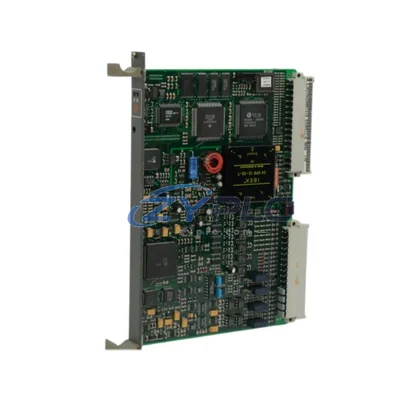
The GE DS200UCVAH1ABC paired with the IS215UCVDH7AM forms the UCVC (Universal Controller Voter Card) assembly at the heart of GE’s Mark VI Speedtronic turbine control platform. Far beyond a conventional control board, this dual-module assembly functions as a critical industrial network interface — orchestrating real-time data exchange between field-level sensors, actuators, I/O racks, and the supervisory control layer. In modern smart factory and power generation environments, where millisecond-level communication latency can determine operational safety, the DS200UCVAH1ABC / IS215UCVDH7AM assembly delivers the deterministic, fault-tolerant connectivity that mission-critical turbine systems demand.
Within the Mark VI architecture, this UCVC board manages the IONet communication backbone — GE’s proprietary high-speed industrial Ethernet protocol designed for deterministic real-time control. IONet enables the UCVC to simultaneously poll distributed I/O packs such as the IS215VCRCH1B (VCRC I/O terminal board) and IS215VCMIH2C (VCMI interface module), aggregate analog and digital signal data from thermocouples, pressure transmitters, and proximity probes, and relay processed values upstream to the Mark VI HMI workstation running GE’s ToolboxST configuration environment. This seamless signal-to-supervisory data flow is what enables operators to achieve full turbine transparency — from combustion dynamics to exhaust temperature profiles — without communication bottlenecks.
Compatibility & Integration Notes
| Parameter |
Specification |
| Primary Communication Protocol |
IONet (GE Proprietary Industrial Ethernet) |
| Secondary Protocol Support |
Modbus RTU / TCP, PROFIBUS DP (via gateway) |
| Interface Type |
Dual-redundant backplane + RJ45 IONet ports |
| Transmission Capability |
Real-time deterministic, <1ms scan cycle |
| Network Compatibility |
Mark VI / Mark VIe control racks, IONet switches |
| System Application |
Gas turbine, steam turbine, combined-cycle plant control |
| SCADA / HMI Integration |
GE ToolboxST, Cimplicity HMI, OSIsoft PI Historian |
| Redundancy Architecture |
TMR (Triple Modular Redundancy) voter logic |
| Warranty |
Warranty and support terms confirmed before quote — Tested & Verified |
Connected Automation Data Flow
Understanding the DS200UCVAH1ABC / IS215UCVDH7AM in isolation understates its role. Its true value emerges when viewed as the central node in a layered industrial communication chain. At the field level, the UCVC board continuously receives analog inputs from Bently Nevada 3500-series vibration monitors and thermocouple inputs routed through IS215TTURH1B turbine temperature I/O packs. These raw signals are digitized, validated through the TMR voter logic embedded in the IS215UCVDH7AM daughter card, and transmitted across the IONet backbone to the Mark VI controller rack.
Within the controller rack, the UCVC communicates with the IS215UCVEH2A (UCVE Ethernet communication board) to bridge IONet data onto plant-wide industrial Ethernet segments, enabling integration with OSIsoft PI data historians and Cimplicity SCADA platforms. Simultaneously, the IS215VPROH1B (VPRO protection board) receives voted output signals from the UCVC to execute turbine protection sequences — overspeed trips, flame-out shutdowns, and vibration-based protective actions — all within deterministic response windows.
For plants requiring protocol translation to legacy DCS systems, the Mark VI’s IS215UCVGH1A gateway module can bridge IONet to Modbus TCP or PROFIBUS DP, allowing the DS200UCVAH1ABC assembly to participate in broader multi-vendor automation networks. This makes the UCVC assembly a genuine industrial protocol gateway — not merely a controller card — capable of anchoring heterogeneous control architectures where GE turbine islands must coexist with Siemens, ABB, or Honeywell DCS platforms.
At the SCADA and remote monitoring layer, data aggregated by the UCVC flows through the Mark VI HMI server to enterprise historians, enabling remote diagnostics, predictive maintenance analytics, and alarm management from centralized control rooms or off-site operations centers. The IS215UCVDH7AM daughter card’s voter logic ensures that even in the event of a single-channel communication fault, the remaining two TMR channels maintain uninterrupted data flow — a critical requirement for continuous-operation power generation assets.
Solving Data Isolation in Industrial Sites
One of the most persistent challenges in turbine control modernization is protocol fragmentation. Legacy Mark IV and Mark V systems relied on proprietary serial communication schemes that created data silos — turbine performance data locked inside the control system, inaccessible to plant-wide SCADA or enterprise ERP platforms. The DS200UCVAH1ABC / IS215UCVDH7AM assembly, operating within the Mark VI framework, directly addresses this by providing structured IONet data outputs that are natively compatible with GE’s ToolboxST engineering environment and can be bridged to open protocols via gateway modules.
For plants managing multiple turbine strings, the UCVC’s TMR architecture eliminates single-point communication failures that previously caused unplanned outages. Where older control boards required physical site visits for diagnostics, the Mark VI’s IONet-connected UCVC enables remote diagnostic access through ToolboxST’s online monitoring mode — allowing engineers to inspect I/O signal health, communication link status, and voter logic outputs from the control room without interrupting turbine operation.
Production line transparency is further enhanced by the UCVC’s ability to timestamp all I/O events at the controller level, providing accurate sequence-of-events (SOE) data for post-trip analysis. This capability transforms raw turbine data into actionable operational intelligence — reducing mean time to repair (MTTR) and supporting continuous improvement programs aligned with IEC 61511 functional safety standards.
System expansion is equally straightforward: additional I/O packs can be added to the IONet backbone without modifying the UCVC’s core configuration, and the Mark VI’s modular rack architecture supports incremental capacity growth as plant requirements evolve. Every DS200UCVAH1ABC / IS215UCVDH7AM unit supplied by ZYPLC undergoes full functional bench testing — including IONet communication verification, TMR voter logic validation, and I/O channel integrity checks — before shipment, Warranty terms are confirmed during quotation.
Industrial Connectivity FAQ
Q1: What communication protocols does the DS200UCVAH1ABC / IS215UCVDH7AM support, and can it integrate with non-GE DCS systems?
The UCVC assembly natively communicates via GE’s IONet industrial Ethernet protocol within the Mark VI rack. For integration with non-GE systems, the Mark VI platform supports Modbus TCP and PROFIBUS DP through dedicated gateway modules such as the IS215UCVGH1A, enabling connectivity with Siemens, ABB, Honeywell, and other third-party DCS or SCADA platforms without replacing the core control architecture.
Q2: How does the TMR architecture in the IS215UCVDH7AM ensure network stability and prevent communication failures?
The IS215UCVDH7AM implements Triple Modular Redundancy (TMR) voter logic, meaning three independent processing channels continuously cross-check I/O data and communication outputs. If one channel develops a fault or communication error, the remaining two channels maintain full control and data transmission without operator intervention — ensuring zero-downtime operation for critical turbine assets.
Q3: What is the communication latency of the IONet backbone, and is it suitable for real-time turbine protection applications?
IONet is designed for deterministic real-time control with sub-millisecond scan cycles, making it fully suitable for turbine protection applications including overspeed detection, flame-out response, and vibration-based trips. The UCVC board’s onboard voter logic executes protection decisions locally, independent of network traffic conditions, ensuring protection response times are not affected by upstream SCADA or historian communication loads.
Q4: Does ZYPLC test the DS200UCVAH1ABC / IS215UCVDH7AM before shipment, and what does the warranty and support terms confirmed before quote cover?
Yes. Every unit undergoes comprehensive functional bench testing including IONet communication link verification, TMR voter logic validation, analog and digital I/O channel integrity checks, and power supply sequencing tests. The warranty and support terms confirmed before quote covers all verified hardware defects identified under normal operating conditions, with direct technical support from ZYPLC’s engineering team throughout the warranty period.