GE IS215VPROH1BD Industrial Network Interface for Mark VI Systems: Precision RTD Data Link in Smart Factory Turbine Control
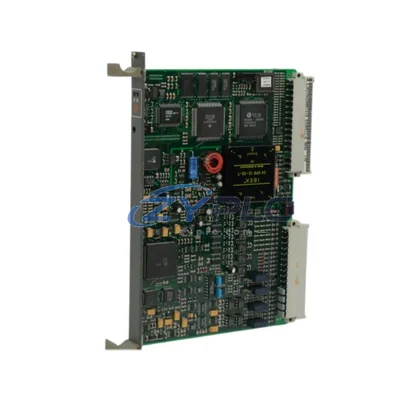
The GE IS215VPROH1BD is a high-performance RTD (Resistance Temperature Detector) Input Card engineered for the GE Speedtronic Mark VI turbine control platform. Designed to serve as a critical node in the industrial data chain, this module bridges field-level temperature sensors and the Mark VI controller backbone, enabling real-time signal acquisition, protocol-consistent data transmission, and seamless integration with SCADA and HMI supervisory layers. In modern smart factory and power generation environments, where millisecond-level data accuracy determines operational safety and efficiency, the IS215VPROH1BD delivers the signal fidelity and network stability that mission-critical turbine systems demand.
At its core, the IS215VPROH1BD captures analog RTD signals from thermocouples and resistance sensors distributed across turbine hot sections, exhaust stages, and bearing assemblies. These raw temperature readings are conditioned, digitized, and transmitted over the Mark VI’s internal I/O network to the GE IS215VCMIH2C VME Communication Interface Module, which coordinates data routing between I/O packs and the main controller. From there, the processed data flows upstream to the GE IS215UCVEH2A UCVx Controller Board, where turbine protection logic, alarm thresholds, and control sequences are executed in real time. This tightly integrated data pipeline ensures that every temperature anomaly detected at the sensor level is reflected instantly in the control logic — eliminating the data latency that can lead to unplanned shutdowns or equipment damage.
The IS215VPROH1BD is fully compatible with the Mark VI’s distributed I/O architecture, operating alongside companion modules such as the GE IS215VSVOH1B Servo Driver Card and the GE IS215VCMIH2C Communication Module within the same I/O pack assembly. This modular design allows plant engineers to expand or reconfigure the control system without disrupting live operations — a key advantage in continuous-process industries such as gas turbine power generation, combined-cycle plants, and industrial compressor stations.
Compatibility & Integration Notes
| Parameter |
Specification |
| Part Number / SKU |
IS215VPROH1BD |
| Brand / Manufacturer |
GE (General Electric) |
| Product Series |
Speedtronic Mark VI |
| Module Type |
RTD Input Card |
| Signal Protocol |
RTD (Resistance Temperature Detector) Analog Input |
| Communication Interface |
Mark VI Internal I/O Bus (IONet) |
| Network Compatibility |
GE Mark VI / Mark VIe Distributed Control Architecture |
| System Application |
Gas Turbine Control, Steam Turbine Control, Compressor Control |
| SCADA / HMI Integration |
Compatible via Mark VI Controller to GE ToolboxST / Cimplicity HMI |
| Mounting |
VME Rack / Mark VI I/O Pack |
| Origin |
United States |
| Warranty |
Warranty and support terms confirmed before quote |
| Availability |
Confirmed via RFQ before quotation |
| Shipping |
Global DHL / FedEx Express |
Connected Automation Data Flow
Understanding the IS215VPROH1BD’s role requires tracing the full industrial data flow from sensor to supervisory system. In a typical Mark VI-controlled gas turbine installation, RTD sensors embedded in the turbine casing, inlet guide vanes, and exhaust diffuser continuously generate analog resistance signals proportional to local temperatures. The IS215VPROH1BD receives these signals, applies precision signal conditioning, and converts them into digital engineering values that the Mark VI controller can process.
These digitized temperature values are transmitted via the Mark VI’s IONet communication bus — GE’s proprietary deterministic Ethernet-based I/O network — to the IS215UCVEH2A UCVx Controller. The controller cross-references incoming RTD data against pre-programmed alarm and trip setpoints. If a temperature exceedance is detected, the controller issues protective actions — fuel valve closure, load shedding, or emergency shutdown — within microseconds, preventing catastrophic equipment failure.
Simultaneously, the temperature data is mirrored to the plant’s SCADA layer via the GE IS215VCMIH2C Communication Interface, which bridges the Mark VI’s internal bus to the plant-wide Ethernet network. Operators monitoring the GE Cimplicity HMI workstation receive live temperature trend displays, historical logging, and alarm annunciation without any manual data extraction. For remote diagnostics, the Mark VI’s ToolboxST engineering software connects over the plant network, allowing maintenance engineers to interrogate IS215VPROH1BD channel values, calibration offsets, and fault codes from a central engineering station — or even remotely via VPN.
In multi-turbine installations, the IS215VPROH1BD-equipped I/O packs communicate with a shared GE IS215VCMIH2C network gateway, aggregating temperature data from multiple units into a unified SCADA dashboard. This architecture supports the GE IS215VSVOH1B Servo Driver Card and GE IS215ACLEH1A AC Line Monitor operating in parallel racks, ensuring that all control-critical signals — temperature, position, voltage — are synchronized across the control system with no data isolation between subsystems.
For plants integrating third-party SCADA platforms such as Wonderware, Ignition, or OSIsoft PI, the Mark VI’s OPC-DA/UA gateway capability allows IS215VPROH1BD temperature data to be published as standard OPC tags, enabling seamless historian integration and cross-platform analytics without custom protocol conversion hardware.
Solving Data Isolation in Industrial Sites
One of the most persistent challenges in legacy turbine control environments is data isolation — the inability to share real-time process data between the turbine control system, the plant DCS, and the enterprise MES/ERP layer. Older Mark V and Mark IV installations often relied on hardwired analog outputs or serial Modbus links to export data, creating bottlenecks that limited visibility and delayed fault response.
The IS215VPROH1BD, as part of the Mark VI platform, addresses this directly. Its integration with the Mark VI’s IONet architecture means that all RTD channel data is natively available on the plant Ethernet backbone without additional protocol converters or signal repeaters. Plant engineers can configure data publishing to OPC servers, historian databases, and cloud-based analytics platforms directly from ToolboxST, eliminating the need for standalone gateway hardware.
For sites upgrading from Mark V to Mark VI, the IS215VPROH1BD’s standardized VME form factor and I/O pack mounting system simplify the migration path. Existing RTD sensor wiring can often be reused, reducing installation costs and minimizing production downtime during the upgrade. The module’s built-in self-diagnostics continuously monitor channel integrity, reporting open-circuit, short-circuit, and out-of-range conditions to the controller — enabling predictive maintenance workflows that reduce unplanned outages.
In smart factory contexts where production line transparency and OEE (Overall Equipment Effectiveness) tracking are priorities, the IS215VPROH1BD’s real-time temperature data feeds directly into energy management and condition monitoring systems. By correlating turbine exhaust temperatures with fuel consumption data from the GE IS215ACLEH1A AC Line Monitor, plant operators can identify efficiency degradation trends weeks before they manifest as performance losses — enabling proactive maintenance scheduling rather than reactive repair.
Every IS215VPROH1BD unit supplied by ZYPLC undergoes pre-shipment functional testing, including channel-by-channel RTD signal verification, communication bus handshake confirmation, and firmware version validation. Units are shipped with full test documentation and are Warranty terms are confirmed during quotation.
Industrial Connectivity FAQ
Q1: What communication protocol does the GE IS215VPROH1BD use to transmit data to the Mark VI controller?
The IS215VPROH1BD transmits digitized RTD signal data over GE’s proprietary IONet — a deterministic, Ethernet-based I/O communication bus used within the Speedtronic Mark VI architecture. IONet ensures low-latency, high-reliability data transfer between I/O packs and the UCVx controller, with typical scan cycle times in the millisecond range suitable for turbine protection applications.
Q2: Is the IS215VPROH1BD compatible with Mark VIe systems, and can it integrate with third-party SCADA platforms?
The IS215VPROH1BD is designed for the Mark VI platform. For Mark VIe systems, GE introduced updated I/O module families with enhanced Ethernet connectivity. However, Mark VI modules can coexist with Mark VIe infrastructure in hybrid upgrade scenarios. For third-party SCADA integration (Wonderware, Ignition, OSIsoft PI), the Mark VI controller supports OPC-DA/UA data publishing, allowing IS215VPROH1BD channel data to be accessed by any OPC-compatible supervisory system without additional hardware.
Q3: How does the IS215VPROH1BD support network stability and fault detection in continuous-operation environments?
The module incorporates built-in channel diagnostics that continuously monitor each RTD input for open-circuit, short-circuit, and signal-out-of-range conditions. Fault status is reported to the Mark VI controller in real time, triggering alarm annunciation on the HMI and logging fault events to the historian. This self-monitoring capability ensures that sensor or wiring faults are detected and reported before they can cause undetected process deviations or false trips.
Q4: What does the warranty and support terms confirmed before quote cover, and how does ZYPLC handle pre-shipment testing?
All IS215VPROH1BD units supplied by ZYPLC are Warranty terms are confirmed during quotation. Prior to shipment, each unit undergoes functional verification including RTD channel signal testing, IONet communication handshake validation, and visual inspection for component integrity. Test reports are available upon request. Global shipping is handled via DHL or FedEx Express, with typical lead times of 3–7 business days to most destinations.