Honeywell 900RTC-H250: Industrial Data Link for HC900 Smart Factory Networks
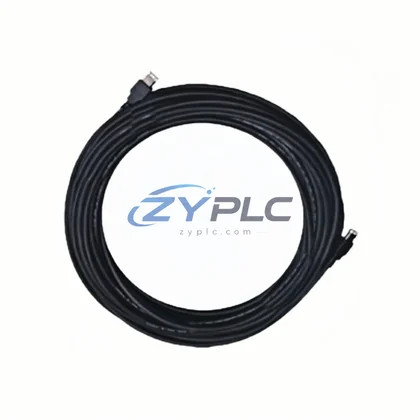
In modern industrial environments where uptime is non-negotiable and data transparency drives operational excellence, the Honeywell 900RTC-H250 RTP Communication Cable serves as a critical physical and protocol-layer bridge within the HC900 Distributed Control System architecture. Designed to carry Remote Terminal Protocol (RTP) signals between the HC900 Controller Rack and remote I/O expansion racks, this 250 mm communication cable ensures deterministic, low-latency data exchange across the control backbone — enabling real-time signal acquisition, process monitoring, and closed-loop automation at the field level.
The 900RTC-H250 is engineered for demanding industrial sites where electromagnetic interference, vibration, and thermal stress are constant challenges. Its shielded construction and precision-terminated connectors maintain signal integrity across the full operating range, making it a reliable choice for chemical processing plants, oil and gas facilities, power generation stations, and advanced manufacturing lines transitioning toward Industry 4.0 connectivity standards.
Compatibility & Integration Notes
| Parameter |
Specification |
| SKU / Part Number |
900RTC-H250 |
| Brand / Manufacturer |
Honeywell Process Solutions |
| Series |
HC900 Distributed Control System (DCS) |
| Communication Protocol |
RTP (Remote Terminal Protocol) — Honeywell Proprietary |
| Interface Type |
Rack-to-Rack Communication Cable (Controller ↔ Remote I/O) |
| Cable Length |
250 mm (0.25 m) |
| Transmission Capability |
High-speed deterministic data transfer between HC900 racks |
| Network Compatibility |
HC900 Controller Rack, HC900 Remote I/O Expansion Racks |
| System Application |
DCS, SCADA Integration, Remote I/O, Process Automation |
| Connector Type |
Proprietary RTP Rack Interface Connector |
| Operating Environment |
Industrial — EMI shielded, vibration-resistant |
| Origin |
United States |
| Warranty |
Warranty and support terms confirmed before quote — Tested before shipment |
Connected Automation Data Flow
The Honeywell 900RTC-H250 sits at the heart of the HC900 system’s distributed I/O architecture. In a typical smart factory deployment, field instruments — including pressure transmitters, flow meters, thermocouples, and discrete sensors — feed analog and digital signals into HC900 Remote I/O modules such as the 900G32-0101 (32-channel digital input) and 900A16-0101 (16-channel analog input). These remote I/O racks communicate upstream to the HC900 Controller Rack — housing the HC900 CPU module (900C32-0143-00) — via the 900RTC-H250 cable, which carries the RTP protocol data stream with deterministic cycle times critical for closed-loop process control.
At the controller level, the HC900 CPU processes incoming field data and executes control logic — PID loops, cascade control, ratio control — before issuing output commands back through the same RTP communication backbone to actuators, control valves, and variable frequency drives (VFDs). In multi-rack configurations, additional 900RTC-H250 cables daisy-chain expansion racks, extending the I/O capacity of the system without introducing communication latency or protocol conversion overhead.
For SCADA and HMI integration, the HC900 controller connects upstream via Ethernet (Modbus TCP or OPC-UA) to supervisory platforms such as Honeywell Experion PKS or third-party SCADA systems running on industrial workstations. HC900 Ethernet Communication Modules (900CS-ETH) bridge the proprietary RTP domain to the plant-wide Ethernet network, enabling real-time data visualization on HC900 Configuration Software (HC Designer) and operator HMI panels. Alarm management, trend logging, and remote diagnostics are all made possible by the uninterrupted data flow that begins at the 900RTC-H250 cable level.
In larger plant architectures, the HC900 system may interface with Honeywell Safety Manager controllers or third-party PLCs via gateway modules, with the 900RTC-H250 ensuring that the local DCS rack communication remains isolated, stable, and immune to upstream network congestion. Edge computing nodes and industrial IoT gateways can tap into the Ethernet layer above the HC900 controller to aggregate process data for cloud analytics, predictive maintenance models, and OEE (Overall Equipment Effectiveness) dashboards — all anchored by the reliable rack-level communication that the 900RTC-H250 provides.
Solving Data Isolation in Industrial Sites
One of the most persistent challenges in legacy and transitional industrial facilities is data isolation — where field devices, control systems, and enterprise platforms operate in disconnected silos, preventing real-time visibility and coordinated response. The Honeywell 900RTC-H250 directly addresses this at the foundational layer of the HC900 DCS architecture.
By providing a reliable, low-latency RTP communication link between the HC900 controller and its remote I/O racks, the 900RTC-H250 eliminates the signal gaps that occur when rack communication cables degrade, are incorrectly specified, or are substituted with non-OEM alternatives. A broken or intermittent rack communication link can cause the HC900 controller to lose visibility of entire I/O banks — triggering false alarms, forcing manual overrides, and creating the very data islands that modern smart factory initiatives aim to eliminate.
For facilities managing protocol heterogeneity — where HC900 DCS systems coexist with Modbus RTU field devices, PROFIBUS PA instruments, or HART-enabled transmitters — the integrity of the RTP backbone is even more critical. Any instability at the rack communication level cascades upward, corrupting the data that protocol gateways and SCADA systems rely on for accurate process representation. The 900RTC-H250, as an OEM-specified component, guarantees the electrical and protocol-layer performance that the HC900 system was designed around.
From a remote monitoring and diagnostics perspective, plant engineers using HC Designer or connected SCADA platforms can only achieve meaningful remote visibility when the underlying rack communication is stable and deterministic. The 900RTC-H250 supports this by maintaining consistent RTP frame timing, enabling the HC900 controller to report accurate I/O status, module health, and communication diagnostics to upstream monitoring systems — reducing downtime and enabling condition-based maintenance strategies.
For production lines undergoing capacity expansion, the 900RTC-H250 supports scalable I/O growth by connecting additional HC900 remote I/O racks to the existing controller without requiring system reconfiguration or protocol changes. This plug-and-extend architecture makes it straightforward to add new measurement points, control loops, or safety interlocks as production demands evolve.
Industrial Connectivity FAQ
Q1: What communication protocol does the Honeywell 900RTC-H250 support, and is it compatible with third-party I/O racks?
The 900RTC-H250 carries Honeywell’s proprietary RTP (Remote Terminal Protocol), which is exclusively used within the HC900 DCS rack architecture. It is designed for use between HC900 Controller Racks and HC900 Remote I/O Expansion Racks only. Third-party I/O racks are not compatible with the RTP interface. For integration with non-HC900 devices, protocol conversion is handled at the Ethernet/Modbus TCP layer via the HC900 Ethernet Communication Module.
Q2: How does the 900RTC-H250 affect communication latency and network stability in multi-rack HC900 configurations?
The 900RTC-H250 is engineered to maintain deterministic RTP cycle times across multi-rack configurations. Its shielded construction minimizes EMI-induced signal degradation, which is the primary cause of communication jitter in industrial rack environments. Using OEM-specified cables like the 900RTC-H250 — rather than generic alternatives — ensures that the HC900 controller’s communication watchdog timers are not triggered by marginal signal quality, preserving system stability and preventing spurious I/O faults.
Q3: Can the 900RTC-H250 be used in SCADA-integrated HC900 systems, and does it support remote diagnostics?
Yes. While the 900RTC-H250 operates at the rack-level RTP layer, its reliable performance is a prerequisite for effective SCADA integration. The HC900 controller aggregates I/O data from all connected remote racks via the RTP backbone and exposes this data to SCADA systems through Modbus TCP or OPC-UA over Ethernet. Remote diagnostics — including I/O module status, communication health, and alarm states — are only accurate when the underlying 900RTC-H250 rack communication is operating within specification.
Q4: What warranty and pre-shipment testing does ZYPLC provide for the Honeywell 900RTC-H250?
All Honeywell 900RTC-H250 units supplied by ZYPLC are covered by a warranty and support terms confirmed before quote from the date of shipment. Each unit undergoes pre-shipment inspection to verify connector integrity, cable continuity, and shielding performance before dispatch. ZYPLC maintains RFQ-based sourcing support of HC900 series communication components to support urgent project timelines and emergency replacement requirements. For availability and lead time, contact our team directly.