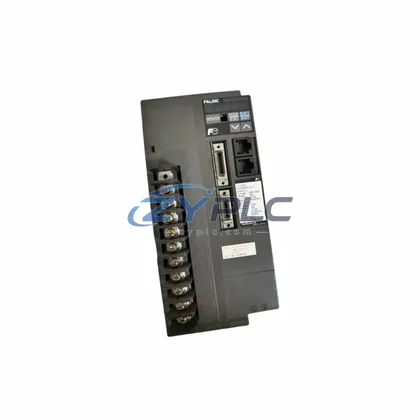
IAI DS-S-C1-L Industrial Network Interface for DS Series Systems: Precision Data Link for Smart Factory Automation
The IAI DS-S-C1-L is a dedicated servo controller output module engineered for the DS Series electric actuator platform. Designed to bridge field-level motion devices with upper-layer control and monitoring systems, the DS-S-C1-L delivers reliable serial communication and pulse-train command output in demanding industrial environments. Whether integrating with a Mitsubishi MELSEC PLC, a Siemens S7 controller, or a Rockwell ControlLogix system, this module provides the deterministic, low-latency data path that modern smart factories require.
In a typical smart factory deployment, data originates at the actuator level — electric cylinders, rotary actuators, and linear sliders from IAI’s RCS2 and PCON-C series — and must travel reliably through the control hierarchy to reach SCADA dashboards, MES platforms, and cloud-based analytics engines. The DS-S-C1-L sits at the heart of this data flow, translating motion commands and position feedback into structured communication frames that upstream systems can consume in real time. Its pulse-train output interface ensures compatibility with a wide range of servo drives and stepper controllers, while its serial communication port enables direct dialogue with IAI’s XSEL multi-axis controller and ACON-C single-axis controllers without additional protocol converters.
Compatibility & Integration Notes
| Parameter |
Specification |
| SKU |
DS-S-C1-L |
| Series |
DS Series |
| Brand |
IAI (Intelligent Actuator Inc.) |
| Module Type |
Servo Controller Output Module |
| Communication Protocol |
Serial (RS-232C / RS-485), Pulse-Train Command Output |
| Interface Type |
Serial Port, Pulse Output Terminal |
| Network Compatibility |
Compatible with PLC I/O networks, SCADA gateways, HMI serial links |
| Transmission Capability |
Position command, speed reference, alarm output, I/O status feedback |
| System Application |
Electric actuator control, multi-axis coordination, remote I/O expansion |
| Origin |
Japan |
| Warranty |
Warranty and support terms confirmed before quote |
Connected Automation Data Flow
Understanding the DS-S-C1-L’s role requires tracing the full data chain from signal acquisition to supervisory control. At the field level, IAI’s RCS2-SA6C rod-type electric actuators and RCS2-RA7C rotary actuators generate position and load feedback signals that are captured by the DS-S-C1-L output module. These signals are formatted and transmitted upstream via the module’s RS-485 serial link to an IAI XSEL-P multi-axis controller, which coordinates motion sequences across multiple axes simultaneously.
From the XSEL-P controller, process data is forwarded to a Mitsubishi MELSEC Q Series PLC via a dedicated CC-Link or SLMP gateway interface. The PLC aggregates motion status, I/O states, and alarm codes from multiple DS-S-C1-L modules distributed across the production line, then passes consolidated data to a Weintek MT8000 Series HMI for operator visualization. Simultaneously, a Moxa NPort 5650 serial device server converts the RS-485 data stream to Ethernet TCP/IP, enabling a Wonderware InTouch or Ignition SCADA platform to poll real-time actuator positions and cycle counts without interrupting the primary control loop.
For remote diagnostics, an IAI RC-PC gateway module bridges the DS Series communication bus to a standard Ethernet network, allowing maintenance engineers to access controller parameters, monitor alarm histories, and perform firmware updates from a central engineering workstation or even a remote VPN connection. This architecture eliminates the need for on-site intervention for routine diagnostics, reducing mean time to repair and improving overall equipment effectiveness (OEE).
In applications requiring coordinated motion with variable-speed drives, the DS-S-C1-L’s pulse-train output connects directly to IAI’s PCON-C single-axis controllers and SCON-C servo controllers, enabling synchronized positioning between electric actuators and servo-driven conveyors or rotary indexers. Proximity sensors and photoelectric detectors feed digital I/O signals into the module’s input terminals, providing real-time part-present and end-of-travel confirmation that the SCADA system logs for traceability and quality reporting.
Solving Data Isolation in Industrial Sites
One of the most persistent challenges in industrial automation is the coexistence of legacy serial devices alongside modern Ethernet-based control systems. Many production facilities operate IAI DS Series actuators alongside older ACON-C and DCON-C controllers that communicate exclusively over RS-232C or RS-485, creating data silos that prevent plant-wide visibility. The DS-S-C1-L addresses this directly by providing a standardized serial output interface that integrates seamlessly with protocol conversion gateways, allowing legacy motion data to flow into contemporary SCADA and MES architectures without requiring actuator replacement.
Protocol inconsistency is another common barrier to production line transparency. When a facility runs a mix of IAI serial controllers, Modbus RTU sensors, and PROFIBUS-connected drives, data aggregation becomes complex and error-prone. By deploying the DS-S-C1-L as the motion controller output stage and pairing it with a Moxa MGate serial-to-Modbus gateway, engineers can normalize all device data into a single Modbus TCP namespace that any SCADA or cloud platform can consume. This approach eliminates custom middleware, reduces integration time, and lowers the risk of communication errors that cause unplanned downtime.
Remote monitoring is increasingly critical as facilities expand across multiple buildings or geographic sites. The DS-S-C1-L’s serial communication output, when routed through an Ethernet gateway, enables centralized monitoring of actuator health, cycle counts, and alarm states from a single SCADA server. Maintenance teams receive alarm notifications the moment a DS Series actuator reports an overload or position deviation, allowing them to dispatch technicians with the correct replacement parts before a minor fault escalates into a production stoppage. System expansion is equally straightforward: additional DS-S-C1-L modules can be daisy-chained on the RS-485 bus, scaling the network from a single actuator to dozens without architectural changes to the upper-layer control system.
Industrial Connectivity FAQ
Q1: What communication protocols does the IAI DS-S-C1-L support, and is it compatible with standard PLC networks?
The DS-S-C1-L supports RS-232C and RS-485 serial communication as well as pulse-train command output. It is compatible with any PLC or controller that accepts serial I/O or pulse-train positioning commands, including Mitsubishi MELSEC, Omron Sysmac, and Siemens S7 series, typically via a serial communication module or gateway adapter.
Q2: How does the DS-S-C1-L perform in terms of communication latency and network stability?
The module is designed for deterministic, low-latency serial communication suitable for real-time motion control. RS-485 multi-drop configurations support baud rates up to 115,200 bps, providing fast, stable data exchange even in electrically noisy industrial environments with proper cable shielding and termination.
Q3: Can the DS-S-C1-L be integrated into an existing SCADA or HMI system without replacing the current control architecture?
Yes. The DS-S-C1-L’s serial output can be connected to a serial device server or protocol gateway (such as a Moxa NPort or IAI RC-PC gateway) to bridge DS Series motion data into Ethernet-based SCADA, HMI, or MES platforms. This allows incremental integration without disrupting existing PLC programs or network topology.
Q4: What warranty and pre-shipment testing does the DS-S-C1-L include?
Every IAI DS-S-C1-L module supplied by ZYPLC includes a warranty and support terms confirmed before quote covering manufacturing defects and communication failures. Each unit undergoes pre-shipment functional testing to verify serial communication integrity, pulse-train output accuracy, and I/O response before dispatch. Stock is maintained for RFQ-confirmed shipment timing to minimize lead times for urgent production requirements.
—