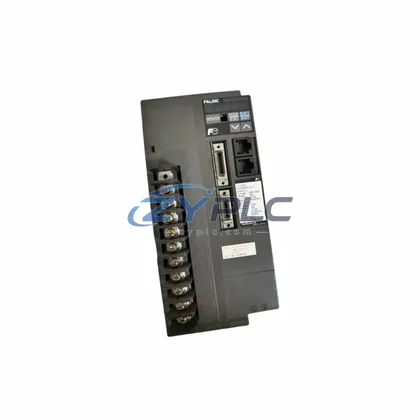
Kollmorgen MMC-SD-12.0-460-D Servo Drive for MMC
The Kollmorgen MMC-SD-12.0-460-D is a high-performance AC servo drive module engineered for seamless integration within the Kollmorgen Motion Master Controller (MMC) distributed motion architecture. Rated at 12.0 A continuous output current and designed for 460 V three-phase input, this drive is purpose-built to operate as a coordinated axis node within multi-axis servo systems. Unlike standalone drives, the MMC-SD-12.0-460-D is conceived as a system component — its value is fully realized when deployed alongside the MMC master controller, shared DC bus infrastructure, feedback modules, and coordinated I/O layers that define the MMC platform.
In modern industrial automation, the servo drive layer sits at the intersection of the control layer and the execution layer. The MMC-SD-12.0-460-D receives motion commands from the MMC master controller via the high-speed synchronous communication bus, translates those commands into precise torque and velocity outputs, and returns real-time position and status feedback — all within deterministic cycle times that are essential for coordinated multi-axis motion. This closed-loop architecture ensures that every axis in the system maintains synchronization, enabling complex motion profiles such as electronic gearing, cam following, and coordinated interpolation across multiple servo axes simultaneously.
From a system architecture perspective, the MMC-SD-12.0-460-D occupies the drive layer beneath the MMC master controller and above the motor and feedback devices. It interfaces upward to the MMC controller for command and status exchange, and downward to the servo motor and encoder for torque delivery and position verification. This layered architecture — control layer, drive layer, motor layer — is the foundation of the MMC platform’s scalability and deterministic performance. Engineers designing new systems or expanding existing MMC installations can add additional MMC-SD drive modules to the shared DC bus rail without restructuring the control architecture, making the platform highly modular and cost-effective for multi-axis applications.
The shared DC bus design of the MMC platform is a critical architectural advantage. When multiple MMC-SD-12.0-460-D drives are connected to a common DC bus, regenerative energy from decelerating axes is recovered and redistributed to accelerating axes within the same bus segment. This energy sharing reduces peak demand on the AC power supply, lowers heat dissipation within the control cabinet, and improves overall system efficiency — particularly in applications with coordinated motion profiles where axes alternate between acceleration and deceleration phases. The DC bus architecture also simplifies cabinet wiring by eliminating the need for individual AC input connections to each drive axis.
Feedback integration is another dimension of the MMC-SD-12.0-460-D’s system role. The drive supports high-resolution encoder feedback, enabling precise position control that is essential for applications requiring tight positional accuracy and repeatability. The feedback data is not only used locally within the drive for commutation and velocity control but is also transmitted back to the MMC master controller for system-level position monitoring, fault detection, and coordinated motion management. This bidirectional data flow between the drive and the controller is what enables the MMC platform to execute complex synchronized motion sequences reliably across all axes.
For system integrators and maintenance engineers, the MMC-SD-12.0-460-D offers significant advantages in terms of long-term maintainability. Because all drive modules within an MMC system share the same hardware platform, firmware architecture, and configuration interface, spare parts management is simplified — a single spare MMC-SD drive module can serve as a replacement for any axis in the system. This interchangeability reduces inventory costs and minimizes downtime during unplanned maintenance events. All units supplied by ZYPLC are covered by a warranty terms confirmed during quotation, ensuring operational confidence throughout the post-installation period.
Product Specification Table
| System Role |
Axis Drive Node — MMC Distributed Motion Architecture |
| SKU / Part Number |
MMC-SD-12.0-460-D |
| Brand / Series |
Kollmorgen / MMC (Motion Master Controller) |
| Product Type |
AC Servo Drive Module |
| Continuous Output Current |
12.0 A |
| Input Voltage |
460 V AC, Three-Phase |
| DC Bus Architecture |
Shared DC Bus — Multi-Axis Energy Sharing |
| Communication Interface |
MMC Synchronous Servo Bus (proprietary high-speed) |
| Feedback Support |
High-Resolution Incremental / Absolute Encoder |
| Control Modes |
Position, Velocity, Torque |
| Installation Environment |
Industrial Control Cabinet, DIN Rail / Panel Mount |
| system integration |
Native MMC Platform — Plug-and-Play Axis Expansion |
| Warranty |
warranty terms confirmed during quotation (ZYPLC) |
| Origin |
United States |
System Compatibility Notes
The MMC-SD-12.0-460-D achieves its full capability when deployed within a complete MMC control system architecture. At the top of the hierarchy, the Kollmorgen MMC Master Controller (such as the MMC-4 or MMC-8 platform) serves as the motion coordinator, executing the application program and issuing synchronized motion commands to all drive axes via the high-speed servo bus. The master controller manages trajectory generation, axis synchronization, and system-level fault handling — functions that depend on reliable, low-latency communication with each MMC-SD drive node.
Power delivery to the MMC-SD-12.0-460-D begins at the MMC Power Supply Module, which rectifies the three-phase AC input and establishes the shared DC bus voltage. Multiple MMC-SD drive modules connect to this common DC bus, enabling the regenerative energy sharing described above. In systems with high regenerative loads, an MMC Regenerative Resistor Module or braking chopper may be added to the bus to dissipate excess energy during rapid deceleration cycles.
On the I/O layer, the MMC platform integrates Kollmorgen MMC I/O Expansion Modules for digital and analog signal management — handling limit switch inputs, home sensor signals, analog command references, and general-purpose I/O for machine interlocking. These I/O modules communicate with the MMC master controller and provide the signal infrastructure that connects the servo system to the broader machine control environment.
For applications requiring integration with plant-level control systems, the MMC platform supports communication gateways that bridge the MMC servo bus to standard industrial protocols such as EtherNet/IP, PROFIBUS, or DeviceNet. This allows the MMC system to operate as a coordinated motion subsystem within a larger PLC-based or DCS-based control architecture, receiving high-level commands from a supervisory controller while managing the servo motion layer autonomously.
At the human-machine interface layer, Kollmorgen-compatible HMI panels or PC-based operator interfaces connect to the MMC master controller to provide real-time axis status visualization, parameter adjustment, and diagnostic access. During commissioning, the Kollmorgen MMC WorkBench software is used to configure drive parameters, tune servo loops, and validate motion programs — a process that benefits directly from the MMC platform’s unified configuration environment, where all MMC-SD drive axes are accessible from a single software interface.
The motor layer consists of Kollmorgen AKM Series or Goldline Series servo motors, matched to the MMC-SD-12.0-460-D based on torque, speed, and feedback requirements. Proper motor-drive matching is essential for achieving the rated 12.0 A continuous current performance and for ensuring stable servo loop behavior across the full operating speed range. Feedback cables connecting the motor encoder to the MMC-SD drive must be shielded and routed away from power conductors to maintain signal integrity in electrically noisy industrial environments.
Industrial Application Notes
The MMC-SD-12.0-460-D is deployed across a wide range of industrial automation sectors where coordinated multi-axis motion is a core process requirement. In packaging machinery, multiple MMC-SD drive axes control film feed, cutting, sealing, and product transfer functions in precise synchronization — electronic gearing and cam profiles replace mechanical line shafts, reducing mechanical complexity and enabling rapid format changeover through software parameter adjustment rather than physical tooling changes.
In printing and converting equipment, the MMC platform’s deterministic synchronization capability is critical for maintaining registration accuracy across web-fed processes. Each MMC-SD drive axis maintains phase alignment with the master reference, ensuring that print registration, die cutting, and lamination operations remain synchronized even during acceleration and deceleration transients.
For semiconductor and electronics manufacturing applications, the MMC-SD-12.0-460-D supports the high-resolution positioning and smooth velocity control required for wafer handling, pick-and-place, and precision dispensing systems. The drive’s ability to operate in torque mode enables force-controlled assembly operations where contact force must be regulated rather than position.
In material handling and logistics automation, MMC-SD drives control conveyor indexing, sortation diverters, and automated storage and retrieval system (ASRS) axes. The shared DC bus architecture is particularly advantageous in these applications, where frequent acceleration and deceleration cycles generate significant regenerative energy that can be recovered and reused within the bus segment.
For process industries including chemical, pharmaceutical, and food processing, the MMC platform’s robust communication architecture and deterministic motion control support continuous process applications where axis coordination must be maintained reliably over extended production runs. The warranty terms confirmed during quotation provided by ZYPLC ensures that replacement units are available and supported throughout the post-installation operational period, minimizing the risk of extended downtime due to drive failure.
Product Compatibility FAQ
Q1: Is the MMC-SD-12.0-460-D compatible with all MMC master controller versions, and what should I verify before installation?
The MMC-SD-12.0-460-D is designed for use within the Kollmorgen MMC platform and is compatible with MMC master controllers that support the corresponding drive firmware version. Before installation, verify that the master controller firmware and the drive firmware are compatible versions as specified in the Kollmorgen MMC system documentation. Additionally, confirm that the shared DC bus voltage rating of the power supply module matches the 460 V input specification of the MMC-SD-12.0-460-D, and that the total continuous current demand of all drive axes does not exceed the rated output capacity of the MMC power supply module.
Q2: How does the MMC-SD-12.0-460-D support system redundancy and fault tolerance in critical applications?
The MMC platform supports fault detection and axis-level fault isolation, allowing the master controller to detect a drive fault, halt the affected axis, and execute a controlled system shutdown or safe-state sequence without disrupting other axes. For applications requiring higher availability, a spare MMC-SD-12.0-460-D drive module can be maintained in inventory and swapped into service rapidly due to the platform’s unified configuration architecture — drive parameters are stored in the MMC master controller and can be downloaded to a replacement drive during commissioning. ZYPLC’s warranty terms confirmed during quotation covers the replacement unit, ensuring that spare inventory is supported throughout the warranty period.
Q3: What are the key commissioning steps for integrating the MMC-SD-12.0-460-D into an existing MMC system, and how long does the process typically take?
Commissioning the MMC-SD-12.0-460-D into an existing MMC system involves four primary steps: physical installation on the shared DC bus rail and connection of motor power and feedback cables; axis configuration within the Kollmorgen MMC WorkBench software, including motor data entry and feedback device selection; servo loop tuning using the WorkBench auto-tuning function or manual gain adjustment; and motion program validation through test cycle execution with the axis under load. For experienced MMC system engineers, a single-axis commissioning process typically requires two to four hours, depending on the complexity of the motion profile and the mechanical characteristics of the load. ZYPLC provides pre-shipment functional testing on all MMC-SD units, reducing the risk of commissioning delays due to drive-level hardware issues.