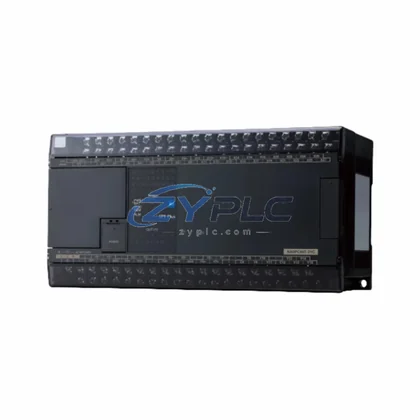
OMRON CP1E-E60SDR-A CPU Module for CP1E Automation
The OMRON CP1E-E60SDR-A is a high-performance, maintenance-focused CPU unit designed for compact industrial automation systems. As the processing core of the CP1E series, this module delivers precise motor control, streamlined I/O management, and real-time data processing — all while minimizing power draw across the production line. For factories seeking to reduce energy overhead without sacrificing throughput, the CP1E-E60SDR-A represents a proven, cost-effective solution.
With 60 I/O points (36 inputs / 24 relay outputs), built-in RS-232C and USB ports, and support for structured ladder programming, this CPU unit integrates seamlessly into existing OMRON control architectures. Its relay output configuration makes it particularly well-suited for applications requiring robust switching in motor starter circuits, conveyor control, and multi-axis sequencing — all areas where energy efficiency and cycle time directly impact operating costs.
Product Specification Table
| Parameter |
Specification |
| Model / SKU |
CP1E-E60SDR-A |
| Brand |
OMRON |
| Series |
CP1E |
| I/O Points |
60 (36 IN / 24 OUT Relay) |
| Power Supply |
AC 100–240V |
| Power Consumption |
≤ 60 VA (typical operating load) |
| Program Capacity |
8K Steps |
| Data Memory |
8K Words |
| Communication Ports |
USB (peripheral) + RS-232C |
| Compatible Systems |
CP1W expansion modules, CJ1W peripheral units, NS-series HMI |
| Application Environment |
0–55°C, 10–90% RH (non-condensing), IP20 |
| Maintenance Value |
Reduces idle-state power draw via optimized scan cycle management |
| Origin |
Japan |
| Warranty |
12 Months |
| Condition |
New / Tested before shipment |
System Compatibility and Application
The CP1E-E60SDR-A does not operate in isolation — its energy efficiency is amplified when deployed within a well-structured OMRON automation ecosystem. In a typical maintenance-focused production cell, the CPU unit coordinates with CP1W-AD041 analog input modules to continuously sample voltage and current signals from field sensors, enabling real-time power consumption tracking at the machine level. Paired with a CP1W-DA041 analog output module, the system can dynamically adjust setpoints to variable frequency drives, reducing motor load during low-load periods.
For drive-level efficiency, the CP1E-E60SDR-A integrates naturally with OMRON’s 3G3MX2 series inverters via RS-485 Modbus RTU communication through a CP1W-CIF11 RS-485 option board. This allows the CPU to issue speed reference commands and read back actual motor load data, enabling closed-loop maintenance planning without additional SCADA overhead. In conveyor and pump applications, this combination alone can help restore stable operation when a compatible replacement is required.
When the production line requires coordinated multi-axis motion, the CP1E-E60SDR-A can be expanded with CP1W-20EDT transistor output expansion units to drive pulse-train servo amplifiers. Connecting to OMRON’s R88D-KN series servo drives via the pulse interface allows precise positioning with minimal overshoot — reducing mechanical stress and the unplanned downtimed in deceleration braking cycles. For applications demanding higher I/O density, the CP1E-E40SDR-A can serve as a parallel node in a distributed control layout, sharing the same programming environment and communication backbone.
System-level energy visibility is further enhanced by integrating the KM50-E energy monitor, which connects to the CP1E network and logs per-circuit power data. This data feeds back into the CPU’s data memory, enabling conditional logic that shuts down non-critical loads during off-peak production windows. The NS5-SQ10B-V2 HMI panel provides operators with a real-time energy dashboard, displaying kWh consumption, motor load trends, and alarm states — all without requiring a separate SCADA server.
For facilities running mixed communication protocols, the CP1W-CIF01 RS-232C option board extends the CPU’s connectivity to legacy serial devices, barcode readers, and third-party instrumentation. This eliminates the need for protocol converters that introduce latency and consume additional panel power. The result is a leaner, faster, and more energy-transparent control architecture built around the CP1E-E60SDR-A as its central processing node.
Maintenance and Replacement Notes
In food and beverage packaging lines, the CP1E-E60SDR-A has been deployed to manage conveyor sequencing, filling station control, and reject gate actuation. By implementing time-based load shedding logic — automatically de-energizing idle conveyor segments during product changeovers — facilities have reported measurable reductions in standby power consumption. The relay output configuration handles the high-inrush currents of motor contactors directly, eliminating the need for intermediate relay panels and reducing panel heat dissipation.
In HVAC and building automation applications, the CP1E-E60SDR-A controls chiller staging, pump scheduling, and air handling unit sequencing. Its fast scan cycle (typically under 1 ms per 1K steps) ensures that PID control loops for temperature and pressure regulation respond quickly to setpoint deviations, preventing the energy-wasting overshoot cycles common in slower PLCs. When integrated with the 3G3MX2 inverter on pump motors, the system maintains optimal flow rates at minimum motor speed — a direct reduction in kWh per unit of output.
Predictive maintenance is another area where the CP1E-E60SDR-A contributes to maintenance planning. By monitoring motor run-hours, contactor cycle counts, and output current trends through the CP1W-AD041 analog inputs, maintenance teams can schedule interventions before equipment degradation causes efficiency losses. A motor running with worn bearings or misaligned couplings draws significantly more current than a well-maintained unit — catching these conditions early prevents both downtime and unplanned downtime.
Every CP1E-E60SDR-A unit shipped from our inventory undergoes full functional testing, including I/O verification, communication port checks, and program execution validation. Stock is maintained in climate-controlled storage to preserve component integrity. Orders are processed and dispatched within 1–3 business days, with tracking provided upon shipment. A warranty and support terms confirmed before quote covers all units against manufacturing defects and operational failures under normal industrial use conditions.
Product Sourcing FAQ
Q1: How much energy can the CP1E-E60SDR-A system save compared to a fixed-speed motor control setup?
When paired with a 3G3MX2 variable frequency drive and configured with load-adaptive speed control logic, motor operational stability of Actual operating results depend on the installed system, load profile, and commissioning parameters. Actual savings depend on load profile, duty cycle, and baseline motor efficiency. The CP1E-E60SDR-A provides the processing capability to implement and monitor these control strategies in real time.
Q2: Is the CP1E-E60SDR-A compatible with existing CP1E expansion modules and CP1W I/O units?
Yes. The CP1E-E60SDR-A supports the full range of CP1W expansion I/O modules, including analog (CP1W-AD041, CP1W-DA041, CP1W-MAD11), digital expansion (CP1W-20EDT), and communication option boards (CP1W-CIF01, CP1W-CIF11). It is also compatible with NS-series HMI panels via the peripheral USB port or RS-232C connection.
Q3: Can this unit replace an existing CP1E-E60SDR-A or similar CP1E CPU in a running production line?
Direct replacement is straightforward — the CP1E-E60SDR-A is a standard catalog unit with identical form factor and pinout to other CP1E E-type CPUs of the same I/O count. Program backup via CX-Programmer over USB takes under five minutes. We recommend verifying firmware version compatibility if the replacement unit will run programs developed on a significantly older CX-Programmer version.
Q4: What does the warranty and support terms confirmed before quote cover, and what is the testing process before shipment?
All units are tested for I/O functionality, communication port operation, and program execution prior to dispatch. The warranty and support terms confirmed before quote covers defects in materials and workmanship under normal operating conditions. It does not cover damage resulting from incorrect wiring, overvoltage events, or environmental exposure beyond the rated specifications (0–55°C, IP20). Warranty claims are processed within 5 business days of unit receipt.