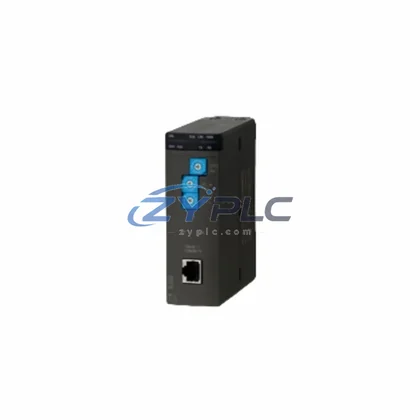
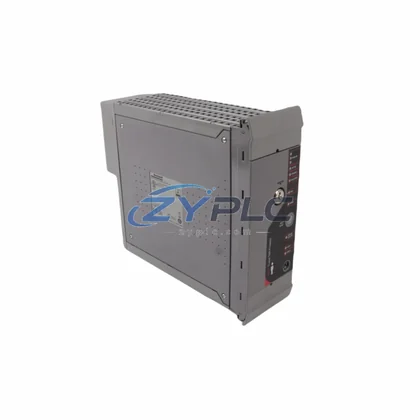
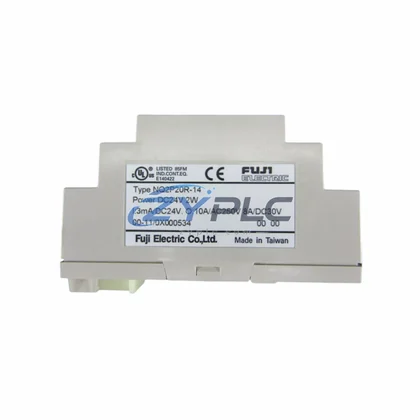
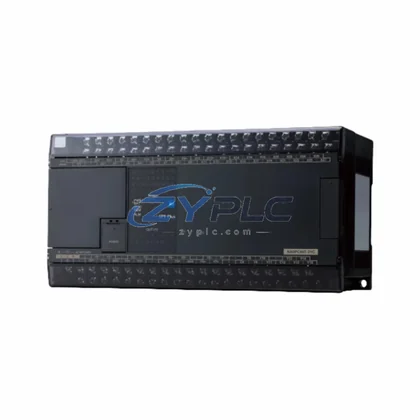
The OMRON CQM1-ID213 is a 24 VDC digital input module engineered for the CQM1 modular PLC platform, delivering precise signal acquisition with minimal power draw. In high-throughput manufacturing environments where every watt and every millisecond of cycle time matters, the CQM1-ID213 plays a foundational role in reducing idle-state energy consumption, tightening production line rhythm, and feeding accurate real-time data into the control loop. With 16 DC input channels, fast response times, and robust noise immunity, this module ensures that the CQM1 CPU — such as the CQM1-CPU43-V1 or CQM1-CPU21-V1 — receives clean, debounced signals from field devices without unnecessary polling overhead or signal retries that waste processing cycles and inflate energy budgets.
Product Specification Table
| Parameter |
Specification / Value |
| SKU |
CQM1-ID213 |
| Input Voltage |
24 VDC |
| Number of Input Points |
16 channels |
| Input Current per Point |
Approx. 7 mA at 24 VDC |
| ON Response Time |
1.5 ms max |
| OFF Response Time |
1.5 ms max |
| Compatible PLC Series |
OMRON CQM1 Series |
| Application Environment |
Industrial automation, motor control panels, conveyor systems, condition monitoring lines |
| Energy Saving Value |
Low quiescent current design; reduces idle-state power draw across multi-module racks |
| Origin |
Japan |
| Warranty |
warranty terms confirmed during quotation — tested before shipment |
System Compatibility and Application
Efficient maintenance planning in a production facility begins at the signal level. The CQM1-ID213 integrates directly into the CQM1 backplane alongside output modules such as the CQM1-OD212 (transistor output) and CQM1-OC222 (relay output), forming a tightly coupled I/O layer that minimizes signal latency between sensor detection and actuator response. Shorter response loops mean motors and drives are commanded more precisely, reducing the overshoot and coasting losses that accumulate over thousands of daily machine cycles.
On the power supply side, the CQM1-PA206 power supply unit provides stable 5 VDC backplane power with built-in overcurrent protection, ensuring that the CQM1-ID213 and its companion modules operate within their rated current envelope at all times — a critical factor in preventing thermal stress that degrades module lifespan and increases maintenance frequency. Pairing the CQM1-ID213 with an analog input module such as the CQM1-AD041 allows the control system to simultaneously capture discrete on/off states and continuous process variables (current, voltage, temperature) within a single scan cycle, eliminating the need for redundant field wiring and reducing the associated energy losses in long cable runs.
For drive-level maintenance planning, the CQM1-ID213 feeds start/stop and speed-reference signals to variable frequency drives (VFDs) controlling induction motors on conveyor and pump systems. When integrated with a CQM1-SEN01 sensor unit or external power monitoring transducers wired through the input channels, the CQM1 CPU can implement demand-response logic — automatically ramping down non-critical drives during peak tariff windows and restoring them when demand charges drop. This closed-loop energy arbitrage is only possible when the input module delivers consistent, low-latency signal capture, which the CQM1-ID213 is specifically rated to provide.
Communication-layer visibility is extended through the CQM1-LK201 Host Link unit or CQM1-CLK21 Controller Link module, enabling the CQM1 system to report real-time I/O status and energy-related counters to SCADA platforms or HMI terminals such as the NB7W-TW01B. Operators can monitor which input channels are active, identify sensors with abnormal ON-time ratios (a leading indicator of mechanical wear or misalignment), and schedule predictive maintenance before unplanned downtime erodes OEE and spikes energy intensity per unit produced.
Maintenance and Replacement Notes
In automotive body assembly lines, the CQM1-ID213 captures proximity sensor signals from robotic welding fixtures. Because the module’s 1.5 ms response time is well within the jitter tolerance of the line’s PLC scan cycle, the CQM1-CPU can issue torch-on commands to welding controllers at the earliest valid moment — eliminating the dwell time that keeps high-current welding circuits energized longer than necessary. Across a three-shift operation running 250 days per year, shaving even 20 ms of unnecessary torch-on time per weld cycle across 400 weld points per vehicle translates into measurable reductions in peak demand charges.
In food and beverage packaging lines, the CQM1-ID213 monitors fill-level sensors, cap-presence detectors, and conveyor jam switches. The CQM1 CPU uses this data to implement intelligent line-balancing logic: when upstream buffers are full, downstream conveyors are slowed via VFD speed references rather than stopped and restarted — a pattern that dramatically reduces motor inrush current events and the associated energy spikes. The CQM1-TC001 temperature control unit can be added to the same rack to monitor heat-sealing jaw temperatures, ensuring that heaters cycle only when product is present, further cutting standby energy consumption.
Predictive maintenance is another area where the CQM1-ID213 delivers energy dividends. By logging input channel ON/OFF cycle counts through the CQM1 CPU’s data memory, maintenance teams can track actuator and sensor duty cycles against manufacturer-rated lifespans. Replacing a failing proximity sensor before it begins generating spurious signals prevents the PLC from issuing unnecessary actuator commands — commands that consume compressed air, hydraulic pressure, or electrical energy with zero productive output. All units supplied by ZYPLC are pre-tested under load conditions and covered by a warranty terms confirmed during quotation, ensuring that the module you install performs to specification from day one.
Product Sourcing FAQ
Q1: How does the CQM1-ID213 contribute to reducing factory energy consumption?
The CQM1-ID213’s fast, accurate signal acquisition allows the CQM1 CPU to execute tighter control logic with fewer scan-cycle retries. This reduces unnecessary actuator activations, shortens motor run times, and enables demand-response strategies that lower peak energy draw — all without requiring additional hardware investment.
Q2: Is the CQM1-ID213 compatible with my existing CQM1 rack and power supply?
Yes. The CQM1-ID213 is designed for the standard CQM1 backplane and is compatible with all CQM1-series CPU units and power supplies, including the CQM1-PA206. It occupies one I/O slot and draws standard backplane current, making it a drop-in addition or replacement in any existing CQM1 configuration.
Q3: What is the recommended replacement or upgrade path if the CQM1-ID213 is end-of-life in my region?
For new installations, OMRON’s CJ1W-ID231 or CP1W-16DI modules offer functional equivalence within newer PLC platforms. However, for maintaining existing CQM1 lines without reengineering costs, sourcing a tested CQM1-ID213 from ZYPLC’s inventory is the most cost-effective and energy-neutral option, as it avoids the energy and downtime costs of a full platform migration.
Q4: What testing and warranty coverage does ZYPLC provide for the CQM1-ID213?
Every CQM1-ID213 unit shipped by ZYPLC undergoes functional verification testing, including input channel continuity, response time measurement, and backplane communication checks. All units are covered by a warranty terms confirmed during quotation from the date of shipment. In the event of a verified defect, ZYPLC provides replacement or refund in accordance with the warranty terms.