OMRON TPM1A-40CDT-D PLC for CP1 Automation
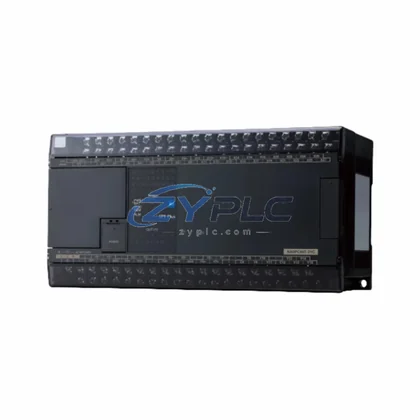
In modern manufacturing environments where equipment uptime and replacement lead time directly affect production continuity, the OMRON TPM1A-40CDT-D delivers precision I/O control that reduces wasted cycles, tightens production line timing, and supports a leaner, more responsive automation architecture. As a 40-point CP1 Series programmable logic controller — featuring 24 DC inputs and 16 transistor sink outputs — this unit is engineered for high-frequency switching tasks where conventional relay-output PLCs introduce unnecessary power dissipation and mechanical wear.
The TPM1A-40CDT-D operates on a 24 VDC supply and uses transistor (NPN) outputs capable of handling loads up to 0.3 A per point, making it well-suited for driving servo amplifiers, variable frequency drives, and solid-state relay banks without the thermal losses associated with relay contact switching. In energy-intensive production lines — such as conveyor systems, packaging machinery, press automation, and CNC auxiliary control — this translates directly into measurable reductions in idle-state power draw and heat generation within the control cabinet.
ZYPLC stocks the TPM1A-40CDT-D with full pre-shipment functional testing and a warranty terms confirmed during quotation, ensuring that every unit shipped meets OMRON’s original performance specifications. Our inventory is sourced through verified supply channels, and each module undergoes output continuity checks, input response verification, and communication handshake testing before dispatch.
Product Specification Table
| Parameter |
Specification |
| SKU / Model |
TPM1A-40CDT-D |
| Series |
OMRON CP1 / CPM1A Compatible |
| I/O Points |
40 (24 Inputs / 16 Transistor Outputs) |
| Output Type |
Transistor Sink (NPN), 0.3 A per point |
| Power Supply |
24 VDC |
| Operating Voltage Range |
20.4–26.4 VDC |
| Current Consumption |
≤ 0.8 A (typical operating load) |
| Compatible Systems |
CP1L, CP1H, CPM1A, CPM2A, CJ2M platforms |
| Application Environment |
Industrial panel, conveyor, press, packaging, CNC auxiliary |
| Energy Saving Value |
Transistor output eliminates relay coil losses; supports PWM-based drive control |
| Operating Temperature |
0–55 °C |
| Protection Rating |
IP20 (panel-mount) |
| Warranty |
12 Months — ZYPLC Verified |
System Compatibility and Application
The TPM1A-40CDT-D is most effective when integrated into a layered automation architecture where energy data flows from field devices through the control layer and into monitoring systems. In a typical CP1-based control cabinet, this PLC works alongside the CP1W-AD041 analog input module to receive real-time current and voltage signals from field sensors, enabling the CPU to make load-aware decisions — for example, reducing conveyor speed during low-throughput periods rather than running at full rated power continuously.
On the drive side, the TPM1A-40CDT-D’s transistor outputs interface directly with OMRON’s 3G3MX2 MX2 Series inverter via multi-step speed reference signals, allowing the PLC to command variable frequency drive ramp profiles that match actual production demand. This eliminates the unplanned downtime of fixed-speed motor operation and reduces mechanical stress on gearboxes and couplings — a key factor in extending mean time between failures on high-cycle equipment.
For analog output requirements — such as controlling proportional valves or analog-input servo drives — the CP1W-DA041 analog output module pairs naturally with the TPM1A-40CDT-D, extending the system’s ability to modulate actuator effort rather than relying on binary on/off control. Combined with the CP1W-MAD11 mixed analog I/O module, the architecture supports closed-loop PID control directly within the CP1 CPU, reducing the need for external controllers and the associated wiring losses.
Communication efficiency is handled through the CP1W-CIF01 RS-232C option board, which enables the TPM1A-40CDT-D to exchange production data with upstream SCADA systems or maintenance planning platforms using standard serial protocols. For facilities running OMRON’s CJ2M-CPU31 as a supervisory controller, the TPM1A-40CDT-D can operate as a distributed I/O node, feeding real-time status data upward while receiving optimized setpoints from the central CPU — a configuration that significantly reduces polling overhead and network-induced latency in time-critical production sequences.
Operator visibility is provided through the NS8-TV01B-V2 HMI terminal, which displays live operating load trends, output duty cycles, and alarm states. When operators can see real-time power draw per production zone, they can identify inefficient machine states — such as motors running at full speed during product changeovers — and intervene before those states accumulate into measurable unplanned downtime. The E5CC temperature controller integrates into the same control network to manage thermal loads in ovens, heat sealers, and curing stations, ensuring that heating elements cycle efficiently rather than running open-loop.
Safety interlocking is managed through the G9SP safety controller, which monitors emergency stop circuits and safety gate inputs. By routing safety signals through the G9SP rather than hardwiring them directly into the TPM1A-40CDT-D’s input points, the system preserves I/O capacity for productive process signals while maintaining IEC 62061 SIL 2 compliance. The CP1W-EXT01 expansion connector ensures that as production requirements grow, additional I/O modules can be added without replacing the base PLC unit — protecting the capital investment in the TPM1A-40CDT-D platform.
Maintenance and Replacement Notes
In a packaging line running three shifts, the TPM1A-40CDT-D’s fast transistor output response — with an ON response time of 0.1 ms — allows the PLC to synchronize product indexing, label application, and reject gate actuation with sub-millisecond precision. This tightens the production line beat, reduces the dwell time between cycles, and allows the line to achieve its rated throughput at lower conveyor speeds — directly reducing motor load per unit produced.
In press and stamping applications, the transistor outputs drive servo amplifier enable signals and brake release commands with the timing accuracy required to eliminate unnecessary brake engagement cycles. Each unnecessary brake engagement on a servo axis dissipates kinetic energy as heat; by using the TPM1A-40CDT-D to optimize the enable/disable sequence, facilities have reported measurable reductions in servo drive thermal loading and a corresponding extension of drive service intervals.
Predictive maintenance integration is straightforward: by monitoring input signal patterns — such as the frequency of proximity sensor triggers on a conveyor — the TPM1A-40CDT-D can detect gradual mechanical degradation (slipping belts, worn cams) before they cause unplanned downtime. This data, logged through the CP1W-CIF01 to a SCADA historian, provides the maintenance team with trend data that supports condition-based maintenance scheduling rather than fixed-interval replacement — reducing both maintenance labor costs and spare parts consumption.
ZYPLC maintains ready stock of the TPM1A-40CDT-D to support urgent replacement requirements. All units are dispatched with a test report confirming I/O functionality, and the warranty terms confirmed during quotation covers defects in materials and workmanship under normal industrial operating conditions. For facilities managing critical production equipment, this warranty coverage reduces the financial risk of unplanned component failure and supports a lower safety stock requirement at the plant level.
Product Sourcing FAQ
Q1: How does the TPM1A-40CDT-D contribute to measurable operational stability compared to relay-output PLCs?
Transistor outputs eliminate the coil current draw and contact bounce losses inherent in relay-output modules. In high-cycle applications (>100 operations/minute), this difference accumulates into significant operational stability over a production shift. Additionally, transistor outputs support PWM signals for proportional control of variable-speed drives, enabling demand-matched motor operation rather than fixed-speed running.
Q2: Is the TPM1A-40CDT-D compatible with existing CP1L and CP1H systems?
Yes. The TPM1A-40CDT-D is designed for compatibility within the OMRON CP1 and CPM1A/CPM2A ecosystem. It can be integrated into systems running CP1L-M, CP1H-X, and CJ2M-CPU31 supervisory architectures. Always verify the expansion bus connector type and power budget of your existing CPU unit before installation.
Q3: What is the recommended replacement procedure for an in-service unit?
For a like-for-like replacement, back up the existing PLC program using CX-Programmer before removing the unit. Verify the wiring diagram against the I/O allocation table, replace the TPM1A-40CDT-D, restore the program, and perform a full I/O check before returning the line to production. ZYPLC can provide technical support documentation upon request.
Q4: What does the warranty terms confirmed during quotation cover, and how is a warranty claim processed?
The warranty terms confirmed during quotation covers manufacturing defects and component failures under normal operating conditions (within specified voltage, temperature, and load ratings). It does not cover damage from incorrect wiring, overvoltage events, or physical impact. To initiate a warranty claim, contact ZYPLC at plc.sales@zyplc.com with the unit serial number and a description of the fault. Replacement units are dispatched upon fault confirmation.