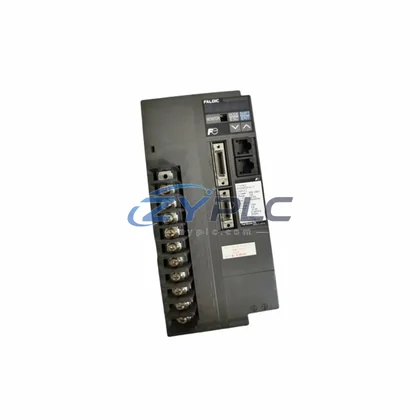
Parker C3S300V4F11 I31 T30 M00 A42: Industrial Data Link for Compax3 Smart Factory Systems
The Parker C3S300V4F11 I31 T30 M00 A42 is a high-performance servo drive from Parker Hannifin’s renowned Compax3 Series, engineered to serve as a critical industrial network interface node within modern smart factory architectures. Rated at 3 kVA continuous output power and designed for seamless integration across multi-axis motion control platforms, this drive delivers deterministic real-time communication, precision torque and velocity regulation, and robust fieldbus connectivity that bridges field-level devices with supervisory control systems. Whether deployed in packaging lines, semiconductor handling equipment, printing machinery, or precision assembly cells, the C3S300V4F11 I31 T30 M00 A42 functions as the backbone of a connected automation data chain — from sensor signal acquisition all the way to SCADA dashboards and MES reporting layers.
In today’s industrial environment, the ability to move data reliably across heterogeneous networks is as important as the mechanical performance of the drive itself. The Compax3 C3S300V4F11 I31 T30 M00 A42 addresses this need with native EtherCAT and CANopen fieldbus support, enabling sub-millisecond cycle times and synchronized multi-axis coordination across distributed control architectures. This makes it an ideal component for facilities transitioning from isolated machine islands to fully transparent, data-driven production environments.
Compatibility & Integration Notes
| Parameter |
Specification |
| SKU |
C3S300V4F11 I31 T30 M00 A42 |
| Brand / Series |
Parker Hannifin / Compax3 |
| Communication Protocols |
EtherCAT, CANopen DS402 |
| Interface Type |
EtherCAT RJ45 (IN/OUT), CAN Sub-D9 |
| Fieldbus Cycle Time |
≤ 1 ms (EtherCAT); ≤ 1 ms (CANopen) |
| Network Topology |
Line, Ring (EtherCAT); Bus (CANopen) |
| Motion Profile Support |
CSP, CSV, CST (Cyclic Sync), Homing, PT, PVT |
| System Compatibility |
Parker ACR Series, Siemens TIA Portal (via gateway), Beckhoff TwinCAT, CODESYS |
| SCADA / HMI Integration |
OPC UA (via gateway), Modbus TCP (via gateway), Parker HMI C3 ServoManager |
| Continuous Output Power |
3 kVA |
| Supply Voltage |
3 × 200–480 VAC, 50/60 Hz |
| Product Type |
Servo Drive |
| Origin |
USA |
| Warranty |
12 Months |
| Availability |
RFQ Available — shipment arranged after confirmation |
Connected Automation Data Flow
The C3S300V4F11 I31 T30 M00 A42 sits at the intersection of motion execution and industrial data communication. In a typical smart factory deployment, the data flow begins at the sensor layer: encoders, resolvers, and linear scales feed position and velocity feedback directly into the drive’s high-resolution feedback interface. This real-time signal acquisition is processed internally at the drive’s servo loop level, with position data simultaneously forwarded upstream via the EtherCAT network to the master controller.
At the controller level, the Parker ACR9000 or ACR7000 multi-axis motion controller acts as the EtherCAT master, orchestrating synchronized motion across multiple Compax3 drives — including the C3S150V4, C3S450V4, and C3S075V4 variants — within the same network segment. The deterministic EtherCAT bus ensures that position commands, torque limits, and fault status are exchanged within a single 1 ms cycle, enabling tight electronic gearing and cam profiling across axes without jitter.
For facilities using CANopen DS402 as the primary fieldbus, the C3S300V4F11 I31 T30 M00 A42 integrates directly with CANopen master PLCs such as the Parker P-Series or third-party controllers from Beckhoff and B&R. The drive’s CANopen node address and baud rate are configurable via the Parker C3 ServoManager software, which also provides real-time oscilloscope views of torque, velocity, and position traces — a critical tool for commissioning and remote diagnostics.
Moving up the network hierarchy, an industrial Ethernet switch — such as a managed DIN-rail switch supporting IEEE 802.3 with IGMP snooping — aggregates EtherCAT segments and connects them to the plant’s SCADA backbone. At this layer, a protocol gateway (e.g., a Moxa MGate or HMS Anybus X-gateway) translates EtherCAT process data into Modbus TCP or OPC UA tags, making drive status, fault codes, and energy consumption data available to SCADA platforms such as Wonderware, Ignition, or Siemens WinCC. HMI panels on the production floor — including Parker’s own C3 HMI terminals — display live axis status, alarm histories, and production counters sourced directly from the drive’s process data objects (PDOs).
For remote I/O expansion, the Compax3 network architecture supports coupling with EtherCAT I/O terminals (e.g., Beckhoff EK1100 coupler with EL series modules), allowing digital and analog field signals from proximity sensors, pressure transducers, and temperature probes to be routed through the same EtherCAT segment as the servo drives. This unified data path eliminates the need for separate fieldbus wiring and reduces cabinet complexity. At the edge, an industrial edge gateway running IEC 61131-3 soft PLC logic can buffer drive data locally and push aggregated metrics to cloud MES or ERP systems via MQTT or REST APIs — completing the data chain from motor shaft to enterprise dashboard.
Solving Data Isolation in Industrial Sites
One of the most persistent challenges in industrial automation is the coexistence of legacy equipment running proprietary protocols alongside modern EtherCAT or Ethernet/IP networks. The Parker Compax3 C3S300V4F11 I31 T30 M00 A42 addresses this directly through its dual-protocol architecture: EtherCAT for high-speed deterministic motion control and CANopen for compatibility with existing machine bus infrastructure. This means facilities do not need to replace their entire control architecture to benefit from real-time network performance — the drive bridges both worlds simultaneously.
Data silos are another common pain point. When servo drives operate as standalone units without network integration, fault events, energy data, and production counts remain trapped inside the drive and are invisible to plant management systems. The C3S300V4F11 I31 T30 M00 A42 eliminates this isolation by exposing all drive parameters — including DC bus voltage, motor temperature, following error, and fault history — as network-accessible objects via CANopen SDOs or EtherCAT CoE (CANopen over EtherCAT) mailbox communication. SCADA engineers can map these objects directly to historian tags, enabling trend analysis, predictive maintenance alerts, and OEE calculations without any additional hardware.
Remote monitoring and diagnostics are further enhanced by the Parker C3 ServoManager software, which supports remote connection over TCP/IP when paired with a suitable serial-to-Ethernet converter or direct Ethernet interface. Maintenance teams can read fault logs, adjust control parameters, and perform test runs from a central engineering workstation — reducing unplanned downtime and eliminating the need for on-site intervention for routine parameter changes. For production line transparency, the drive’s real-time PDO data can feed directly into MES dashboards, providing shift supervisors with live visibility into cycle counts, axis utilization rates, and alarm frequencies. System expansion is equally straightforward: additional Compax3 drives can be added to the EtherCAT ring without reconfiguring the master controller, as the EtherCAT topology supports hot-connect segments in compatible configurations.
Industrial Connectivity FAQ
Q1: What is the minimum EtherCAT cycle time supported by the C3S300V4F11 I31 T30 M00 A42, and does it affect motion synchronization?
The Compax3 C3S300V4F11 I31 T30 M00 A42 supports EtherCAT cycle times as low as 1 ms in Cyclic Synchronous Position (CSP), Velocity (CSV), and Torque (CST) modes. At this cycle time, distributed clock synchronization (DC sync) ensures that all drives on the EtherCAT segment execute their position updates within nanosecond-level jitter, making it suitable for high-precision multi-axis electronic gearing and cam applications.
Q2: Is the C3S300V4F11 I31 T30 M00 A42 compatible with third-party PLCs and SCADA systems that do not natively support EtherCAT?
Yes. While the drive natively supports EtherCAT and CANopen, integration with Modbus TCP, PROFINET, or OPC UA-based SCADA systems is achievable through protocol gateways such as the HMS Anybus X-gateway or Moxa MGate series. These gateways translate EtherCAT or CANopen process data into the target protocol transparently, allowing the drive to appear as a standard Modbus register map or OPC UA node to the supervisory system.
Q3: How is network stability maintained in high-vibration or electrically noisy industrial environments?
The Compax3 series is designed for industrial EMC compliance (CE, UL). EtherCAT communication uses standard shielded Cat5e/Cat6 cables with RJ45 connectors, and the drive’s internal EMC filter suppresses conducted interference on the power supply lines. For CANopen networks, proper termination resistors (120 Ω at each bus end) and shielded twisted-pair cables are recommended to maintain signal integrity at baud rates up to 1 Mbit/s. The drive also supports watchdog timers on both fieldbus interfaces, triggering a configurable safe-state response if network communication is interrupted.
Q4: What does the warranty terms confirmed during quotation cover, and how is the unit tested before shipment?
Every Parker C3S300V4F11 I31 T30 M00 A42 unit supplied by ZYPLC undergoes a pre-shipment functional test covering power-on self-test, fieldbus communication verification, and basic motion response validation. The warranty terms confirmed during quotation covers manufacturing defects and component failures under normal operating conditions. Units are shipped in anti-static packaging with full documentation. For warranty claims or technical support, contact ZYPLC directly at plc.sales@zyplc.com or +86 19859288691.