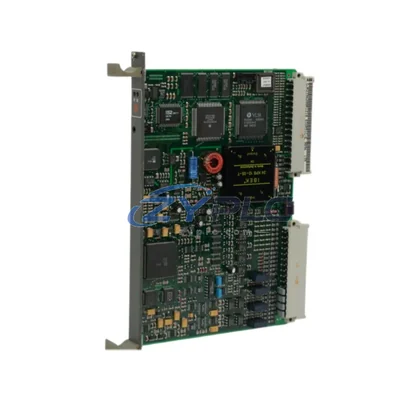
ProSoft MVI46-MCM Communication Module for SLC 500
The ProSoft MVI46-MCM is a high-performance Modbus master/slave communication module engineered for seamless integration within the Allen-Bradley SLC 500 control platform. Designed to occupy a single slot in the SLC 500 chassis, this module bridges legacy Modbus RTU and Modbus ASCII serial networks directly into the SLC 500 backplane, enabling real-time data exchange between the processor and distributed field devices without requiring external protocol converters or standalone gateways.
In modern layered automation architectures, reliable communication between the control layer and the I/O or field device layer is critical for maintaining process consistency, diagnostic transparency, and system-wide data integrity. The MVI46-MCM addresses this requirement by supporting up to two independent serial ports, each configurable as a Modbus master or Modbus slave. This dual-port architecture allows the module to simultaneously poll remote Modbus devices—such as variable frequency drives, power meters, temperature controllers, and intelligent field transmitters—while also responding to supervisory requests from SCADA or HMI platforms operating on a separate Modbus network.
Product Specification Table
| Parameter |
Specification |
| System Role |
Modbus Master/Slave Communication Interface |
| Compatible Platform |
Allen-Bradley SLC 500 (1746 Chassis) |
| Communication Protocols |
Modbus RTU, Modbus ASCII |
| Serial Ports |
2 × Configurable RS-232/RS-485 |
| Backplane Data Transfer |
Up to 4000 words per port (read/write) |
| Baud Rate |
110 bps to 115.2 kbps |
| Power Supply |
Backplane powered via SLC 500 chassis |
| Operating Temperature |
0°C to 60°C |
| Certifications |
UL, CE, CSA |
| Warranty |
warranty terms confirmed during quotation |
System Compatibility Notes
Within a complete SLC 500 control system architecture, the MVI46-MCM operates as the primary communication bridge between the central processor and serial-based field networks. The Allen-Bradley 1747-L553 SLC 5/05 processor typically serves as the system controller, executing ladder logic and managing data tables that the MVI46-MCM reads from and writes to across the backplane. Power for the entire rack assembly is delivered by the 1746-P2 Power Supply, which provides regulated DC voltage to all modules installed in the chassis.
For digital and analog signal acquisition, the system commonly incorporates 1746-IB16 DC Input modules and 1746-OB16 DC Output modules to handle discrete control functions, while 1746-NI4 Analog Input modules manage process variable monitoring from 4–20 mA transmitters and RTD sensors. These I/O modules share the same backplane as the MVI46-MCM, ensuring deterministic data throughput between the communication layer and the control layer.
When the architecture requires Ethernet connectivity for SCADA integration or remote programming, the ProSoft MVI46-MNET Modbus TCP/IP module can be deployed alongside the MVI46-MCM, creating a dual-network communication topology that supports both serial and Ethernet-based Modbus devices within the same rack. For applications demanding DeviceNet connectivity to distributed motor starters or pneumatic valve manifolds, the 1747-SDN DeviceNet Scanner module extends the SLC 500 system reach into the device-level network layer.
In larger installations where multiple SLC 500 racks must coordinate, the 1746-BAS BASIC Module or additional communication modules facilitate inter-rack data sharing and custom protocol handling. The physical infrastructure relies on the 1746-A13 13-Slot Chassis to house all modules, with the backplane serving as the high-speed data highway connecting every component in the rack.
Operator interface is typically provided by an Allen-Bradley PanelView Plus HMI terminal, which communicates with the SLC 5/05 processor via Ethernet or DH-485 to display real-time process data, alarm status, and diagnostic information sourced from the Modbus network through the MVI46-MCM. This layered approach—where the communication module feeds field data to the processor, which in turn serves the HMI—ensures clean separation of concerns and simplifies troubleshooting during commissioning and ongoing maintenance.
Industrial Application Notes
The ProSoft MVI46-MCM finds extensive deployment across industries where legacy Modbus serial devices must be integrated into centralized SLC 500 control platforms. In water and wastewater treatment facilities, the module connects flow meters, level transmitters, and chemical dosing pumps operating on Modbus RTU networks to the central PLC, enabling automated process control with full supervisory visibility. Municipal pump stations frequently rely on this module to aggregate data from multiple remote terminal units distributed across geographically dispersed sites.
In manufacturing environments—particularly packaging lines, material handling systems, and batch processing plants—the MVI46-MCM enables the SLC 500 controller to communicate with third-party drives, temperature controllers, and condition monitoring devices that use Modbus as their native protocol. This eliminates the need for costly equipment replacement when upgrading control system capabilities, preserving capital investment in existing field instrumentation.
Power generation and distribution facilities utilize the module to interface protective relays, power quality analyzers, and generator controllers with the plant-level SLC 500 automation system. The dual-port configuration is particularly valuable in these applications, allowing one port to serve as a Modbus master polling field devices while the second port operates as a slave responding to the plant SCADA system.
Oil and gas operations, mining ventilation control systems, and metallurgical process lines also benefit from the MVI46-MCM’s ability to consolidate serial Modbus data into the SLC 500 architecture, reducing wiring complexity and improving diagnostic access to remote instrumentation.
Product Compatibility FAQ
Q1: Is the MVI46-MCM compatible with all SLC 500 processors, and what chassis configurations are supported?
A: The MVI46-MCM is compatible with SLC 5/03, SLC 5/04, and SLC 5/05 processors. It installs in any available slot of a standard 1746-series chassis, including the 1746-A4, 1746-A7, and 1746-A13 configurations. The module is backplane-powered and requires no external power supply. Configuration is performed through ProSoft Configuration Builder software, with data exchange managed via M0/M1 files in the SLC processor.
Q2: How does the MVI46-MCM integrate with existing Ethernet-based SCADA systems alongside serial Modbus networks?
A: The module handles serial Modbus communication while Ethernet connectivity is managed by the SLC 5/05 processor’s built-in Ethernet port or a dedicated MVI46-MNET Modbus TCP module. Data acquired by the MVI46-MCM from serial devices is written to SLC data tables, which are then accessible to SCADA systems via Ethernet. This architecture maintains protocol separation while ensuring unified data availability at the supervisory level.
Q3: What warranty and long-term support does ZYPLC provide for the MVI46-MCM?
A: Every MVI46-MCM supplied by ZYPLC includes a warranty terms confirmed during quotation covering manufacturing defects and functional failures under normal operating conditions. Our technical support team assists with system configuration, architecture compatibility verification, and commissioning guidance. Inventory is maintained for shipment arranged after confirmation to minimize project downtime.