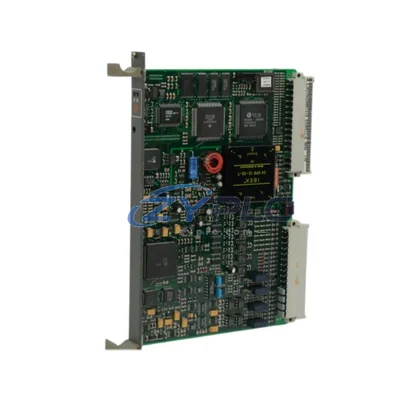
ProSoft MVI56-101M Communication Module for ControlLogix
In modern industrial automation, no component operates in isolation. The ProSoft MVI56-101M is a Modbus master/slave communication module purpose-built for Allen-Bradley ControlLogix backplane environments, and its value is best understood not as a standalone device, but as a critical node within a layered control system architecture. From the controller layer down through I/O, network, power, HMI, and field execution layers, the MVI56-101M delivers the protocol bridging and data integrity that keeps every tier of the system synchronized, responsive, and maintainable over the long term.
Product Specification Table
| Parameter |
Specification |
| System Role |
Modbus Master / Slave Communication Module |
| Host Platform |
Allen-Bradley ControlLogix (MVI56 Series) |
| Backplane Interface |
ControlLogix 1756 backplane, single slot |
| Protocol Support |
Modbus RTU, Modbus ASCII (Master & Slave) |
| Serial Ports |
2 × RS-232/RS-422/RS-485 configurable ports |
| Data Transfer Rate |
300 bps to 115.2 kbps |
| Internal Data Memory |
Up to 5,000 registers (read/write blocks) |
| Power Consumption |
800 mA @ 5 VDC (backplane supplied) |
| Operating Temperature |
0°C to 60°C (32°F to 140°F) |
| Relative Humidity |
5% to 95% non-condensing |
| Mounting |
ControlLogix chassis (e.g., 1756-A4, 1756-A7, 1756-A13) |
| Communication Isolation |
Optical isolation on serial ports |
| system integration |
Full system integration with ControlLogix tag database via ladder logic MSG instructions |
| Warranty |
warranty terms confirmed during quotation — all units supplied by ZYPLC |
System Compatibility Notes
The MVI56-101M is designed to slot directly into a ControlLogix chassis alongside the system’s primary CPU — such as the 1756-L72 or 1756-L74 — without requiring any external conversion hardware. This tight backplane integration means that Modbus data is exchanged with the controller’s tag database in real time, enabling deterministic scan-cycle performance that standalone serial converters simply cannot match.
Power architecture is equally important to system reliability. The MVI56-101M draws its operating power from the ControlLogix backplane, which is supplied by a dedicated chassis power supply such as the 1756-PA75 (120/240 VAC input) or the 1756-PB75 (24 VDC input). This eliminates the need for a separate 24 VDC rail for the communication module itself, simplifying cabinet wiring and reducing potential failure points in the power distribution layer.
On the I/O layer, the MVI56-101M works in concert with analog and digital I/O modules mounted in the same or extended chassis. Modules such as the 1756-IF16 (16-channel analog input) and 1756-OB16E (16-channel digital output, electronically fused) share the same backplane bus, and the MVI56-101M’s Modbus master capability allows it to poll field instruments — flow meters, pressure transmitters, variable frequency drives — and write their values directly into the controller’s I/O image table. This creates a unified data environment where process values from legacy Modbus devices appear alongside native ControlLogix I/O without any additional middleware.
For Ethernet-based network layers, the MVI56-101M complements EtherNet/IP infrastructure modules such as the 1756-EN2T. While the EN2T handles high-speed EtherNet/IP communications to SCADA systems, historian servers, and remote I/O adapters, the MVI56-101M manages the serial Modbus segment — older field instruments, third-party meters, and legacy RTUs — ensuring that no device is left outside the control architecture regardless of its protocol generation. This dual-network approach is common in power generation, water treatment, and petrochemical facilities where equipment lifecycles span decades.
Wiring termination is handled through the 1756-TBCH or equivalent removable terminal blocks, which allow field wiring to remain in place during module replacement — a critical advantage during planned maintenance windows. In redundant system designs, a secondary ControlLogix chassis equipped with an identical MVI56-101M and a 1756-RM2 redundancy module can take over communication responsibilities within milliseconds of a primary chassis fault, maintaining Modbus polling continuity without operator intervention.
HMI integration is achieved through the ControlLogix tag server, which exposes MVI56-101M data blocks to operator stations running PanelView Plus 7 terminals or FactoryTalk View SE clients. Because the Modbus data is mapped into standard ControlLogix tags, HMI configuration requires no custom OPC drivers or protocol translators — the same tag names used in ladder logic appear directly in the HMI development environment, accelerating commissioning and reducing configuration errors.
For DeviceNet field bus segments, the 1756-DNB DeviceNet scanner module can coexist in the same chassis, allowing the MVI56-101M to handle Modbus serial devices while the DNB manages smart actuators and distributed I/O nodes on the DeviceNet network. This multi-protocol chassis architecture is a hallmark of mature ControlLogix system design and is fully supported by the MVI56-101M’s non-intrusive backplane communication model.
Industrial Application Notes
The MVI56-101M finds its most demanding applications in industries where legacy serial devices must coexist with modern Ethernet-based control infrastructure. In power generation and electrical substation automation, the module bridges Modbus RTU energy meters, protection relays, and transformer monitoring units into the ControlLogix environment, enabling centralized SCADA visibility without replacing field instrumentation. Utilities operating IEC 61850 substations frequently retain Modbus serial segments for legacy bay controllers, and the MVI56-101M provides the reliable, isolated serial interface required for these mixed-protocol environments.
In petrochemical and refinery process control, the MVI56-101M integrates Modbus-capable analyzers, flow computers, and custody transfer meters into the plant DCS or PLC architecture. Its optical isolation on serial ports protects the ControlLogix backplane from ground loops and electrical noise common in hazardous area cable runs, while its configurable baud rate and parity settings accommodate the full range of legacy instrument configurations found across aging process units.
For municipal water and wastewater treatment facilities, the module enables ControlLogix systems to communicate with Modbus-based pump controllers, chemical dosing systems, and level transmitters distributed across large geographic sites. Its master/slave flexibility allows a single MVI56-101M to simultaneously poll multiple remote devices while also responding as a slave to a supervisory SCADA master — a dual-role capability that reduces module count and simplifies cabinet layouts in remote pump stations.
In mining and metallurgical processing, where conveyor drives, crusher controls, and flotation cell instrumentation often use Modbus RTU as their native protocol, the MVI56-101M provides the robust serial communication backbone that keeps production data flowing to the control room. Its wide operating temperature range and vibration tolerance make it suitable for installation in motor control centers and field junction boxes in harsh mining environments.
Packaging and discrete manufacturing lines benefit from the MVI56-101M’s ability to integrate Modbus-capable vision systems, barcode readers, and third-party servo drives into the ControlLogix architecture, enabling coordinated motion and inspection data to be processed within a single controller scan cycle.
Product Compatibility FAQ
Q1: Is the MVI56-101M compatible with all ControlLogix chassis sizes, and can it be used in a redundant controller configuration?
The MVI56-101M is compatible with all standard ControlLogix chassis, including the 1756-A4, 1756-A7, 1756-A10, and 1756-A13. In redundant configurations using the 1756-RM2 redundancy module, a matched pair of MVI56-101M modules — one in each chassis — maintains Modbus communication continuity during controller switchover. ProSoft’s module firmware supports the ControlLogix redundancy framework, and ZYPLC can supply matched pairs with verified firmware versions to ensure seamless redundant operation. All units are covered by a warranty terms confirmed during quotation from date of shipment.
Q2: How does system integration work between the MVI56-101M and the ControlLogix tag database, and what ladder logic is required?
system integration is achieved through ProSoft’s standard ladder logic template, which uses MSG instructions to move data between the MVI56-101M’s internal register memory and ControlLogix controller tags. The module maps Modbus holding registers, input registers, coils, and discrete inputs into defined data arrays within the controller’s tag database. Engineers configure the module via ProSoft Configuration Builder (PCB) software, defining poll lists, node addresses, function codes, and register mappings. No custom function blocks or third-party middleware are required — the integration is entirely native to the ControlLogix programming environment, making it straightforward to commission and maintain.
Q3: What is the long-term maintenance and supply strategy for the MVI56-101M, and what does the warranty terms confirmed during quotation cover?
ZYPLC supports RFQ sourcing for the MVI56-101M to support both new system builds and long-term maintenance requirements. The warranty terms confirmed during quotation covers manufacturing defects, firmware integrity, and electrical performance from the date of shipment. In the event of a warranty claim, ZYPLC provides advance replacement to minimize system downtime. For installations requiring extended lifecycle support beyond the warranty period, ZYPLC offers supply continuity agreements that guarantee module availability for planned maintenance cycles. Customers are encouraged to contact ZYPLC’s technical team to discuss sparing strategies aligned with their plant maintenance schedules.