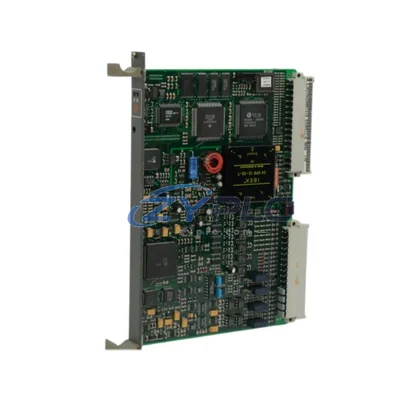
Saia Burgess PCD2.F522 Communication Interface for PCD2
The Saia Burgess PCD2.F522 is a dedicated serial communication interface module engineered for seamless integration within the PCD2 modular programmable controller platform. Designed to operate as a critical node in multi-layer industrial control architectures, the PCD2.F522 enables reliable RS-485 and RS-232 serial communication between the PLC control layer and field devices, remote I/O stations, operator panels, and third-party instrumentation. Its role extends beyond simple data exchange — it serves as the communication backbone that binds the control layer, I/O layer, network layer, and human-machine interface layer into a coherent, responsive automation system.
In modern industrial control architectures, system consistency depends on the uninterrupted flow of signals across all layers. The PCD2.F522 addresses this requirement by providing a stable, electrically isolated serial communication channel that reduces noise interference in demanding environments such as power distribution panels, process control cabinets, and machine automation enclosures. When deployed alongside the PCD2.K106 CPU module, the PCD2.F522 extends the controller’s native communication capacity without requiring additional gateway hardware, reducing both cabinet footprint and system latency.
The module slots directly into the PCD2 backplane, sharing the internal bus with other function modules including the PCD2.E110 digital input module, PCD2.A460 analog output module, and PCD2.W380 communication processor. This tight architectural integration ensures that data from field sensors and actuators is processed and transmitted with minimal delay, supporting real-time control loops in applications where response time is critical. The PCD2.F522 is fully compatible with the PCD2.C100 power supply module, which provides regulated DC power across the backplane, ensuring stable operation even under variable load conditions.
From a network architecture perspective, the PCD2.F522 supports point-to-point and multi-drop RS-485 topologies, enabling a single module to communicate with up to 32 field nodes on a single bus segment. This capability is particularly valuable in distributed I/O architectures where remote terminal units, motor drives, and smart sensors must report to a central PLC without the overhead of Ethernet-based protocols. In systems where Ethernet connectivity is required at the supervisory level, the PCD2.F522 can operate in parallel with the PCD2.J520 Ethernet communication module, allowing simultaneous serial field communication and SCADA-level data exchange.
Redundancy and long-term maintainability are central to the PCD2.F522’s design philosophy. In critical process applications — such as water treatment, chemical dosing, or substation automation — system architects often specify redundant communication paths. The PCD2.F522 supports this requirement by operating as a secondary communication channel alongside the primary Ethernet or PROFIBUS interface, ensuring that field data remains accessible even if the primary network experiences a fault. This redundancy capability integrates naturally with the PCD2.M480 memory module, which retains program data and communication parameters during power interruptions, enabling rapid system recovery without manual reconfiguration.
For human-machine interface integration, the PCD2.F522 provides a direct serial link to operator panels and HMI terminals that use RS-232 or RS-485 protocols. This allows plant operators to monitor process variables, acknowledge alarms, and adjust setpoints from local display units without routing data through the main Ethernet network. In conjunction with the PCD3.T760 touch panel or equivalent HMI devices, the PCD2.F522 creates a complete operator interface layer that is both responsive and independent of network availability.
Installation and commissioning of the PCD2.F522 follow standard PCD2 platform procedures. The module is inserted into any available function slot on the PCD2 backplane and configured through the Saia PG5 programming environment. Communication parameters including baud rate, parity, stop bits, and protocol selection are set via software, eliminating the need for manual DIP switch configuration. This software-defined approach reduces commissioning time and minimizes the risk of configuration errors during system startup or module replacement.
Long-term maintenance is simplified by the module’s hot-swap compatibility within supported PCD2 configurations, allowing field engineers to replace a faulty PCD2.F522 without powering down the entire control cabinet. Spare module availability is maintained through ZYPLC’s inventory supply chain, ensuring that replacement units can be sourced quickly to minimize downtime. All PCD2.F522 modules supplied by ZYPLC are covered by a, providing assurance of module integrity and performance from the date of delivery.
Product Specification Table
| Parameter |
Specification |
| System Role |
Serial Communication Interface Module — PCD2 Platform |
| Compatible Platform |
Saia Burgess PCD2 Modular PLC Series |
| Communication Interfaces |
RS-232 / RS-485 (software selectable) |
| RS-485 Bus Nodes |
Up to 32 nodes per bus segment |
| Baud Rate Range |
300 bps – 115,200 bps |
| Electrical Isolation |
Optocoupler-isolated serial lines |
| Supply Voltage |
Via PCD2 backplane (5 VDC internal bus) |
| Operating Temperature |
0°C to +55°C |
| Mounting |
PCD2 backplane slot (DIN rail cabinet) |
| Configuration Tool |
Saia PG5 Programming Environment |
| Country of Origin |
Switzerland (CH) |
| Warranty |
(ZYPLC) |
System Compatibility Notes
The PCD2.F522 achieves its full potential when deployed as part of a coordinated PCD2 system architecture. A typical installation pairs the PCD2.F522 with the PCD2.K106 CPU module as the central processing unit, supported by the PCD2.C100 power supply module for regulated backplane power. Digital field signals are collected through the PCD2.E110 digital input module, while process outputs are managed via the PCD2.A460 analog output module. For applications requiring expanded I/O capacity, the PCD2.W380 communication processor handles inter-rack data exchange, and the PCD2.M480 memory module ensures program and parameter retention across power cycles. At the network layer, the PCD2.J520 Ethernet module provides SCADA connectivity, while the PCD2.F522 maintains serial field communication in parallel. Operator interaction is facilitated through the PCD3.T760 HMI panel, completing a fully integrated, multi-layer control architecture that supports both local and remote operation.
Industrial Application Notes
The PCD2.F522 is deployed across a wide range of industrial sectors where reliable serial communication is essential to system performance. In water and wastewater treatment facilities, the module connects PLC controllers to remote pump stations, flow meters, and chemical dosing units distributed across large geographic areas, enabling centralized monitoring and control over RS-485 multi-drop networks. In power distribution and substation automation, the PCD2.F522 provides a communication link between protection relays, energy meters, and the main SCADA system, supporting IEC 60870-5-101 and Modbus RTU protocols. In petrochemical and refinery process control, the module integrates with field transmitters and control valves in hazardous area installations, where its electrical isolation characteristics are critical for signal integrity. In mining and metallurgical operations, the PCD2.F522 supports communication with variable frequency drives, conveyor control panels, and weighing systems across extended cable runs. In packaging and discrete manufacturing lines, the module enables high-speed serial communication between the PLC and servo drives, barcode readers, and vision systems, supporting flexible production scheduling and quality control workflows.
Product Compatibility FAQ
Q1: Is the PCD2.F522 compatible with both new PCD2 system builds and existing PCD2 installations requiring communication expansion?
Yes. The PCD2.F522 is designed for both greenfield PCD2 system deployments and retrofit installations. It occupies any available function slot on the PCD2 backplane and is recognized automatically by the PG5 programming environment, requiring only software configuration to activate. No hardware modifications to the existing rack or CPU are necessary, making it an efficient solution for expanding communication capacity in operational systems.
Q2: Can the PCD2.F522 operate simultaneously with Ethernet communication modules such as the PCD2.J520 in the same rack?
Yes. The PCD2.F522 and PCD2.J520 operate independently on the PCD2 backplane, each managing their respective communication channels without interference. This parallel operation supports architectures where serial field communication and Ethernet-based SCADA connectivity must coexist, providing both local device integration and supervisory data access within a single PLC rack.
Q3: What does the cover, and how does ZYPLC support long-term spare parts availability for the PCD2.F522?
The covers manufacturing defects and functional failures under normal operating conditions from the date of delivery. ZYPLC maintains dedicated inventory of PCD2.F522 modules to support both replacement sourcing after RFQ confirmation needs and long-term maintenance planning. In the event of a warranty claim, ZYPLC provides technical assessment and module replacement coordination to minimize system downtime. For ongoing maintenance programs, ZYPLC can advise on recommended spare module quantities based on system criticality and installed base size.