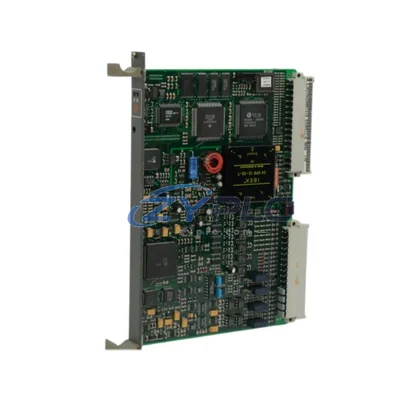
Siemens 39ACM14CAN Advanced Control Module for Symphony Plus
The Siemens 39ACM14CAN is a high-performance Advanced Control Module (ACM) engineered for deployment within the Symphony Plus Distributed Control System (DCS) architecture. Designed to operate at the core of the control layer, this module delivers deterministic scan-cycle execution, robust signal processing, and seamless integration across multi-tier automation hierarchies. Whether deployed in greenfield installations or as a replacement component in an existing Symphony Plus platform, the 39ACM14CAN provides the processing backbone that sustains system-wide operational continuity, redundancy integrity, and long-term maintainability across demanding industrial environments.
In modern industrial automation, no module operates in isolation. The 39ACM14CAN is architected to function as a coordinating intelligence node within a layered control system — interfacing upward with supervisory SCADA and historian platforms, laterally with peer control modules and communication gateways, and downward with I/O subsystems, field instruments, and actuator networks. Its role within the Symphony Plus ecosystem is to ensure that control logic execution, data acquisition, and inter-module communication remain synchronized, deterministic, and fault-tolerant across all operational states.
Product Specification Table
| System Role |
Advanced Control Module — Control Layer Processor |
| Compatible Platform |
Siemens Symphony Plus DCS |
| Module Series |
Symphony Plus ACM Series |
| Product Type |
Advanced Control Module (ACM) |
| SKU / Part Number |
39ACM14CAN |
| Manufacturer |
Siemens (formerly ABB / Elsag Bailey) |
| Country of Origin |
Germany |
| Communication Protocol |
ControlNet / CAN-based fieldbus architecture |
| Control Architecture |
Distributed Control System (DCS), multi-drop module topology |
| Redundancy Support |
Hot-standby redundancy compatible within Symphony Plus redundant controller pairs |
| Mounting |
Symphony Plus module rack / backplane installation |
| Operating Temperature |
0°C to 60°C (standard industrial enclosure) |
| Power Supply Compatibility |
Symphony Plus rack-integrated DC power distribution |
| system integration |
Full system integration with Symphony Plus engineering tools and HMI layers |
| Warranty |
warranty terms confirmed during quotation — tested, verified, and ready for system deployment |
System Compatibility Notes
The 39ACM14CAN does not function as a standalone device — it is a system-level component whose value is realized through its coordinated interaction with the full Symphony Plus control architecture. At the controller layer, the ACM works in conjunction with peer modules such as the Siemens 39BCM14CAN (Basic Control Module) and the 39PCM14CAN (Process Control Module) to distribute control logic across the rack, ensuring that no single module becomes a processing bottleneck during high-density I/O scan cycles.
At the I/O layer, the 39ACM14CAN interfaces with Symphony Plus analog and digital I/O modules — including the 39AI14CAN analog input module and the 39DO14CAN digital output module — through the backplane bus, enabling high-speed, low-latency signal acquisition and command dispatch. The backplane itself, typically the Symphony Plus 14-slot module rack, provides the physical and electrical foundation for all inter-module communication, power distribution, and mechanical stability within the control cabinet.
For network-layer connectivity, the 39ACM14CAN communicates upstream via the Symphony Plus ControlNet communication gateway or equivalent fieldbus bridge modules, enabling integration with plant-wide SCADA systems, OPC DA/UA data servers, and process historians. This communication architecture supports real-time data exchange between the control layer and the supervisory layer without introducing latency that could compromise closed-loop control performance.
At the power layer, the module relies on the Symphony Plus rack power supply module — typically a redundant dual-feed configuration — to maintain uninterrupted operation during utility fluctuations or maintenance switching events. Redundant power architectures are strongly recommended in continuous process environments where control interruption carries significant operational or safety risk.
The human-machine interface layer connects to the 39ACM14CAN’s control domain through Symphony Plus Composer engineering workstations and operator HMI terminals, providing real-time visualization of process variables, alarm management, and control loop tuning. The system integration capability of the 39ACM14CAN ensures that all configuration data, tag assignments, and control strategies are fully synchronized between the engineering environment and the runtime controller — eliminating configuration drift and reducing commissioning time.
For applications requiring high-availability operation, the 39ACM14CAN supports hot-standby redundancy when paired with a secondary ACM module in a redundant controller configuration. Automatic failover between primary and standby modules occurs without process interruption, maintaining bumpless transfer of control output signals to field actuators, control valves, variable frequency drives (VFDs), and relay output modules connected downstream.
Industrial Application Notes
The Siemens 39ACM14CAN is deployed across a wide range of heavy industrial and process automation sectors where system reliability, architectural consistency, and long-term maintainability are non-negotiable requirements.
In power generation and electrical utilities, the 39ACM14CAN serves as the control processor for boiler management systems, turbine control loops, and auxiliary equipment sequencing — environments where deterministic scan cycles and redundant controller architectures are mandated by operational safety standards. Its compatibility with the Symphony Plus platform ensures seamless integration with existing plant DCS infrastructure without requiring full system replacement.
In oil, gas, and petrochemical processing, the module is deployed within control cabinets managing distillation column regulation, compressor anti-surge control, and pipeline pressure management. The 39ACM14CAN’s robust communication architecture and support for redundant configurations make it well-suited for hazardous area control rooms where unplanned downtime carries significant financial and safety consequences.
In water and wastewater treatment, the module coordinates pump sequencing, chemical dosing control, and filtration process management across distributed treatment facilities. Its modular architecture allows plant engineers to expand I/O capacity incrementally by adding compatible Symphony Plus I/O modules to existing racks — preserving capital investment while accommodating process expansion.
In mining, metallurgy, and mineral processing, the 39ACM14CAN manages conveyor drive coordination, crusher control, and flotation cell regulation — applications characterized by high vibration, wide temperature variation, and continuous 24/7 operational demands. The module’s industrial-grade construction and Symphony Plus platform compatibility ensure reliable performance in these mechanically demanding environments.
In packaging and discrete manufacturing, the ACM provides the control intelligence for multi-axis sequencing, vision system integration, and production line synchronization — leveraging the Symphony Plus platform’s ability to bridge process control and discrete automation within a unified engineering environment.
Product Compatibility FAQ
Q1: Is the Siemens 39ACM14CAN compatible with existing Symphony Plus racks and backplanes without hardware modification?
Yes. The 39ACM14CAN is designed for direct installation into standard Symphony Plus 14-slot module racks using the existing backplane bus connectors. No hardware modification is required for rack integration. However, firmware version compatibility between the ACM and the rack’s communication infrastructure should be verified during pre-installation engineering review. Our technical team can assist with compatibility confirmation prior to shipment.
Q2: Can the 39ACM14CAN be configured for hot-standby redundancy, and what additional components are required?
Yes. The 39ACM14CAN supports hot-standby redundant controller configurations when paired with a second ACM module of the same firmware revision. Redundant operation requires a compatible Symphony Plus redundancy communication link and appropriate rack slot allocation for the standby module. The redundancy configuration is managed through the Symphony Plus Composer engineering environment, which provides automatic synchronization of control strategies and tag databases between primary and standby controllers. Our warranty terms confirmed during quotation covers both primary and standby modules supplied as a redundant pair.
Q3: What does the warranty terms confirmed during quotation cover, and how is long-term spare parts availability managed for Symphony Plus ACM modules?
The warranty terms confirmed during quotation covers all verified 39ACM14CAN modules against manufacturing defects, functional failures, and communication interface faults under normal operating conditions. Each module undergoes functional testing prior to shipment to confirm operational integrity. For long-term spare parts management, we maintain dedicated inventory of Symphony Plus ACM series modules to support planned maintenance cycles, emergency replacements, and system expansion projects. Customers operating Symphony Plus platforms in critical infrastructure applications are encouraged to establish a strategic spare parts agreement to ensure module availability throughout the system’s operational lifecycle. Contact our technical sales team for multi-unit pricing and long-term supply arrangements.