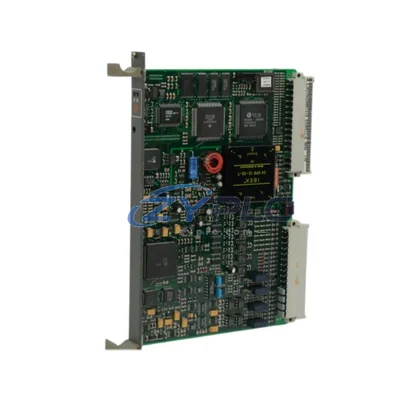
Siemens 6DD1606-3AC0 Industrial Network Interface for SIMADYN D Systems: Bridging the Industrial Data Link
The Siemens 6DD1606-3AC0 is a high-performance industrial communication module engineered for the SIMADYN D modular control platform — one of Siemens’ most robust closed-loop and drive control systems deployed across power generation, steel mills, paper machines, and heavy process industries. As factories evolve toward fully connected smart manufacturing environments, the 6DD1606-3AC0 serves as a critical network interface node, enabling seamless data exchange between field-level devices, PLC controllers, drive systems, and upper-level SCADA and HMI supervisory platforms.
In modern industrial sites, data isolation remains one of the most persistent barriers to operational transparency. The 6DD1606-3AC0 addresses this challenge directly by providing a structured communication pathway that connects the SIMADYN D processor rack to external automation networks. Whether the application involves synchronizing multi-axis drive control, aggregating real-time process variables for historian systems, or enabling remote diagnostics from a central control room, this module delivers the communication backbone that smart factories depend on.
Compatibility & Integration Notes
| Specification |
Details |
| SKU / Part Number |
6DD1606-3AC0 |
| Brand / Manufacturer |
Siemens |
| Series / Platform |
SIMADYN D |
| Module Type |
Industrial Communication / Network Interface Module |
| Communication Protocol |
SINEC H1 / Industrial Ethernet (peer-to-peer and master-slave) |
| Interface Type |
Backplane bus interface + external network port |
| Data Transmission |
Real-time cyclic and acyclic data exchange |
| Network Compatibility |
SIMADYN D rack, Siemens SIMATIC S5/S7 compatible gateways, PROFIBUS DP upstream bridges |
| System Application |
Drive control, process automation, SCADA integration, HMI data acquisition |
| Origin |
Germany |
| Warranty |
warranty terms confirmed during quotation |
| Stock Status |
RFQ Available — shipment arranged after confirmation |
Connected Automation Data Flow
The 6DD1606-3AC0 operates at the heart of a layered industrial communication architecture. At the field level, process signals originate from sensors, encoders, and actuators wired into the SIMADYN D I/O subsystem. These signals are processed by the SIMADYN D processor cards — such as the 6DD1607-0AA0 PM5 processor module — which execute closed-loop control algorithms in real time. The 6DD1606-3AC0 then acts as the network bridge, packaging this process data and transmitting it upstream across the plant communication network.
In drive-intensive applications, the module works in close coordination with Siemens SIMOREG DC Master and SIMOVERT MASTERDRIVES frequency converters, which rely on cyclic communication to receive speed references and torque setpoints while returning actual values, fault codes, and status words. This bidirectional data flow is essential for coordinated multi-drive systems found in rolling mills, winding machines, and extruder lines.
At the network layer, the 6DD1606-3AC0 interfaces with Siemens SINEC H1 Industrial Ethernet infrastructure, allowing the SIMADYN D platform to participate in plant-wide data networks alongside SIMATIC S7-400 PLCs and SIMATIC NET CP 443-1 communication processors. This integration enables the SIMADYN D system to share process data with WinCC SCADA servers and SIMATIC HMI TP/MP series operator panels, providing operators with real-time visualization of drive states, process variables, and alarm conditions.
For remote I/O expansion, the SIMADYN D architecture supports distributed I/O racks connected via the internal bus, with the 6DD1606-3AC0 ensuring that all distributed data points are consolidated and forwarded to the supervisory layer without latency gaps. In sites where legacy PROFIBUS DP networks coexist with newer Ethernet infrastructure, gateway modules such as the Siemens IM 153-2 remote I/O interface serve as protocol bridges, and the 6DD1606-3AC0 ensures the SIMADYN D controller remains a fully participating node in this hybrid network topology.
Edge computing and remote diagnostics are increasingly important in heavy industry. The 6DD1606-3AC0 enables plant engineers to access SIMADYN D diagnostic data — including cycle time overruns, communication errors, and module health status — through connected SCADA historian platforms and remote monitoring dashboards. This capability reduces unplanned downtime by allowing maintenance teams to identify developing faults before they escalate into production stoppages.
Solving Data Isolation in Industrial Sites
One of the most common challenges in legacy industrial environments is the coexistence of multiple incompatible communication protocols across different generations of equipment. A steel plant may operate SIMADYN D drive controllers alongside newer SIMATIC S7-300 PLCs, third-party PROFIBUS DP sensors, and Modbus RTU-based instrumentation — each speaking a different protocol with no native path to share data. The 6DD1606-3AC0 resolves this by providing a standardized network interface that allows the SIMADYN D platform to participate in the broader plant automation network, eliminating data silos between the drive control layer and the process control layer.
Protocol unification is only part of the solution. Network stability is equally critical in high-cycle industrial environments where communication interruptions can trigger emergency stops or production quality deviations. The 6DD1606-3AC0 is designed for continuous 24/7 operation in industrial cabinet environments, with robust EMC shielding and deterministic communication timing that ensures data integrity even in electrically noisy plant conditions.
For production line transparency, the module enables real-time KPI streaming to MES and ERP systems, allowing production managers to monitor OEE metrics, energy consumption per drive, and batch traceability data without manual data collection. System expansion is equally straightforward — additional SIMADYN D racks and communication modules can be integrated into the existing network without reconfiguring the entire communication architecture, protecting the customer’s investment as production capacity grows.
Every 6DD1606-3AC0 unit supplied by ZYPLC undergoes pre-shipment functional testing to verify communication link establishment, data throughput integrity, and module self-diagnostics. Units are shipped with a warranty terms confirmed during quotation, and our technical team provides application support for integration into existing SIMADYN D installations.
Industrial Connectivity FAQ
Q1: What communication protocols does the Siemens 6DD1606-3AC0 support?
The 6DD1606-3AC0 is designed for the SIMADYN D platform and supports SINEC H1 Industrial Ethernet communication, enabling cyclic and acyclic data exchange with Siemens SIMATIC controllers, SCADA systems, and HMI platforms. For PROFIBUS DP integration, upstream gateway modules are used in conjunction with this interface card.
Q2: Can the 6DD1606-3AC0 be integrated with WinCC SCADA and SIMATIC HMI systems?
Yes. When connected via the SINEC H1 network, the SIMADYN D system — with the 6DD1606-3AC0 as its network interface — can exchange process data with WinCC SCADA servers and SIMATIC HMI operator panels, enabling real-time visualization, alarm management, and remote diagnostics from the supervisory control layer.
Q3: How does ZYPLC ensure the quality of the 6DD1606-3AC0 before shipment?
Each unit undergoes pre-shipment functional testing covering communication link initialization, data exchange verification, and module self-diagnostic checks. All units are covered by a warranty terms confirmed during quotation, and we maintain ready stock to support urgent project timelines with fast global shipping.
Q4: Is the 6DD1606-3AC0 compatible with both legacy SIMADYN D installations and newer Siemens automation architectures?
The 6DD1606-3AC0 is purpose-built for the SIMADYN D rack architecture. It is fully compatible with existing SIMADYN D installations and can coexist in plant networks alongside SIMATIC S7-series PLCs and SIMATIC NET communication processors, making it suitable for both legacy system maintenance and hybrid automation environments undergoing gradual modernization.
—