Siemens 6FL7820-8CA10 Communication for ADD5100
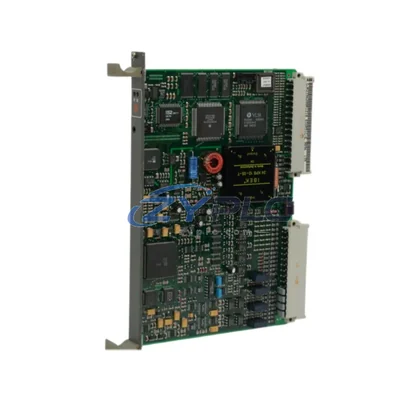
The Siemens 6FL7820-8CA10 is a dedicated communication module engineered for seamless integration within the ADD5100 control system architecture. Rather than functioning as a standalone component, this module is designed to serve as the communication backbone of a layered automation system — bridging the control layer, I/O layer, network layer, and supervisory interface layer into a coherent, high-availability industrial platform. In distributed manufacturing environments, process control facilities, and critical infrastructure applications, the integrity of inter-layer communication directly determines system uptime, diagnostic accuracy, and long-term maintainability. The 6FL7820-8CA10 addresses these demands with precision-engineered signal routing, deterministic data exchange, and robust electrical isolation that sustains performance across demanding industrial conditions.
Within the ADD5100 architecture, the 6FL7820-8CA10 occupies a pivotal role at the network layer, coordinating data flow between the CPU processing core and downstream I/O expansion modules, remote terminal units, and field devices. Its integration with the ADD5100 backplane ensures that communication latency remains within the deterministic bounds required for closed-loop control applications, including motion sequencing, pressure regulation, and multi-axis coordination. Engineers deploying this module benefit from a standardized communication interface that reduces configuration overhead and accelerates commissioning timelines across multi-cabinet installations.
Product Specification Table
| Parameter |
Specification |
| System Role |
Network-Layer Communication Module — ADD5100 Architecture |
| Brand / Manufacturer |
Siemens |
| Full SKU |
ADD5100 6FL7820-8CA10 |
| Series |
ADD5100 |
| Product Type |
Communication Module |
| Communication Capability |
Industrial fieldbus / backplane communication; system integration ready |
| Electrical Interface |
Backplane-mounted; compatible with ADD5100 rack and power distribution bus |
| Installation Environment |
Control cabinet / DIN rail enclosure; industrial-grade EMC shielding |
| Operating Temperature |
0°C to +55°C (standard industrial range) |
| Origin |
Germany (DE) |
| Warranty |
warranty terms confirmed during quotation — covers manufacturing defects and functional failure under normal operating conditions |
| Availability |
Availability confirmed by RFQ; tested and inspected prior to dispatch |
System Compatibility Notes
The 6FL7820-8CA10 achieves its full potential when deployed as part of a coordinated ADD5100 control system rather than as an isolated component. In a typical system architecture, the module interfaces directly with the ADD5100 CPU module, which handles program execution, scan cycle management, and inter-module arbitration. Power integrity for the communication module is maintained by the ADD5100 power supply unit, which provides regulated DC bus voltage across the backplane, ensuring that communication timing is not disrupted by transient load events on the power rail.
On the I/O layer, the 6FL7820-8CA10 coordinates data exchange with digital input modules, analog output modules, and high-speed counter modules mounted within the same rack or connected via remote I/O expansion. This coordination enables the CPU to receive real-time process values and issue control commands with minimal cycle-time overhead. For installations requiring extended I/O reach, the module supports communication with remote I/O stations connected through fieldbus segments, allowing engineers to distribute I/O across large plant footprints without sacrificing data integrity or scan-cycle determinism.
At the network layer, the 6FL7820-8CA10 facilitates connectivity with SCADA systems, DCS platforms, and industrial Ethernet switches through standardized protocol interfaces. This enables supervisory data acquisition, alarm management, and historian integration without requiring additional gateway hardware. In redundant architecture designs, the module can be paired with a redundant communication module or a hot-standby CPU configuration, ensuring that a single point of failure in the communication path does not interrupt process control. Terminal modules and marshalling panels connected downstream of the I/O layer benefit from the stable, low-jitter communication that the 6FL7820-8CA10 provides, reducing the risk of spurious alarms or missed control events.
For human-machine interface integration, the module’s communication capability supports data exchange with HMI panels and operator workstations, enabling real-time visualization of process variables, setpoint adjustment, and diagnostic readback. Drive controllers and servo amplifiers connected at the execution layer receive coordinated command signals routed through the communication module, ensuring that motion profiles and process sequences are executed with the timing precision required for high-throughput production lines.
Industrial Application Notes
The Siemens 6FL7820-8CA10 is well-suited for deployment across a broad range of industrial sectors where layered automation architecture is the standard design approach. In discrete manufacturing environments — including automotive assembly, electronics production, and precision machining — the module supports high-speed I/O coordination and deterministic communication between the machine control layer and the plant-level MES or ERP integration layer. Its robust EMC performance makes it suitable for installation in close proximity to variable-frequency drives, servo systems, and high-current switching equipment without signal degradation.
In the power generation and electrical distribution sector, the 6FL7820-8CA10 supports substation automation and grid-tied control applications where communication reliability and data integrity are non-negotiable. The module’s ability to maintain stable communication under electrically noisy conditions — characteristic of high-voltage switchgear environments — makes it a dependable choice for protection relay coordination and SCADA-linked monitoring systems.
Petrochemical and oil-and-gas process control installations benefit from the module’s compatibility with hazardous-area control architectures, where the ADD5100 system is deployed in conjunction with intrinsically safe I/O barriers and explosion-proof enclosures. Water treatment and wastewater management facilities use the ADD5100 platform for pump sequencing, chemical dosing control, and remote telemetry, with the 6FL7820-8CA10 providing the communication link between distributed pump stations and the central SCADA server.
In mining and metallurgical applications, the module supports conveyor control systems, crusher sequencing, and smelter process automation, where the combination of high ambient temperature tolerance, vibration resistance, and deterministic communication is essential for continuous operation. Packaging line automation and food-and-beverage processing facilities deploy the ADD5100 architecture for high-speed filling, labeling, and palletizing sequences, with the 6FL7820-8CA10 ensuring that the communication layer keeps pace with the rapid I/O update rates demanded by these applications.
Product Compatibility FAQ
Q1: Is the Siemens 6FL7820-8CA10 compatible with existing ADD5100 racks and backplanes, and does it require firmware updates before installation?
The 6FL7820-8CA10 is designed for direct installation into ADD5100-series racks and is compatible with the standard ADD5100 backplane bus. Prior to installation, it is recommended to verify the firmware revision of the host CPU module against Siemens compatibility matrices to confirm that the communication module’s protocol stack is aligned with the CPU’s communication handler version. In most cases, no firmware update is required for standard deployments, but systems running legacy firmware versions may benefit from an update to access the module’s full system integration feature set.
Q2: How does the 6FL7820-8CA10 support redundant communication architectures, and what is the recommended configuration for high-availability systems?
For high-availability applications, the 6FL7820-8CA10 can be deployed in a redundant pair configuration within the ADD5100 architecture, where a primary and standby communication module operate in parallel. The system’s redundancy manager — typically implemented at the CPU level — monitors communication health and executes bumpless switchover in the event of a module fault. This configuration is particularly relevant for continuous process industries such as petrochemical refining and power generation, where unplanned communication interruptions carry significant operational and safety consequences. Engineers should consult the ADD5100 system redundancy design guide for rack slot assignment and switchover timing parameters.
Q3: What does the warranty terms confirmed during quotation cover, and what is the process for warranty claims or long-term spare parts support?
The warranty terms confirmed during quotation provided with the Siemens 6FL7820-8CA10 covers manufacturing defects, component failures, and functional non-conformance under normal operating conditions as defined by Siemens technical specifications. The warranty period commences from the date of dispatch. In the event of a warranty claim, the module should be returned with a fault description and original purchase documentation. ZYPLC maintains a dedicated spare parts inventory for ADD5100-series components, ensuring that replacement modules are available for rapid dispatch to minimize system downtime. For long-term maintenance planning, customers are encouraged to establish a standing spare parts agreement to guarantee module availability beyond the standard warranty period.