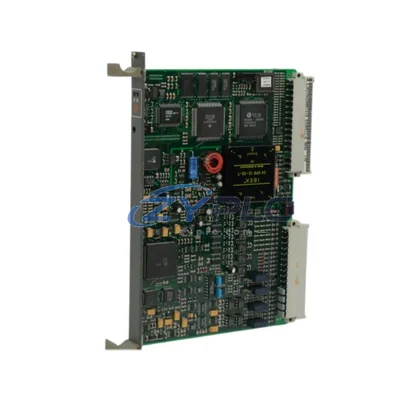
Siemens 6SL3544-0FB20-1FA0 Control Unit for SINAMICS G120D
The Siemens 6SL3544-0FB20-1FA0 is a dedicated Control Unit engineered for deployment within the SINAMICS G120D distributed drive system architecture. Unlike centralized drive topologies, the G120D platform positions intelligence directly at the motor, and the 6SL3544-0FB20-1FA0 serves as the command and communication core of that distributed node. In multi-axis automation environments — spanning manufacturing lines, conveyor systems, material handling, water treatment, and process industries — this Control Unit enables precise speed and torque regulation while maintaining seamless integration across all layers of the control hierarchy.
Within a layered automation system, the 6SL3544-0FB20-1FA0 occupies the drive control layer, interfacing upward to the PLC or DCS control layer via PROFINET IO or PROFIBUS DP, and downward to the Power Module (such as the 6SL3525-0PE21-8AA1 or 6SL3525-0PE25-5AA1) through the internal drive interface. This architecture eliminates the need for centralized control cabinets in many applications, reducing wiring complexity and improving system response time. The Control Unit communicates with higher-level controllers — including Siemens SIMATIC S7-1500 or S7-300 series PLCs — using cyclic and acyclic PROFINET data exchange, supporting both standard and safety-integrated communication profiles.
System architects integrating the 6SL3544-0FB20-1FA0 benefit from its native support for SINAMICS Safety Integrated functions, enabling STO (Safe Torque Off) and SS1 (Safe Stop 1) without external safety relays in many configurations. This reduces component count in the safety layer and simplifies compliance with IEC 62061 and ISO 13849 requirements. When paired with a SIMATIC ET 200SP distributed I/O station or a SIMATIC HMI panel such as the KTP700 Basic, operators gain full visibility into drive status, fault diagnostics, and parameter sets from a unified engineering environment via TIA Portal.
The 6SL3544-0FB20-1FA0 supports parameterization and commissioning through STARTER or TIA Portal Startdrive, allowing engineers to configure ramp-up times, PID control loops, motor identification routines, and communication node addresses without specialized hardware. Drive parameters can be stored on a memory card (compatible with the SINAMICS parameter card format), enabling rapid replacement and cloning across identical drive nodes — a critical advantage in large-scale installations with dozens of distributed axes.
From a network architecture perspective, the Control Unit’s PROFINET interface supports media redundancy protocol (MRP) ring topologies, ensuring communication continuity even in the event of a single cable fault. This is particularly valuable in applications such as bottling lines, automotive assembly, and mining conveyor systems where unplanned downtime carries significant operational cost. The drive node can be addressed independently within the PROFINET device name scheme, and its diagnostic data — including current draw, temperature, fault codes, and operating hours — is accessible via standard PROFINET acyclic read/write services.
In power layer design, the 6SL3544-0FB20-1FA0 Control Unit operates in conjunction with the G120D Power Module, which accepts 380–480 V AC three-phase input and delivers variable frequency output to the connected motor. The system supports both asynchronous induction motors and synchronous permanent magnet motors, with automatic motor identification (AMI) routines that optimize control parameters during initial commissioning. Line-side components such as the SINAMICS G120 line filter (6SL3203-0BE21-8SD0 or equivalent) and braking resistors can be integrated to manage harmonic distortion and regenerative energy in deceleration-heavy applications.
For maintenance and long-term asset management, the 6SL3544-0FB20-1FA0 provides structured fault memory with timestamped entries, enabling root-cause analysis without on-site instrumentation. Its IP65-rated enclosure (when installed in the G120D housing) allows direct field mounting in dusty or wet environments, reducing the need for additional protective enclosures. Spare unit management is simplified by the parameter card cloning capability, and ZYPLC maintains availability subject to RFQ confirmation of the 6SL3544-0FB20-1FA0 with a warranty terms confirmed during quotation covering manufacturing defects and functional failures under normal operating conditions.
Product Specification Table
| Parameter |
Specification |
| System Role |
Distributed Drive Control Unit — SINAMICS G120D Platform |
| Compatible Power Modules |
SINAMICS G120D Power Module (6SL352x series) |
| Communication Interface |
PROFINET IO / PROFIBUS DP |
| Safety Functions |
STO, SS1 (Safety Integrated, IEC 62061 / ISO 13849) |
| Supply Voltage (Logic) |
24 V DC (via Power Module backplane) |
| Motor Compatibility |
Asynchronous (induction) and synchronous (PM) motors |
| Parameterization Tool |
TIA Portal Startdrive / STARTER |
| Parameter Storage |
SINAMICS memory card (cloning supported) |
| Protection Rating |
IP65 (in G120D housing) |
| Operating Temperature |
-10 °C to +50 °C |
| Installation Environment |
Field-mount, distributed topology, cabinet-free |
| Origin |
Germany |
| Warranty |
warranty terms confirmed during quotation (ZYPLC availability subject to RFQ confirmation) |
System Compatibility Notes
The 6SL3544-0FB20-1FA0 does not operate in isolation — its value is realized through coordinated integration with complementary components across the full control system stack. At the control layer, a Siemens SIMATIC S7-1500 CPU (such as the CPU 1515-2 PN) acts as the PROFINET IO controller, issuing speed setpoints and reading actual values from each G120D drive node via cyclic process data exchange. The S7-1500’s integrated PROFINET interface supports up to 256 IO devices per port, making it well-suited for large distributed drive networks.
At the I/O layer, a SIMATIC ET 200SP distributed I/O station may be co-located with the G120D drives to handle local digital and analog signals — limit switches, proximity sensors, temperature transmitters — without routing all field signals back to a central cabinet. The ET 200SP communicates on the same PROFINET segment as the 6SL3544-0FB20-1FA0, reducing network complexity and scan time.
For human-machine interface, a SIMATIC HMI KTP900 Basic panel or TP1200 Comfort panel provides operators with real-time drive status, fault acknowledgment, and parameter visualization. TIA Portal’s unified engineering framework allows the same project file to contain PLC logic, HMI screens, and drive parameterization, reducing engineering time and version control risk.
In the power layer, the SINAMICS G120D Power Module paired with the 6SL3544-0FB20-1FA0 may be supplemented by a SINAMICS G120 Smart Line Module (SLM) in regenerative applications, feeding braking energy back to the supply network rather than dissipating it as heat. Line reactors and EMC filters (such as the 6SL3203 series) protect upstream equipment from drive-generated harmonics.
Terminal modules and shield connection clamps from the SIMATIC S7 accessory range complete the installation, ensuring reliable signal grounding and cable management in field enclosures. Together, these components — the 6SL3544-0FB20-1FA0 Control Unit, G120D Power Module, S7-1500 PLC, ET 200SP I/O, KTP900 HMI, line filter, and associated terminal hardware — form a coherent, scalable, and maintainable distributed drive architecture.
Industrial Application Notes
The 6SL3544-0FB20-1FA0 finds application across a broad range of industrial sectors where distributed motor control, network integration, and safety compliance are primary engineering requirements.
In manufacturing and assembly lines, the G120D platform with the 6SL3544-0FB20-1FA0 Control Unit enables precise conveyor speed synchronization across multiple axes, supporting both independent and coordinated motion profiles. Automotive body shop conveyors, engine assembly lines, and component transfer systems benefit from the drive’s PROFINET-based speed following and the ability to implement electronic gearing without dedicated motion controllers.
In water and wastewater treatment, pump and blower drives controlled by the 6SL3544-0FB20-1FA0 deliver operational stability through variable speed operation, with PID control loops maintaining pressure or flow setpoints autonomously. The IP65 field-mount capability eliminates the need for drive cabinets in wet areas, reducing installation cost and maintenance access time.
In mining and bulk material handling, the distributed architecture of the G120D system — anchored by the 6SL3544-0FB20-1FA0 — allows long conveyor systems to be controlled from a single PROFINET network segment, with each drive node independently diagnosable and replaceable without system shutdown. The MRP ring topology support ensures communication resilience in environments where cable damage is a recurring risk.
In petrochemical and process industries, the Safety Integrated functions of the 6SL3544-0FB20-1FA0 support SIL 2-capable STO implementations, meeting functional safety requirements for agitator, pump, and compressor drives in hazardous area adjacent installations. Integration with SIMATIC PCS 7 or equivalent DCS platforms is achieved via PROFIBUS DP or PROFINET, with standard drive function blocks available in the process control library.
In packaging and food processing, the drive’s fast communication cycle times and deterministic PROFINET response support high-speed filling, labeling, and wrapping machine axes, where speed accuracy and fault response time directly affect product quality and line efficiency.
Product Compatibility FAQ
Q1: Is the 6SL3544-0FB20-1FA0 compatible with both PROFINET and PROFIBUS DP networks, and can it be used in an existing S7-300 system?
The 6SL3544-0FB20-1FA0 supports PROFINET IO as its primary communication interface. PROFIBUS DP compatibility depends on the specific firmware variant and optional communication board fitted to the G120D unit. For integration with legacy Siemens SIMATIC S7-300 systems using PROFIBUS DP, engineers should verify the communication module variant (CU250D-2 DP vs. CU250D-2 PN) against the project’s network topology. ZYPLC’s technical team can assist in confirming the correct variant for your architecture prior to order.
Q2: How does the warranty terms confirmed during quotation apply, and what does it cover for the 6SL3544-0FB20-1FA0?
ZYPLC’s warranty terms confirmed during quotation covers manufacturing defects and functional failures under normal operating conditions for the 6SL3544-0FB20-1FA0 from the date of shipment. Warranty claims are processed through direct contact with ZYPLC’s support team. Units showing damage from incorrect installation, overvoltage events, or environmental exposure outside the rated operating range are assessed on a case-by-case basis. Replacement or repair is coordinated to minimize system downtime, and ZYPLC maintains buffer stock of the 6SL3544-0FB20-1FA0 to support rapid exchange.
Q3: What is the recommended commissioning procedure for the 6SL3544-0FB20-1FA0 in a new PROFINET architecture, and how long does initial setup typically take?
Commissioning the 6SL3544-0FB20-1FA0 in a new PROFINET architecture follows a structured sequence: (1) assign the PROFINET device name using TIA Portal’s online device view or a PROFINET commissioning tool; (2) load the drive’s GSD file into the PLC project and configure the IO device with the required process data telegrams (typically Telegram 1 or Telegram 20 for standard speed control); (3) perform motor identification (AMI) with the motor connected and the drive in commissioning mode; (4) configure safety parameters if STO/SS1 functions are required, and perform the mandatory safety acceptance test. For a single-axis installation by an experienced drive engineer, initial commissioning typically requires 2–4 hours. Multi-axis systems with MRP ring topology and safety integration may require 1–2 days of structured commissioning time.
—