Siemens A5E02490424 Industrial Network Interface for ET 200S Systems: Bridging the Industrial Data Link in Smart Factory Environments
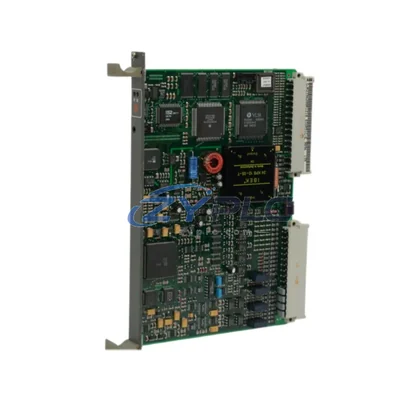
The Siemens A5E02490424 is a high-performance Digital I/O Module designed for the ET 200S distributed I/O platform, engineered to serve as a critical node in the industrial data chain connecting field devices, PLC controllers, remote I/O stations, HMI panels, SCADA systems, variable frequency drives, sensors, and supervisory systems. In modern smart factory deployments, seamless data flow between the shop floor and the control room is not optional — it is the backbone of operational efficiency, and the A5E02490424 is purpose-built to deliver exactly that.
Operating within the PROFIBUS-DP communication architecture, this module enables deterministic, real-time signal acquisition from field-level sensors and actuators, transmitting structured process data upstream to Siemens S7-300 and S7-400 PLC controllers via the ET 200S head station interface. The module’s digital I/O channels support both discrete input signal collection and output command execution, making it a dual-function component in any automated production line. Whether interfacing with proximity sensors, photoelectric detectors, solenoid valves, or relay outputs, the A5E02490424 ensures that every signal is captured, validated, and transmitted with minimal latency across the PROFIBUS network segment.
In a typical smart factory data flow, the A5E02490424 sits at the field level, collecting binary process signals and feeding them into the ET 200S station. The ET 200S IM 151-1 interface module then aggregates this data and communicates it over PROFIBUS-DP to the S7-300 CPU, where the STEP 7 or TIA Portal program logic processes the inputs and issues control outputs back through the same data path. This closed-loop architecture supports cycle times well within the demands of high-speed assembly, packaging, and material handling applications. When integrated with a Siemens SIMATIC S7-1500 system via a PROFIBUS-to-PROFINET gateway such as the IE/PB Link PN IO, the A5E02490424 can participate in a fully converged OT network, enabling data visibility from the field device all the way to the MES or ERP layer.
For facilities running WinCC or WinCC OA SCADA platforms, the digital I/O states managed by the A5E02490424 are available as real-time process variables, enabling operators to monitor machine status, track alarm conditions, and execute remote control commands from centralized HMI workstations. This integration eliminates the need for manual field inspections and supports predictive maintenance workflows by surfacing I/O fault states before they escalate into unplanned downtime. When paired with a Siemens SIMATIC ET 200SP or ET 200M station in a hybrid I/O architecture, the A5E02490424 provides backward-compatible PROFIBUS connectivity for legacy field devices while the broader system migrates toward PROFINET-based infrastructure.
The module also plays a key role in alarm feedback and remote diagnostics. Through the PROFIBUS diagnostic telegram mechanism, the A5E02490424 reports channel-level faults — including short circuits, wire breaks, and overload conditions — directly to the PLC CPU, which can then forward these diagnostic events to the SCADA alarm management system. This end-to-end fault visibility, from the individual I/O channel to the operator dashboard, is what distinguishes a connected smart factory from a traditional siloed production environment. Integration with Siemens SIMATIC NET communication infrastructure further extends this diagnostic capability to remote monitoring scenarios, where maintenance engineers can interrogate module status from off-site locations via secure industrial VPN connections.
For system integrators designing scalable automation architectures, the A5E02490424 supports hot-swappable module replacement within the ET 200S rack, minimizing maintenance downtime and supporting continuous production. Its compact form factor and DIN rail mounting compatibility make it suitable for installation in standard control cabinets alongside Siemens SITOP power supply units, SIRIUS motor starters, and other SIMATIC peripheral components. The module’s wide operating temperature range and robust EMC shielding ensure reliable performance in demanding industrial environments, including automotive body shops, chemical processing plants, food and beverage production lines, and semiconductor fabrication facilities.
Every A5E02490424 unit supplied by ZYPLC undergoes pre-shipment functional testing to verify I/O channel integrity, PROFIBUS communication handshake, and power consumption within specification. Units are sourced from verified supply channels and are backed by a warranty terms confirmed during quotation, covering manufacturing defects and communication failures under normal operating conditions. Inventory is maintained RFQ Available for rapid dispatch, supporting both urgent replacement orders and planned system expansion projects. Global shipping is available with full export documentation, including commercial invoice, packing list, and certificate of origin where required.
Compatibility & Integration Notes
| Parameter |
Specification |
| SKU / Part Number |
A5E02490424 |
| Brand |
Siemens |
| Series |
ET 200S |
| Communication Protocol |
PROFIBUS-DP |
| Interface Type |
Digital I/O Module |
| Network Compatibility |
PROFIBUS DP V0/V1, S7-300/S7-400 PLC Systems |
| Transmission Capability |
Real-time discrete signal acquisition and output control |
| System Application |
PLC Control, Remote I/O, SCADA Integration, HMI Monitoring |
| Mounting |
DIN Rail, ET 200S Rack |
| Origin |
Germany |
| Warranty |
12 Months |
| Availability |
RFQ Available — shipment arranged after confirmation |
Connected Automation Data Flow
The A5E02490424 operates at the intersection of field-level signal collection and network-level data transmission. In a representative smart factory deployment, discrete signals from inductive proximity sensors and photoelectric barriers are wired directly to the module’s digital input channels. The module encodes these binary states into PROFIBUS-DP data frames, which are transmitted to the Siemens ET 200S IM 151-1 Standard interface module at the head of the I/O station. The IM 151-1 aggregates data from multiple I/O modules — including analog input modules such as the Siemens 6ES7134-4FB01-0AB0 and output modules such as the 6ES7132-4BB01-0AB0 — and forwards the consolidated process image to the upstream S7-300 CPU 315-2 DP over the PROFIBUS segment.
At the PLC level, the STEP 7 program processes the incoming I/O data and generates control outputs, which are routed back through the ET 200S station to actuators and motor starters connected to the digital output channels of the A5E02490424. For facilities that have migrated to TIA Portal and the S7-1500 platform, a Siemens SCALANCE X208 managed industrial Ethernet switch provides the PROFINET backbone, while a SIMATIC NET IE/PB Link gateway bridges the legacy PROFIBUS segment — including the ET 200S station — into the PROFINET network. This hybrid architecture allows the A5E02490424 to continue operating without hardware replacement while the broader control system evolves.
At the supervisory level, Siemens WinCC SCADA software subscribes to the process variables mapped from the A5E02490424 I/O channels, displaying real-time machine status on operator HMI panels. Alarm conditions — such as a digital input remaining active beyond a configured time threshold — are automatically escalated to the alarm management system, triggering notifications to maintenance personnel via the SCADA alarm server. For edge computing scenarios, a Siemens SIMATIC IPC427E industrial PC running edge analytics software can subscribe to the same PROFIBUS data stream, enabling local anomaly detection and OEE calculation without relying on cloud connectivity.
Solving Data Isolation in Industrial Sites
One of the most persistent challenges in industrial automation is the fragmentation of communication protocols across different generations of equipment. A production line may simultaneously operate Siemens PROFIBUS devices, legacy serial RS-485 instruments, and newer PROFINET-enabled drives — each speaking a different protocol and unable to exchange data without explicit gateway intervention. The A5E02490424, as part of the ET 200S ecosystem, addresses this challenge by providing a standardized PROFIBUS-DP interface that aggregates discrete field signals into a single, structured data stream accessible to the PLC and, through it, to any higher-level system.
Data isolation — where field device states are visible only to the local PLC and invisible to SCADA, MES, or ERP systems — is a root cause of poor production transparency and slow incident response. By ensuring that every digital I/O state managed by the A5E02490424 is reflected in the PLC process image and subsequently available to WinCC or third-party SCADA platforms via OPC UA or S7 communication drivers, the module contributes directly to production line transparency. Operators gain real-time visibility into machine states, cycle counts, and fault conditions without requiring manual data collection or separate field instrumentation.
Remote monitoring is another area where the A5E02490424 delivers measurable value. In facilities where maintenance engineers are responsible for multiple production lines or geographically distributed sites, the ability to remotely interrogate I/O module status via the PROFIBUS diagnostic interface — and to surface that data through the SCADA system to a web-based dashboard or mobile HMI — eliminates the need for physical site visits for routine status checks. System expansion is equally straightforward: the ET 200S platform supports modular slot-by-slot expansion, allowing additional A5E02490424 modules or other I/O types to be added to an existing station without reconfiguring the PROFIBUS network or modifying the PLC hardware configuration beyond adding the new module to the STEP 7 or TIA Portal hardware catalog.
Industrial Connectivity FAQ
Q: What is the communication latency of the A5E02490424 on a PROFIBUS-DP network?
A: PROFIBUS-DP operates with deterministic cycle times typically ranging from 1 ms to 10 ms depending on the number of slaves and the configured baud rate (up to 12 Mbit/s). The A5E02490424 responds within the standard PROFIBUS polling cycle, making it suitable for time-critical discrete control applications in assembly and packaging lines.
Q: Is the A5E02490424 compatible with both S7-300 and S7-400 PLC systems?
A: Yes. The module operates as a standard PROFIBUS-DP slave within the ET 200S station and is compatible with any PROFIBUS-DP master, including Siemens S7-300, S7-400, and S7-1500 systems (via IE/PB Link gateway). It can also be integrated with third-party PROFIBUS masters that support DP V0 or V1 protocol.
Q: How does the module handle network instability or PROFIBUS communication interruptions?
A: In the event of a PROFIBUS communication failure, the A5E02490424 enters a safe state as configured in the ET 200S parameter settings — either holding last output values or switching outputs off. The IM 151-1 interface module generates a diagnostic alarm that is forwarded to the PLC CPU and, through the SCADA system, to the operator alarm console, enabling rapid fault identification and recovery.
Q: What does the warranty terms confirmed during quotation cover, and how is pre-shipment testing conducted?
A: Every A5E02490424 unit supplied by ZYPLC is functionally tested prior to shipment, verifying digital I/O channel operation, PROFIBUS communication initialization, and power supply integrity. The warranty terms confirmed during quotation covers manufacturing defects and communication failures under normal operating conditions. Warranty claims are processed directly through ZYPLC’s technical support team, with replacement or repair turnaround coordinated to minimize production impact.