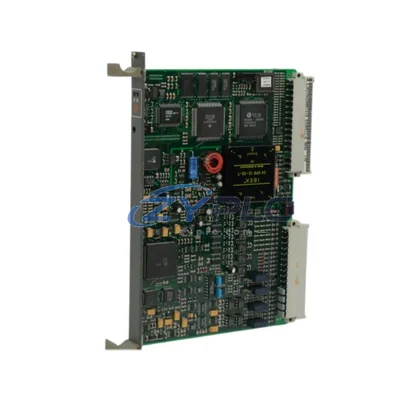
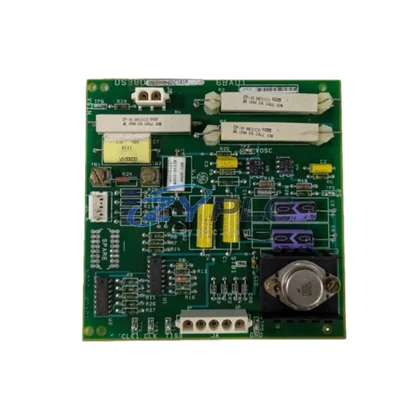
Siemens A5E02822120 Rectifier Trigger Board: Precision Control for SINAMICS Automation
The Siemens A5E02822120 is a high-performance rectifier trigger board engineered for deployment within the SINAMICS and SIMOREG drive families. Designed to govern the firing sequence of thyristor-based rectifier bridges, this board sits at the heart of DC drive energy conversion — translating AC supply into precisely regulated DC bus voltage with minimal switching losses. In demanding industrial environments where energy costs are a primary operational concern, the A5E02822120 delivers the gate-pulse accuracy and thermal stability needed to sustain peak drive efficiency across extended production cycles.
Unlike generic trigger assemblies, the A5E02822120 is factory-calibrated to Siemens SIMOREG DC Master and SINAMICS DCM converter specifications, ensuring that firing angles are synchronized with the drive’s internal control loop. This tight integration reduces harmonic distortion on the AC supply side, lowers reactive power demand, and directly contributes to measurable reductions in facility operating load — a critical advantage for plants operating under ISO 50001 maintenance planning frameworks or pursuing carbon-reduction targets.
Product Specification Table
| Parameter |
Specification / Value |
| Part Number / SKU |
A5E02822120 |
| Manufacturer |
Siemens |
| Compatible Drive Series |
SINAMICS DCM, SIMOREG DC Master (6RA70 / 6RA80) |
| Board Function |
Thyristor Rectifier Gate Trigger / Firing Pulse Control |
| Operating Voltage |
Per SINAMICS DCM / SIMOREG internal bus specification |
| Firing Angle Accuracy |
High-precision synchronization with drive control board |
| Energy Efficiency Contribution |
Reduced harmonic distortion; lower reactive power demand |
| Compatible Systems |
SINAMICS DCM, SIMOREG 6RA70, SIMOREG 6RA80, CUD control units |
| Application Environment |
Heavy industry, steel mills, paper machines, extruders, hoists, cranes |
| Origin |
Germany |
| Inventory Status |
RFQ Available — shipment arranged after confirmation |
| Pre-shipment Testing |
Full functional and load test performed before dispatch |
| Warranty |
warranty terms confirmed during quotation |
System Compatibility and Application
The A5E02822120 rectifier trigger board does not operate in isolation — its operational-efficiency impact is amplified when integrated within a well-architected SINAMICS or SIMOREG drive system. In a typical high-power DC drive cabinet, the trigger board interfaces directly with the SIMOREG CUD (Central Unit Drive) control board, which executes the speed and current regulation algorithms. The CUD issues firing angle commands to the A5E02822120, which then generates the precise gate pulses delivered to the thyristor stack. Any degradation in trigger timing — caused by a faulty board — results in asymmetric conduction, elevated DC ripple, and increased motor heating, all of which translate to wasted energy and accelerated insulation wear.
Upstream of the drive, Siemens SENTRON PAC power monitoring devices — such as the SENTRON PAC3200 or PAC4200 — can be deployed to measure real-time active power, reactive power, and power factor at the drive input. When the A5E02822120 is functioning correctly, operators will observe a stable, low-distortion current waveform on these meters, confirming that the rectifier bridge is firing symmetrically. Pairing the drive with a SINAMICS S120 active infeed module in adjacent machine groups further reduces grid-side harmonics across the production line.
On the motor side, the regulated DC output from the SIMOREG converter — governed by the A5E02822120 — feeds directly into DC motors controlling rolling mills, winding machines, or extruder screws. Stable firing pulse control means the motor armature current remains smooth, reducing torque ripple and mechanical stress on gearboxes and couplings. This directly extends mean time between failures (MTBF) for mechanical drivetrain components. In multi-drive lines, the SIMOREG 6RA80 units can be networked via PROFIBUS-DP or PROFINET IO, with a Siemens S7-1500 PLC coordinating speed references and energy setpoints across all axes — a configuration where the integrity of each drive’s trigger board is essential to system-wide efficiency.
For I/O expansion and process signal acquisition, Siemens ET 200SP distributed I/O modules connected to the S7-1500 backbone collect temperature, current feedback, and encoder signals from the motor and load. These signals feed into energy dashboards on a Siemens SIMATIC HMI Comfort Panel, giving operators real-time visibility into drive efficiency, motor loading, and operating load per production batch. When the A5E02822120 is replaced with a genuine Siemens spare, the restoration of correct firing angles is immediately reflected in improved power factor readings on the SENTRON meters and reduced thermal output from the drive cabinet — measurable outcomes that justify planned maintenance over reactive breakdown repair.
Maintenance and Replacement Notes
In steel processing plants, the SIMOREG DC Master drives controlled by the A5E02822120 regulate the armature current of main rolling mill motors rated at hundreds of kilowatts. A degraded trigger board introduces firing asymmetry that forces the drive to compensate with higher average current, increasing copper losses in both the motor and the converter thyristors. Replacing a worn A5E02822120 with a tested, genuine unit has been documented to restore drive efficiency to nameplate levels, reducing operating load per ton of processed steel by measurable percentages.
In paper and pulp mills, winding section drives must maintain precise tension control across wide speed ranges. The A5E02822120 ensures that the rectifier bridge responds accurately to current reference changes issued by the CUD, preventing the overshoot and hunting that waste energy and cause web breaks. Stable tension control also reduces the frequency of emergency stops — each of which dissipates kinetic energy as heat in braking resistors — contributing to a lower overall energy budget for the winding section.
For crane and hoist applications, regenerative braking capability in SIMOREG drives depends on the trigger board’s ability to switch the rectifier bridge into inversion mode, feeding energy back to the AC supply during lowering operations. A correctly functioning A5E02822120 enables full four-quadrant operation, recovering braking energy that would otherwise be lost as heat. In high-cycle crane operations — such as those in automotive stamping plants or container terminals — this regenerative capability can represent a significant fraction of total drive operating load.
Predictive maintenance programs benefit directly from monitoring drive cabinet temperatures and DC bus ripple levels. When these indicators trend upward without a change in load, the trigger board is a primary suspect. Stocking the A5E02822120 as a critical spare — with a verified warranty terms confirmed during quotation and pre-shipment functional test — ensures that maintenance teams can execute a rapid board swap during a planned maintenance window rather than suffering an unplanned production stoppage. Reducing mean time to repair (MTTR) for drive faults is one of the highest-leverage actions available to industrial energy managers, as unplanned downtime not only halts production but also forces inefficient restart cycles that consume disproportionate energy.
Product Sourcing FAQ
Q1: How does the A5E02822120 contribute to measurable operational stability in a SIMOREG drive system?
The A5E02822120 controls the firing angles of the thyristor rectifier bridge. Precise, symmetrical firing minimizes DC bus ripple and reactive current draw from the AC supply, directly improving the drive’s power factor and reducing I²R losses in the motor armature. In high-power applications, even a 1–2% improvement in drive efficiency translates to significant energy cost savings over an annual operating cycle.
Q2: Is the A5E02822120 compatible with both SINAMICS DCM and SIMOREG 6RA70/6RA80 platforms?
Yes. The A5E02822120 is designed for use within Siemens SINAMICS DCM and SIMOREG DC Master converter families, including 6RA70 and 6RA80 series units. Always verify the exact drive type and firmware version against Siemens documentation or contact our technical team before ordering to confirm compatibility with your specific drive configuration.
Q3: What testing is performed before the A5E02822120 is shipped?
Every A5E02822120 unit dispatched from our facility undergoes a full functional test that verifies gate pulse output timing, signal integrity, and board-level power supply rails. Test results are logged and the unit is shipped only upon passing all acceptance criteria. This pre-shipment testing protocol is the foundation of our warranty terms confirmed during quotation commitment.
Q4: What is covered under the warranty terms confirmed during quotation, and what is the recommended replacement interval?
The warranty terms confirmed during quotation covers manufacturing defects and functional failures under normal operating conditions. It does not cover damage resulting from incorrect installation, overvoltage events, or operation outside the drive’s specified environmental ratings. For drives operating in high-cycle or high-ambient-temperature environments, we recommend inspecting the trigger board annually as part of a planned preventive maintenance schedule, replacing it proactively if thermal discoloration, component swelling, or increased DC ripple is observed.