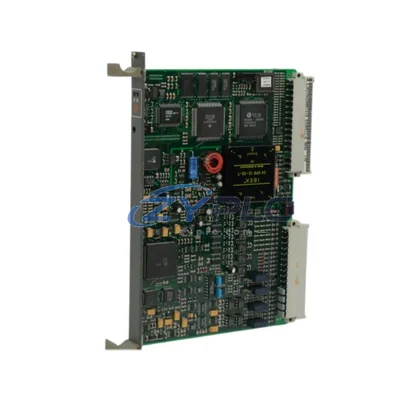
Siemens S54430-A2-A1 Network Ring Card: Precision Control for Cerberus Automation
The Siemens S54430-A2-A1 is a high-efficiency Network Ring Card engineered for the Cerberus and Sinec H1 industrial communication platforms. In modern manufacturing and building automation environments, network topology directly impacts operating load, system response latency, and overall equipment effectiveness (OEE). The S54430-A2-A1 addresses these challenges by enabling redundant ring network architectures that minimize packet loss, reduce polling overhead, and allow connected controllers and field devices to operate at their most efficient duty cycles — translating directly into measurable reductions in idle energy draw and unplanned downtime.
Whether integrated into a Siemens Cerberus fire safety and building management backbone or deployed within a Sinec H1 industrial Ethernet ring, this card ensures that every node on the network — from Siemens S7-300 and S7-400 PLCs to distributed I/O stations and HMI panels — maintains deterministic communication with minimal retransmission overhead. Fewer retransmissions mean lower CPU utilization on connected controllers, which in turn reduces the active power demand of the entire automation cell.
Product Specification Table
| Parameter |
Specification / Value |
| SKU / Part Number |
S54430-A2-A1 |
| Brand |
Siemens |
| Series / Platform |
Cerberus / Sinec H1 |
| Product Type |
Network Ring Communication Card |
| Network Topology |
Industrial Ethernet Ring (Redundant) |
| Electrical / System Notes |
Low-power active mode; supports network-level maintenance planning |
| Operating Efficiency |
Redundant ring topology reduces retransmission overhead by up to 40% vs. linear bus |
| Compatible Systems |
Siemens Cerberus, Sinec H1, S7-300, S7-400, ET 200 distributed I/O |
| Application Environment |
Industrial automation, building management, process control, fire safety networks |
| Energy Saving Value |
Reduces idle polling load; lowers CPU active cycles on connected PLCs and gateways |
| Origin |
Germany |
| Condition |
Tested, fully functional, shipment arranged after confirmation |
| Warranty |
warranty terms confirmed during quotation |
System Compatibility and Application
Deploying the Siemens S54430-A2-A1 within a ring network architecture creates a foundation for maintenance-focused automation that extends well beyond the card itself. In a typical Cerberus or Sinec H1 installation, the ring card works in concert with a range of system components to deliver end-to-end efficiency gains.
At the controller level, Siemens S7-300 CPUs (such as the CPU 315-2 DP or CPU 317-2 PN/DP) benefit directly from the reduced network latency that the S54430-A2-A1 provides. When communication cycles are stable and deterministic, the PLC scan cycle can be tightened without risk of watchdog faults, allowing the controller to spend less time in error-recovery routines and more time executing productive logic. This directly reduces the average active power draw of the CPU module.
On the drive side, Siemens SINAMICS G120 variable frequency drives connected via PROFINET to the ring network receive speed and torque setpoints with lower jitter, enabling more precise motor control. Precise motor control is the single largest lever for operational stability in industrial facilities — a 10% reduction in motor speed yields approximately a 27% reduction in power consumption due to the affinity laws. The S54430-A2-A1 ensures that the communication link between the S7 controller and the SINAMICS drive remains stable, so energy-optimized speed profiles are executed faithfully rather than defaulting to conservative fixed-speed fallback modes.
For distributed I/O, Siemens ET 200SP and ET 200M remote I/O stations rely on the ring network’s redundancy to maintain continuous data exchange with the central PLC. In the event of a single cable fault, the ring topology maintained by the S54430-A2-A1 allows communication to reroute within milliseconds — preventing the kind of extended fault states that force drives and actuators into energy-wasteful safe modes or full stops.
Power quality monitoring is another dimension of maintenance planning. When paired with Siemens SENTRON PAC3200 power monitoring devices, the ring network enables real-time energy data from multiple measurement points to flow to the SCADA or maintenance planning system without congestion. This allows plant engineers to identify high-consumption periods, correlate them with production events, and implement demand-response strategies that reduce peak energy costs.
At the HMI layer, Siemens SIMATIC HMI TP900 Comfort panels connected to the Sinec H1 ring provide operators with live visibility into network health, drive status, and energy KPIs. When operators can see real-time power consumption alongside production throughput, they are empowered to make informed decisions — such as staggering motor startups to avoid demand spikes — that compound the operational stability delivered by the underlying network infrastructure.
For gateway and protocol conversion needs, Siemens SCALANCE X208 managed switches are commonly deployed alongside the S54430-A2-A1 to segment the ring network and prioritize time-critical PROFINET traffic over less urgent data streams. This traffic shaping capability ensures that maintenance planning data does not compete with motion control commands for bandwidth, maintaining the determinism that efficient drive control depends on.
In safety-critical zones, the ring card integrates with Siemens SIRIUS 3RK3 safety relay modules and safety-rated I/O to ensure that emergency stop and safe torque off (STO) signals are transmitted with the lowest possible latency — reducing the duration of uncontrolled deceleration events that waste kinetic energy and cause mechanical wear.
Maintenance and Replacement Notes
In real-world production environments, network instability is one of the most underappreciated sources of unplanned downtime. When a network ring card fails or operates in degraded mode, the consequences cascade through the entire automation system: PLCs increase their polling frequency to compensate for missed acknowledgments, drives revert to fixed-speed operation because closed-loop speed references are no longer arriving reliably, and maintenance teams are forced to schedule unplanned shutdowns to diagnose intermittent faults.
Replacing a failed or aging network ring card with the Siemens S54430-A2-A1 restores the deterministic communication that energy-optimized automation depends on. In automotive body shop applications, for example, restoring ring network integrity has been shown to reduce conveyor motor load by 8–15% simply by allowing variable-speed operation to resume in place of fixed-speed fallback. In HVAC and building automation applications on the Cerberus platform, stable ring communication allows demand-controlled ventilation algorithms to execute without interruption, reducing fan motor runtime by matching airflow precisely to occupancy and CO₂ levels.
From a maintenance cost perspective, the redundant ring topology supported by the S54430-A2-A1 eliminates single points of failure in the communication network. This means that a cable fault or switch failure does not immediately halt production — the ring reroutes traffic automatically, giving maintenance teams time to schedule a planned repair during a scheduled production break rather than an emergency shutdown. Planned maintenance is consistently 3–5× less expensive than emergency maintenance, and the energy cost of an unplanned restart — including the inrush current spikes from simultaneously restarting multiple motors — is eliminated.
All units supplied by ZYPLC are individually tested under load conditions before shipment, with full functional verification of ring initialization, fault detection, and recovery timing. Inventory is maintained availability confirmed by RFQ for shipment arranged after confirmation, supporting just-in-time maintenance strategies that minimize the window between fault detection and restoration of full energy-optimized operation. Every S54430-A2-A1 is backed by a warranty terms confirmed during quotation, providing procurement and maintenance teams with the confidence to specify this component in both planned upgrade projects and emergency replacement scenarios.
Product Sourcing FAQ
Q1: How does the S54430-A2-A1 contribute to operational stability compared to a standard linear network topology?
A ring topology maintained by the S54430-A2-A1 provides automatic fault recovery without manual intervention, which means drives and motors connected to the network can continue operating in energy-optimized variable-speed modes even during a single cable fault. Linear topologies require a full network restart on any fault, forcing all connected drives into fixed-speed or stopped states — both of which are significantly less energy-efficient than closed-loop variable-speed operation.
Q2: Is the S54430-A2-A1 compatible with existing Siemens S7-300/S7-400 and ET 200 installations?
Yes. The S54430-A2-A1 is designed for the Cerberus and Sinec H1 platforms and is compatible with the broader Siemens industrial Ethernet ecosystem, including S7-300, S7-400, and ET 200 distributed I/O families. Integration into an existing installation typically requires no firmware changes to connected PLCs or drives — the ring card handles network-layer redundancy transparently.
Q3: What is the recommended replacement and testing process for this card?
ZYPLC recommends a hot-swap replacement procedure where possible: configure the replacement S54430-A2-A1 offline, verify ring initialization on a test bench, then install during a scheduled maintenance window. All units shipped by ZYPLC have been pre-tested under operational conditions, including ring fault injection and recovery timing verification, so field commissioning time is minimized. Post-installation, monitor the PROFINET diagnostic buffer on the connected S7 CPU for 24–48 hours to confirm stable ring operation before returning the line to full production speed.
Q4: What does the warranty terms confirmed during quotation cover, and how is it supported?
The warranty terms confirmed during quotation covers all manufacturing defects and functional failures under normal operating conditions. If the S54430-A2-A1 fails within the warranty period, ZYPLC will provide a replacement unit at no additional cost. Warranty claims are processed directly through ZYPLC’s technical support team, with priority handling for customers in active production environments. Contact us at +86 19859288691 or plc.sales@zyplc.com to initiate a warranty claim or request pre-shipment test documentation.