Siemens U-08B Base Unit for APACS+: Control System Backbone and Cross-Layer Coordination
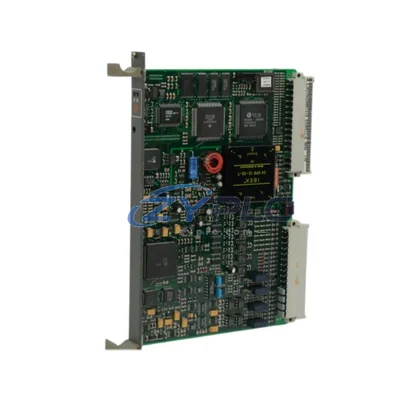
The Siemens U-08B is an 8-slot DCS base unit purpose-built for the APACS+ distributed control system platform. In modern industrial automation, no component operates in isolation — every module, card, and communication interface must function as part of a coherent, layered control architecture. The U-08B serves as the physical and electrical backbone of that architecture, providing the structural foundation upon which CPU modules, I/O cards, power supplies, and communication gateways are mounted, interconnected, and coordinated. Understanding the U-08B means understanding how a complete APACS+ control system is assembled, scaled, and sustained over its operational lifecycle.
At the control layer, the U-08B hosts the APACS+ controller module — typically the ACM (Advanced Controller Module) or compatible CPU cards — which executes the real-time control logic governing process variables across the plant. The backplane’s internal bus architecture ensures deterministic, low-latency communication between the CPU and all installed I/O modules, eliminating the signal delays that can compromise closed-loop control performance in demanding process environments. This tight integration between the controller and the base unit is what allows APACS+ systems to maintain scan cycle consistency even under high I/O load conditions.
At the I/O layer, the U-08B’s eight module slots accommodate a full range of APACS+ analog and digital I/O cards, including AI (Analog Input), AO (Analog Output), DI (Digital Input), and DO (Digital Output) modules. Engineers designing systems for continuous process control — such as flow, pressure, temperature, and level loops — can populate the base unit with the precise mix of I/O types required by the application. The modular slot architecture also supports future I/O expansion without requiring changes to the base unit itself, preserving the capital investment in the installed backplane infrastructure.
At the network and communication layer, the U-08B supports the installation of APACS+ communication modules that interface with plant-wide networks including INFI-NET, Ethernet-based supervisory systems, and OPC-compatible SCADA platforms. This enables the base unit to serve as a node within a multi-drop control network, where process data flows upward to historian servers and MES systems while setpoints and control commands flow downward from the operator interface. The system integration capability of the APACS+ platform means that the U-08B can participate in coordinated control strategies that span multiple base units, controllers, and network segments — a critical requirement for large-scale process plants.
At the power layer, the U-08B is designed to work in conjunction with APACS+ power supply modules that deliver regulated DC power to all installed cards via the backplane bus. Redundant power supply configurations are supported, allowing engineers to implement N+1 power redundancy within the same rack — a standard requirement in industries where unplanned downtime carries significant financial or safety consequences. The power distribution architecture of the U-08B ensures that individual module failures do not propagate power faults to adjacent slots, maintaining system stability during partial failures.
At the human-machine interface layer, the U-08B integrates seamlessly with APACS+ operator workstations and engineering terminals running the APACS+ configuration and monitoring software suite. Maintenance engineers can use these tools to perform online diagnostics, view module health status, and execute firmware updates without taking the base unit offline — a capability that is essential for continuous process industries where scheduled shutdowns are infrequent. The engineering environment also supports structured documentation of the I/O assignment, tag database, and control strategy associated with each U-08B installation, simplifying future modifications and regulatory compliance audits.
At the execution layer, the U-08B connects to field devices — transmitters, control valves, motor starters, and variable frequency drives — through the I/O modules installed in its slots. The integrity of this connection determines the quality of the process data available to the controller and the precision of the control outputs delivered to the actuators. The U-08B’s robust backplane design minimizes ground loops, signal crosstalk, and EMI-induced noise, ensuring that the field signals arriving at the I/O cards accurately represent the physical process conditions.
Product Specification Table
| Parameter |
Specification |
| System Role |
DCS Backplane / Base Unit — APACS+ Platform |
| Module Slots |
8 slots (compatible with APACS+ I/O, CPU, and communication modules) |
| Compatible Controllers |
ACM (Advanced Controller Module) and APACS+ compatible CPU cards |
| Backplane Bus |
Internal parallel bus for deterministic CPU-to-I/O communication |
| Power Input |
Accepts APACS+ power supply modules; supports redundant power configuration |
| Operating Voltage |
24 VDC (via backplane power distribution from installed power supply module) |
| Communication Support |
INFI-NET, Ethernet supervisory interface (via communication modules) |
| Installation |
DIN rail or panel-mount rack installation; standard APACS+ enclosure compatible |
| Operating Temperature |
0°C to 60°C (typical industrial control cabinet environment) |
| Relative Humidity |
5% to 95% non-condensing |
| system integration |
Supported — multi-node APACS+ network coordination |
| Warranty |
warranty terms confirmed during quotation — all units tested prior to shipment |
| Origin |
Germany (Siemens APACS+ product line) |
| Availability |
RFQ Available — global shipping available |
System Compatibility Notes
The U-08B does not function as a standalone component — it is the integration point for an entire cluster of APACS+ system elements. In a typical APACS+ control cabinet, the U-08B base unit is populated with an ACM controller module occupying the primary CPU slot, flanked by a combination of AI-830 analog input cards for 4–20 mA process signals, DO-801 digital output cards for discrete actuator control, and a CI-830 communication interface module for INFI-NET connectivity. A dedicated APACS+ power supply module — such as the PS-830 — provides regulated 24 VDC to the backplane, with a second PS-830 installed in a redundant configuration to eliminate single-point power failure risk.
In multi-rack APACS+ installations, multiple U-08B base units are interconnected via the INFI-NET control network, allowing the ACM controllers in each rack to share process data, coordinate setpoints, and execute plant-wide control strategies. A remote I/O expansion unit — such as the APACS+ RIO base unit — can be added to extend the I/O capacity of the system without adding a second controller, reducing hardware costs in applications where additional I/O points are needed but additional control processing capacity is not. The U-08B’s role as the physical host for these modules makes it the central element around which the entire APACS+ system architecture is designed.
For applications requiring operator visibility, the U-08B-based control system connects to APACS+ operator workstations running the APACS+ OW (Operator Workstation) software, providing real-time process displays, alarm management, and trend visualization. Engineering workstations running the APACS+ EW (Engineering Workstation) software provide the configuration environment for the control strategy, I/O tag database, and network topology — all of which reference the U-08B as the physical host for the configured I/O and control modules. Terminal blocks and marshalling panels downstream of the U-08B’s I/O cards provide the field wiring interface, completing the signal path from the process to the control system and back to the actuators.
Industrial Application Notes
The Siemens U-08B base unit has been deployed across a wide range of process industries where the APACS+ platform was selected as the primary DCS. In power generation facilities, U-08B-based APACS+ systems manage boiler combustion control, turbine governor interfaces, and auxiliary system monitoring — applications where scan cycle determinism and redundant power are non-negotiable requirements. The 8-slot capacity of the U-08B allows a single rack to handle the I/O density typical of a boiler control loop cluster, reducing the number of racks required and simplifying cabinet layout.
In petrochemical and refinery applications, U-08B base units are used in APACS+ systems controlling distillation column loops, heat exchanger bypass valves, and compressor anti-surge systems. The ability to mix analog and digital I/O modules within the same base unit simplifies the I/O assignment for process areas where both continuous and discrete signals are present. The system integration capability of the APACS+ platform allows U-08B nodes in different process areas to share data and coordinate control actions — for example, coordinating feed rate adjustments between upstream and downstream process units in response to a common process disturbance.
In water and wastewater treatment plants, U-08B-based APACS+ systems manage pump sequencing, chemical dosing control, and filtration process monitoring. The robust operating temperature range and humidity tolerance of the U-08B make it suitable for installation in control rooms adjacent to wet process areas, where ambient conditions can be more challenging than in a typical manufacturing environment. In mining and minerals processing applications, U-08B base units are found in APACS+ systems controlling crusher feed rates, conveyor speed loops, and flotation cell level control — applications where the system must operate continuously with minimal maintenance intervention.
In packaging and discrete manufacturing lines that incorporate process control elements — such as temperature-controlled curing ovens, adhesive application systems, or pneumatic actuator networks — the U-08B provides the I/O infrastructure for integrating these process control functions into the broader APACS+ system architecture. The long service life of the APACS+ platform means that many of these installations remain in operation for 15–20 years, making the availability of replacement U-08B base units a critical factor in the long-term maintenance planning of the facility.
Product Compatibility FAQ
Q1: Is the Siemens U-08B compatible with all APACS+ I/O and communication modules, and can it be mixed with APACS+ modules from different production batches?
A: The U-08B is designed as a universal base unit for the APACS+ platform and is compatible with the full range of APACS+ I/O modules, CPU cards, and communication interfaces produced for that platform. Module compatibility is governed by the APACS+ system architecture rather than production batch dates, meaning that modules produced at different times can generally be installed in the same U-08B base unit provided they are configured correctly in the APACS+ engineering environment. For specific module compatibility questions, the APACS+ system documentation and the engineering workstation configuration tool provide the authoritative reference. All U-08B units supplied by ZYPLC are tested for backplane bus integrity prior to shipment and are covered by a warranty terms confirmed during quotation.
Q2: Can the U-08B support redundant controller configurations, and what is required to implement CPU redundancy in an APACS+ system?
A: CPU redundancy in APACS+ systems is typically implemented at the system architecture level rather than within a single U-08B base unit. A redundant APACS+ controller configuration uses two ACM modules — a primary and a standby — which synchronize their control state via the INFI-NET network. Each ACM is installed in its own U-08B base unit, with the I/O modules connected to both controllers via the APACS+ I/O bus architecture. This approach provides controller-level redundancy while maintaining full I/O access from both the primary and standby controllers. The U-08B’s role in this architecture is to provide the physical mounting and backplane connectivity for the ACM and associated I/O modules in each redundant controller node.
Q3: What is the recommended approach for replacing a U-08B base unit in an operating APACS+ system, and how does the warranty terms confirmed during quotation apply to replacement units?
A: Replacing a U-08B base unit in an operating APACS+ system requires careful planning to minimize process disruption. The recommended approach is to schedule the replacement during a planned maintenance window, during which the affected control loops are placed in manual mode or transferred to a redundant controller node if available. The replacement U-08B is pre-configured with the same slot assignments as the original unit, and all I/O modules are transferred from the old base unit to the new one in the same slot positions to preserve the I/O tag mapping in the APACS+ engineering database. All U-08B units supplied by ZYPLC carry a warranty terms confirmed during quotation covering manufacturing defects and backplane bus failures. Units are tested for electrical integrity and backplane communication performance prior to shipment, and ZYPLC’s technical support team is available to assist with installation planning and post-installation commissioning verification.