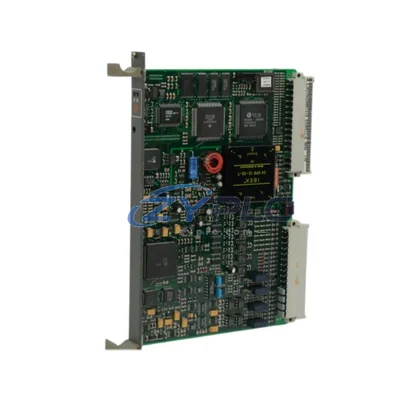
Siemens ULC0065 Communication Interface for SINAUT ST7
The Siemens ULC0065 is a dedicated communication interface module engineered for deployment within SINAUT ST7 telecontrol architectures. Rather than functioning as a standalone component, the ULC0065 is designed to serve as a critical node in a layered automation hierarchy — bridging field-level controllers, remote terminal units, and supervisory control systems across geographically distributed infrastructure. Its role within the control architecture is to ensure reliable, deterministic data exchange between SIMATIC S7 PLCs and the SINAUT ST7 telecontrol network, enabling operators to maintain full situational awareness and command authority over remote assets.
In modern industrial control system design, the communication layer is not an afterthought — it is the backbone of operational continuity. The ULC0065 addresses this requirement by providing a structured, protocol-consistent interface that supports system integration across multiple system layers. Whether deployed in power distribution substations, water treatment facilities, oil and gas pipeline monitoring stations, or municipal infrastructure networks, the ULC0065 delivers the communication stability and architectural coherence that long-term system reliability demands.
Product Specification Table
| Parameter |
Specification |
| System Role |
Telecontrol Communication Interface — SINAUT ST7 Network Node |
| Compatible Platform |
SIMATIC S7-300 / S7-400 / S7-1200 / S7-1500 (via CP modules) |
| Communication Protocol |
SINAUT ST7 Telecontrol Protocol |
| Interface Type |
Serial / WAN Communication Interface |
| Transmission Medium |
Leased Line, Dial-Up, GSM/GPRS (via modem pairing) |
| Data Transmission Rate |
Up to 38.4 kbps (application-dependent) |
| Operating Voltage |
24 V DC (nominal) |
| Power Consumption |
Typically ≤ 5 W (load-dependent) |
| Operating Temperature |
0 °C to +60 °C |
| Storage Temperature |
-40 °C to +70 °C |
| Protection Class |
IP20 (panel/cabinet installation) |
| Installation |
DIN Rail / Control Cabinet Mounting |
| Country of Origin |
Germany |
| Series |
SINAUT ST7 |
| Warranty |
— Tested, Verified, Ready for System Integration |
System Compatibility Notes
The ULC0065 does not operate in isolation. Its value is realized only when it is correctly positioned within a complete, coordinated control system architecture. In a typical SINAUT ST7 deployment, the ULC0065 interfaces directly with the TIM 4R-IE (Telecontrol Interface Module), which manages IP-based communication between the SINAUT master station and remote substations. The TIM 4R-IE handles the upper-layer network routing, while the ULC0065 manages the lower-level serial communication link — together forming a robust, two-tier communication stack.
At the controller level, the ULC0065 is commonly paired with SIMATIC S7-300 CPU modules such as the CPU 315-2 DP or CPU 317-2 PN/DP, which serve as the local processing units at remote stations. These CPUs handle real-time logic execution and pass process data to the ULC0065 for upstream transmission. For applications requiring higher processing capacity or integrated safety functions, the S7-400 CPU 414-3 PN/DP provides an alternative platform with expanded memory and multi-rack support.
On the I/O layer, the ULC0065 architecture is typically supported by SM 1231 analog input modules and SM 1232 analog output modules, which capture field signals from sensors, transmitters, and actuators. These signals are processed locally by the CPU and then relayed through the ULC0065 to the SINAUT ST7 master station — enabling centralized monitoring of distributed field conditions without requiring dedicated communication hardware at every I/O point.
Network-layer stability is further reinforced through the use of SCALANCE M826-2 industrial LTE routers, which provide wireless WAN connectivity for remote stations where fixed-line infrastructure is unavailable or cost-prohibitive. The SCALANCE M826-2 integrates seamlessly with the SINAUT ST7 communication stack, supporting VPN tunneling and redundant SIM card operation for continuous uptime in harsh field environments.
Power supply integrity is maintained through SITOP PSU8200 series power supply units, which deliver regulated 24 V DC to the ULC0065 and associated rack components. The SITOP PSU8200 supports diagnostic output signaling, enabling the control system to detect power anomalies before they escalate into communication failures — a critical feature in unmanned remote station deployments.
For applications requiring modem-based WAN connectivity, the SINAUT MD720-3 GSM/GPRS modem is the standard pairing for the ULC0065 in legacy and hybrid telecontrol networks. The MD720-3 provides reliable dial-up and GPRS connectivity over public mobile networks, extending the reach of the SINAUT ST7 architecture to locations beyond fixed-line coverage.
At the supervisory level, the ST7cc and ST7sc SINAUT master station software platforms provide the centralized data management, alarm handling, and historical logging functions that complete the control architecture. The ULC0065 serves as the field-side counterpart to these master station components, ensuring that remote station data is consistently formatted, time-stamped, and transmitted in compliance with the ST7 protocol specification.
For installations requiring communication redundancy, the CP 343-1 Ethernet communication processor can be deployed alongside the ULC0065 to provide a parallel IP-based communication path. This dual-path architecture ensures that a failure in the serial WAN link does not result in a complete loss of remote station visibility — a design principle that is increasingly mandated in critical infrastructure applications.
Industrial Application Notes
The ULC0065 finds its most demanding applications in industries where communication reliability is directly linked to operational safety and regulatory compliance. In power distribution and transmission networks, the module enables substation automation systems to report breaker status, transformer load data, and fault events to centralized SCADA platforms in real time. The deterministic nature of the SINAUT ST7 protocol ensures that alarm messages are delivered with consistent latency, even under high network load conditions.
In water and wastewater treatment facilities, the ULC0065 supports remote monitoring of pump stations, flow meters, and chemical dosing systems distributed across large geographic areas. Operators at central control rooms can issue setpoint adjustments and receive process feedback through the SINAUT ST7 network without requiring on-site personnel — reducing operational costs and improving response times to process deviations.
The oil and gas sector relies on the ULC0065 for pipeline monitoring applications, where pressure, flow, and temperature data must be continuously transmitted from remote metering stations to central control facilities. The module’s compatibility with GSM/GPRS modems makes it particularly well-suited for pipeline segments in remote terrain where fiber or copper infrastructure is not available.
In mining and metallurgical operations, the ULC0065 supports the integration of distributed control systems across large mine sites, enabling centralized coordination of conveyor systems, ventilation controls, and ore processing equipment. The module’s robust operating temperature range and industrial-grade construction ensure reliable performance in the dusty, vibration-prone environments typical of mining applications.
For municipal infrastructure and smart city applications, the ULC0065 enables the integration of traffic management systems, street lighting controls, and environmental monitoring networks into unified SCADA architectures — supporting the trend toward centralized urban infrastructure management.
Product Compatibility FAQ
Q1: Is the ULC0065 compatible with both S7-300 and S7-400 controller platforms, and can it be integrated into an existing SINAUT ST7 network without replacing the master station software?
A: The ULC0065 is designed for system integration within the SINAUT ST7 ecosystem and is compatible with SIMATIC S7-300 and S7-400 controller platforms when used in conjunction with the appropriate CP communication modules. It can be added to an existing SINAUT ST7 network without requiring master station software upgrades, provided the ST7cc or ST7sc version in use supports the ULC0065 device type. Configuration is performed through STEP 7 or TIA Portal with the SINAUT ST7 configuration tool, and the module’s station address and communication parameters must be aligned with the master station database. Our technical team can assist with compatibility verification prior to deployment.
Q2: What redundancy options are available when deploying the ULC0065 in critical infrastructure applications, and how does the module support long-term maintenance strategies?
A: For critical infrastructure deployments, the ULC0065 can be integrated into a dual-path communication architecture using a parallel CP 343-1 Ethernet module as a backup communication channel. This configuration allows the SINAUT ST7 master station to automatically switch to the IP-based path if the primary serial WAN link fails, maintaining continuous data flow without operator intervention. For long-term maintenance, the ULC0065’s modular design allows field replacement without disturbing adjacent rack components, and its compatibility with standard SIMATIC S7 diagnostic tools simplifies fault isolation. All units supplied by ZYPLC are covered by a and have been functionally tested prior to shipment.
Q3: How should the ULC0065 be configured for deployment in a SINAUT ST7 network using GSM/GPRS connectivity, and what are the key commissioning steps?
A: When deploying the ULC0065 with GSM/GPRS connectivity via the SINAUT MD720-3 modem, the commissioning process involves configuring the modem’s APN settings, assigning a static IP or dynamic DNS address for the remote station, and defining the polling cycle and data point mapping in the SINAUT ST7 configuration tool. The ULC0065 must be assigned a unique station address within the ST7 network, and its serial interface parameters (baud rate, parity, stop bits) must match the modem’s RS-232 port configuration. Signal strength verification and end-to-end communication testing should be performed before the station is placed in service. ZYPLC provides pre-shipment functional testing documentation and can supply configuration support for complex multi-station deployments. All units are backed by a covering hardware defects and communication interface integrity.