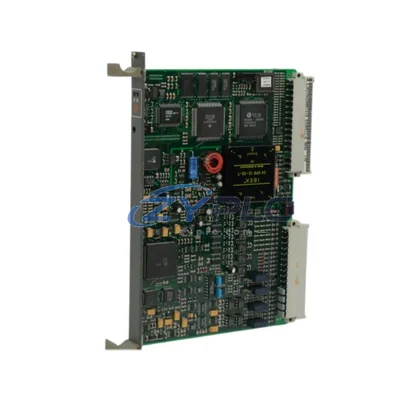
Triconex 4211 Industrial Network Interface: Bridging Safety Systems and Smart Factory Data Links
The Triconex 4211 is a high-integrity TMR (Triple Modular Redundancy) Communication Module engineered for the Tricon CX Series safety-rated control platform. In modern industrial environments where process safety and real-time data visibility must coexist, the 4211 serves as the critical network interface that connects field-level safety instrumented systems (SIS) to plant-wide SCADA, DCS, and historian architectures. Whether deployed in oil and gas, petrochemical, power generation, or advanced manufacturing, this module ensures that safety-critical data flows reliably from the Tricon CX controller to supervisory systems without compromising the integrity of the safety loop.
At the heart of the 4211’s design is its TMR architecture, which operates three independent processing channels simultaneously and uses voting logic to detect and tolerate faults in real time. This fault-tolerant communication backbone means that even during a single-channel failure, data transmission to upstream systems continues uninterrupted — a requirement in any SIL 2 or SIL 3 certified process environment. The module interfaces directly with the Tricon CX main chassis backplane, enabling seamless integration with the Triconex Tricon CX Controller and its associated I/O modules, including the 3703E Enhanced Analog Input Module and the 3805E Digital Output Module, which feed real-time process values into the communication layer for upstream reporting.
From a network communication perspective, the 4211 supports standard industrial protocols that allow it to act as a gateway between the safety controller and higher-level systems. Process data collected from field transmitters, pressure sensors, temperature loops, and valve positioners connected through the Tricon CX I/O bus is packaged and transmitted to Triconex TriStation 1131 engineering workstations and plant historians via the module’s communication ports. This enables operators to monitor safety system states, view diagnostic data, and receive alarm notifications through integrated SCADA and HMI platforms — all without requiring manual polling or interrupting the safety execution cycle.
In smart factory deployments, the 4211 plays a pivotal role in eliminating data isolation between the safety layer and the operational technology (OT) network. By bridging the Tricon CX safety controller with plant-level systems such as Wonderware System Platform, Ignition SCADA, or OSIsoft PI Historian, the module enables continuous data flow from the safety instrumented function (SIF) layer to dashboards, KPI reporting tools, and remote monitoring centers. Engineers can configure alarm thresholds, review trip logs, and perform remote diagnostics without physically accessing the controller cabinet — a significant advantage in hazardous or geographically distributed installations.
The 4211 also supports integration with Triconex ACM (Advanced Communication Module) configurations and can operate alongside Triconex 4119A and 4351B communication modules in multi-node Tricon CX architectures, allowing system designers to build redundant communication paths that match the fault-tolerance philosophy of the safety controller itself. In larger installations, the module works in conjunction with industrial managed Ethernet switches and fiber optic media converters to extend the communication reach across plant segments, ensuring that data from remote process units arrives at the control room with minimal latency.
Every Triconex 4211 unit supplied by ZYPLC undergoes pre-shipment functional verification, including communication port testing, backplane interface checks, and protocol handshake validation. Units are sourced from verified supply channels and are accompanied by a , providing procurement teams and maintenance engineers with the confidence needed for critical infrastructure projects. Stock availability is maintained to support both planned capital projects and urgent replacement requirements, with fast global logistics to minimize plant downtime.
Compatibility & Integration Notes
| Parameter |
Specification |
| SKU / Part Number |
4211 |
| Brand |
Triconex |
| Series |
Tricon CX |
| Module Type |
TMR Communication Module |
| Architecture |
Triple Modular Redundancy (TMR) |
| Protocol Support |
Modbus TCP, Modbus RTU, Triconex proprietary SIS protocol |
| Interface Type |
Backplane bus interface, Ethernet RJ45, Serial RS-232/RS-485 |
| Network Compatibility |
Industrial Ethernet, DCS integration, SCADA/Historian connectivity |
| Safety Rating |
SIL 2 / SIL 3 capable (IEC 61511 / IEC 61508) |
| System Application |
Safety Instrumented Systems (SIS), Process Safety, Oil & Gas, Power |
| Communication Redundancy |
Triple-channel fault-tolerant voting |
| Warranty |
12 Months |
| Condition |
New / Refurbished (tested) |
| Origin |
United States |
Connected Automation Data Flow
In a typical Tricon CX safety system deployment, the Triconex 4211 sits at the intersection of the safety execution layer and the plant communication network. Field instruments — including pressure transmitters, gas detectors, and flow meters — deliver analog and digital signals to the Tricon CX chassis through the 3703E Analog Input Module and 3664 Digital Input Module. These signals are processed by the Tricon CX safety controller under the TMR voting logic, and the resulting process values and system diagnostics are then passed to the 4211 communication module for network transmission.
The 4211 forwards this data upstream to the TriStation 1131 Engineering Workstation, where safety engineers can review logic execution, modify setpoints within validated change management procedures, and download updated safety programs. Simultaneously, the module feeds real-time process data to the plant DCS gateway or OPC-UA server, making safety system states visible in the operator HMI without creating a direct control path into the SIS — preserving the independence required by IEC 61511.
For remote monitoring applications, the 4211’s Ethernet port connects through an industrial managed Ethernet switch — such as those from the Hirschmann or Moxa product families — to a plant-wide fiber backbone, enabling the Ignition SCADA or Wonderware InTouch HMI to display live safety system data, active alarms, and trip histories. In facilities using OSIsoft PI or equivalent historians, the 4211 enables continuous data archiving of safety-related process variables, supporting post-incident analysis and regulatory compliance reporting. The Triconex 4119A and 4351B modules can be deployed in parallel communication nodes to provide additional network paths and expand the system’s data throughput capacity as the installation grows.
Solving Data Isolation in Industrial Sites
One of the most persistent challenges in process safety environments is the communication gap between the safety instrumented system and the broader plant automation network. Legacy SIS installations often operate as isolated islands — their data inaccessible to SCADA operators, maintenance teams, or corporate reporting systems without manual extraction. The Triconex 4211 directly addresses this problem by providing a standards-compliant, protocol-capable communication interface that integrates the Tricon CX safety controller into the plant’s OT network without compromising the safety system’s independence or integrity.
Protocol incompatibility is another common barrier. Plants running mixed automation environments — with Modbus RTU devices on the field level, Ethernet-based DCS systems at the supervisory level, and OPC-DA or OPC-UA interfaces at the historian layer — require a communication module that can bridge these layers. The 4211’s multi-protocol support enables it to serve as the translation point between the Tricon CX’s internal safety bus and the plant’s standard industrial communication infrastructure, eliminating the need for external protocol converters or middleware servers.
For production transparency and line digitization initiatives, the 4211 enables real-time visibility into safety system states, including active bypasses, inhibited functions, and diagnostic fault codes. This data, when surfaced through SCADA dashboards or MES reporting tools, gives operations managers the information they need to make informed decisions about maintenance scheduling, process optimization, and regulatory compliance. Remote diagnostic capability further reduces the need for on-site intervention, lowering maintenance costs and improving response times in geographically distributed or hazardous-area installations. As plant networks expand, the 4211’s compatibility with the broader Tricon CX ecosystem ensures that new I/O nodes, communication paths, and supervisory connections can be added without redesigning the safety communication architecture.
Industrial Connectivity FAQ
Q1: What communication protocols does the Triconex 4211 support?
The 4211 supports Modbus TCP and Modbus RTU as standard industrial protocols, in addition to the Triconex proprietary SIS communication protocol used for TriStation 1131 connectivity. This enables integration with a wide range of SCADA platforms, DCS gateways, and OPC servers commonly deployed in process safety environments.
Q2: Is the Triconex 4211 compatible with SIL 2 and SIL 3 safety systems?
Yes. The 4211 is designed for use within the Tricon CX TMR safety platform, which is certified for use in SIL 2 and SIL 3 safety instrumented functions per IEC 61508 and IEC 61511. The module’s TMR architecture ensures that communication faults do not propagate into the safety execution layer, maintaining the required independence between the SIS and the plant network.
Q3: How does the 4211 handle network stability and communication latency in real-time safety applications?
The 4211’s TMR design provides inherent fault tolerance at the communication level — if one channel experiences a fault, the remaining two channels continue to transmit data without interruption. Communication latency is managed through the module’s dedicated backplane interface, which prioritizes safety execution over network reporting tasks, ensuring that the safety controller’s scan cycle is never compromised by network load.
Q4: What warranty and pre-shipment testing does ZYPLC provide for the Triconex 4211?
All Triconex 4211 units supplied by ZYPLC are covered by a from the date of shipment. Prior to dispatch, each unit undergoes functional verification including communication port testing, backplane interface validation, and protocol handshake checks. Units are sourced from verified supply channels and are available from stock to support both planned projects and urgent replacement requirements.