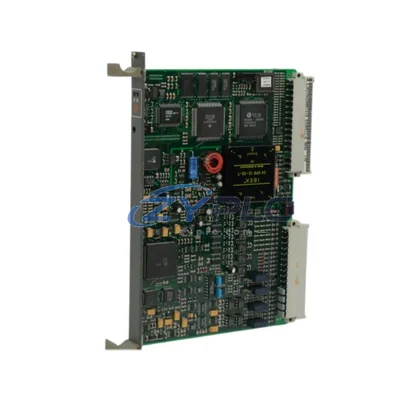
Triconex PI3381 Communication Module for Tricon
The Triconex PI3381 is a high-integrity communication module engineered for deployment within the Tricon Triple Modular Redundancy (TMR) safety and control platform. Rather than functioning as a standalone component, the PI3381 is designed to operate as a critical node within a layered industrial automation architecture — bridging the control layer, I/O subsystems, network infrastructure, and supervisory interfaces into a unified, fault-tolerant system. Its role in maintaining signal continuity, protocol consistency, and inter-module synchronization makes it an indispensable element in high-availability process control environments.
In modern distributed control system (DCS) and safety instrumented system (SIS) architectures, communication integrity is not optional — it is foundational. The PI3381 addresses this requirement by providing stable, deterministic data exchange between the Tricon main chassis and external process networks. Whether integrated into a petroleum refinery, a chemical processing plant, a power generation facility, or a water treatment system, the PI3381 ensures that control commands and process feedback travel reliably across all system layers without latency or data corruption.
Product Specification Table
| Parameter |
Specification |
| System Role |
DCS / SIS Communication Interface Module |
| Compatible Platform |
Triconex Tricon TMR Safety Controller |
| Communication Architecture |
Triple Modular Redundancy (TMR) — 3-leg parallel processing |
| Supported Protocols |
TriStation, Modbus RTU/TCP, OPC (via gateway), proprietary Tricon bus |
| Electrical Interface |
Backplane-mounted; powered via Tricon chassis power rail |
| Operating Voltage |
24 VDC (supplied via chassis) |
| Operating Temperature |
0°C to +60°C |
| Humidity Range |
5% to 95% RH, non-condensing |
| Installation Method |
Chassis slot insertion — Tricon main or expansion chassis |
| Certifications |
IEC 61508 SIL 3 capable (platform-level) |
| system integration |
Fully supported — compatible with existing Tricon system configurations |
| Warranty |
Warranty and support terms confirmed before quote — covered from date of shipment |
System Compatibility Notes
The PI3381 does not operate in isolation. Its value is realized only when understood within the context of the complete Tricon system architecture. A typical deployment integrating the PI3381 will include the Triconex Tricon Main Chassis as the structural backbone, housing the processor, I/O, and communication modules in a unified enclosure. The Triconex MP3008 Main Processor Module serves as the computational core, executing the safety logic and coordinating all inter-module communication — the PI3381 acts as its communication arm toward external networks and supervisory systems.
On the I/O side, digital input modules such as the Triconex DI3401 and digital output modules like the Triconex DO3401 feed real-time field signals into the processor. Analog input modules including the Triconex AI3351 handle continuous process variables such as pressure, temperature, and flow — all of which depend on the PI3381’s communication pathway to reach the DCS historian or SCADA layer above. The Triconex TCM4351 Tricon Communication Module may operate in parallel with the PI3381 in larger architectures, providing redundant communication paths to ensure no single point of failure exists at the network interface level.
Power integrity is maintained through the Triconex PS3101 Power Supply Module, which delivers regulated DC power to all chassis-mounted modules including the PI3381. In redundant power configurations, dual PS3101 units operate in parallel, ensuring that a power supply failure does not interrupt communication continuity. At the network layer, Modbus TCP gateways and OPC-DA/UA servers interface with the PI3381 to translate Tricon-native protocol data into formats consumable by third-party DCS platforms, historian databases, and MES systems. This system integration capability is one of the PI3381’s most operationally significant features — it allows the Tricon safety system to coexist and communicate within heterogeneous automation environments without requiring protocol conversion at the field level.
At the human-machine interface layer, operator workstations running TriStation 1131 programming software connect to the Tricon system through the communication infrastructure that the PI3381 supports. Engineering teams use this pathway for online diagnostics, logic downloads, and real-time system monitoring. The PI3381 thus serves not only as a runtime communication module but also as the engineering access point for system commissioning and long-term maintenance activities.
Industrial Application Notes
The PI3381 is deployed across a wide range of safety-critical and process-critical industries where communication reliability directly impacts operational safety and production continuity.
In oil and gas processing and petrochemical facilities, the PI3381 integrates the Tricon safety system with the plant-wide DCS, enabling emergency shutdown (ESD) logic to receive process data from field instruments and transmit trip commands to final control elements — all within deterministic response times. The TMR architecture ensures that even in the event of a single-leg hardware fault, communication continuity is maintained without operator intervention.
In power generation plants — including thermal, nuclear, and combined-cycle facilities — the PI3381 supports turbine protection systems, boiler management systems, and grid synchronization logic by maintaining reliable data exchange between the safety controller and the plant control network. Its ability to sustain communication under electrical noise conditions typical of high-voltage switchgear environments makes it particularly well-suited for power industry applications.
In water and wastewater treatment infrastructure, the PI3381 enables remote monitoring and control of pump stations, chemical dosing systems, and filtration processes by providing a stable communication bridge between the Tricon controller and SCADA systems. In mining and metallurgical operations, it supports conveyor safety interlocks, crusher protection systems, and smelter process controls where communication interruptions can result in equipment damage or personnel hazards.
For pharmaceutical and food processing environments, the PI3381’s deterministic communication behavior supports batch control systems where data integrity and audit trail completeness are regulatory requirements. In packaging and discrete manufacturing lines, it provides the communication backbone for safety-rated machine guarding and emergency stop systems integrated into the broader production control architecture.
Product Compatibility FAQ
Q1: Is the Triconex PI3381 compatible with both legacy and current-generation Tricon chassis configurations?
The PI3381 is designed for use within the Triconex Tricon platform and is compatible with standard Tricon main chassis and expansion chassis configurations. For specific slot compatibility and firmware version requirements, it is recommended to cross-reference the module’s hardware revision with the chassis model in use. ZYPLC’s technical team can assist with compatibility verification prior to procurement to ensure seamless system integration into your existing architecture.
Q2: How does the PI3381 support system redundancy and fault tolerance in a TMR architecture?
Within the Tricon TMR architecture, all three processing legs independently execute the same control logic and communicate simultaneously. The PI3381 participates in this redundancy model by maintaining synchronized communication state across all active legs. In the event of a single-leg fault, the remaining two legs continue to operate and communicate without interruption, ensuring that the safety function is preserved and that no spurious trip or communication blackout occurs. This design meets IEC 61508 SIL 3 requirements at the platform level.
Q3: What does the Warranty and support terms confirmed before quote cover, and what support is available for installation and commissioning?
All PI3381 modules supplied by ZYPLC are covered by a Warranty and support terms confirmed before quote from the date of shipment, covering hardware defects and functional failures under normal operating conditions. ZYPLC also provides pre-shipment functional verification and documentation support. For installation and commissioning, our engineering support team is available to assist with slot assignment, firmware compatibility checks, TriStation configuration guidance, and system-level integration testing. Contact us at plc.sales@zyplc.com or +86 19859288691 for technical assistance.