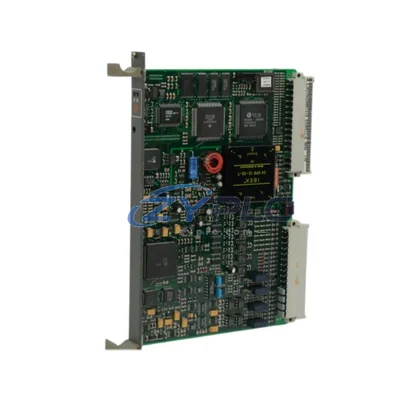
VIBRO-METER 200-510-074-113 MPC4 Module for VM600
The VIBRO-METER VM600 MPC4 module (part number 200-510-074-113) is a high-precision machinery protection and condition monitoring card engineered for seamless integration within the VM600 rack-based control architecture. Designed to operate as a core processing element at the measurement and protection layer, this module coordinates signal acquisition, threshold evaluation, and real-time data transmission across the full control hierarchy — from field-level transducers through to supervisory SCADA and DCS platforms.
In modern industrial automation environments, machinery protection systems must function not as isolated instruments but as deeply integrated nodes within a layered control architecture. The MPC4 module fulfills this role by bridging the I/O layer — where vibration, speed, and process signals originate — with the control and communication layers where decisions are made and acted upon. Its architecture-ready design ensures that engineers can deploy it within new VM600 rack assemblies or as a direct replacement in existing installations without reconfiguration of adjacent modules.
The VM600 platform is built around a modular backplane architecture. The MPC4 module slots directly into the VM600 rack chassis, sharing the internal communication bus with companion cards such as the AMC8 analog monitoring card, the IOC4T input/output conditioning module, and the RPS600 redundant power supply unit. This tight hardware integration eliminates signal latency between measurement and protection response, which is critical in high-speed rotating machinery applications such as gas turbines, steam turbines, compressors, and large induction motors.
From a system architecture perspective, the MPC4 occupies the measurement and protection layer, receiving conditioned analog signals from proximity probes, velocity transducers, and accelerometers connected through the IOC4T or equivalent signal conditioning modules. Processed data is then passed upward through the VM600 communication backbone to the VME600 or VC-8 communication gateway modules, which interface with plant-level Ethernet, Modbus TCP, or PROFIBUS DP networks. This layered signal flow ensures that protection logic remains deterministic and independent of higher-level network congestion.
Redundancy is a fundamental design consideration in the VM600 architecture. The MPC4 module supports hot-standby configurations when paired with a redundant rack and the appropriate crossover cabling. In critical applications — such as offshore compressor trains or power generation turbines — dual-rack redundancy ensures that a single module failure does not interrupt protection coverage. The RPS600 redundant power supply further reinforces system availability by providing uninterrupted power to all rack-mounted modules, including the MPC4, during primary supply transitions.
For engineering teams responsible for long-term plant maintenance, the MPC4’s standardized form factor and firmware compatibility across VM600 generations significantly reduce spare parts complexity. A single certified spare can serve multiple rack positions across a plant, reducing inventory carrying costs and minimizing mean time to repair (MTTR). The module’s onboard diagnostics also support predictive maintenance workflows by flagging internal faults before they escalate to protection trips.
Commissioning the MPC4 within a VM600 system is supported by the VM600 Rack Configuration Software, which provides a graphical interface for channel assignment, alarm threshold configuration, and communication parameter setup. Integration with the VibroSight condition monitoring software platform enables trend analysis, spectrum visualization, and alarm management across all connected VM600 racks — providing a unified view of machinery health across the entire plant.
All units supplied by ZYPLC are covered by a undergo functional verification prior to dispatch. Each module is tested for channel integrity, communication bus response, and power consumption within specified tolerances. This ensures that replacement modules arrive ready for installation without requiring additional bench testing, reducing plant downtime during maintenance windows.
Product Specification Table
| Parameter |
Specification |
| Part Number |
200-510-074-113 |
| Module Type |
MPC4 — Machinery Protection Card |
| Compatible Rack |
VM600 Rack Chassis (4-slot, 8-slot, 16-slot) |
| System Role |
Measurement & Protection Layer |
| Input Channels |
4 independent measurement channels |
| Signal Types |
Vibration (displacement, velocity, acceleration), Speed, Phase |
| Communication |
VM600 internal bus; Modbus TCP / PROFIBUS DP via gateway |
| Power Supply |
Via VM600 backplane (RPS600 compatible) |
| Operating Temperature |
0°C to +60°C |
| Humidity |
5% to 95% RH, non-condensing |
| Mounting |
DIN rack, VM600 chassis slot |
| Country of Origin |
Switzerland |
| Warranty |
(ZYPLC) |
| system integration |
Full VM600 architecture compatibility |
System Compatibility Notes
The MPC4 module achieves its full potential when deployed as part of a coordinated VM600 system architecture. A typical installation integrates the following components across the control hierarchy:
At the I/O and signal conditioning layer, the IOC4T input/output conditioning module receives raw transducer signals and conditions them for the MPC4’s measurement inputs. Proximity probes and velocity sensors connect directly to the IOC4T, which handles impedance matching and signal filtering before passing conditioned signals to the MPC4 via the backplane.
At the power layer, the RPS600 redundant power supply provides dual-feed power to the VM600 rack, ensuring that the MPC4 and all co-resident modules maintain operation during primary supply interruptions. In critical turbine protection applications, this redundancy is non-negotiable.
At the communication and network layer, the VME600 communication gateway and VC-8 Ethernet interface module translate the VM600 internal bus protocol to plant-standard Modbus TCP or PROFIBUS DP, enabling the MPC4’s measurement data to reach DCS platforms such as ABB System 800xA or Emerson DeltaV without protocol conversion overhead.
At the monitoring and analytics layer, the AMC8 analog monitoring card complements the MPC4 by handling additional analog process variables — temperature, pressure, and flow — within the same rack, providing a unified data stream to the VibroSight software platform.
At the human-machine interface layer, panel-mounted HMI terminals connected via the plant Ethernet network display real-time VM600 data, including MPC4 channel readings, alarm states, and module health diagnostics, giving operators immediate situational awareness without requiring access to the rack room.
This coordinated architecture — spanning the IOC4T, RPS600, VME600, VC-8, AMC8, and MPC4 — delivers a complete, redundant, and scalable machinery protection solution suitable for the most demanding continuous process environments.
Industrial Application Notes
The VIBRO-METER VM600 MPC4 200-510-074-113 is deployed across a wide range of heavy industrial sectors where rotating machinery protection is safety-critical:
Power Generation: In gas turbine and steam turbine protection systems, the MPC4 monitors shaft vibration, axial displacement, and differential expansion in real time. Its fast response time ensures that protection trips are initiated within milliseconds of threshold exceedance, preventing catastrophic bearing or seal failures.
Oil & Gas / Petrochemical: Compressor trains in LNG plants, refineries, and offshore platforms rely on VM600-based protection systems to maintain continuous operation. The MPC4’s SIL-capable architecture supports functional safety requirements under IEC 61511, making it suitable for safety instrumented system (SIS) integration.
Mining & Metallurgy: Large ball mills, SAG mills, and crusher drives in mining operations generate complex vibration signatures that the MPC4 captures and analyzes. Early detection of imbalance, misalignment, and bearing defects reduces downtime in high-throughput production environments.
Water & Wastewater Treatment: High-capacity pump stations and blower systems in water treatment facilities benefit from continuous vibration monitoring, enabling condition-based maintenance scheduling and extending equipment service life.
Pulp, Paper & Packaging: High-speed rotating equipment in paper machines and packaging lines requires precise vibration monitoring to maintain product quality and prevent costly production interruptions. The MPC4’s multi-channel architecture allows simultaneous monitoring of multiple machine trains from a single rack.
Product Compatibility FAQ
Q1: Is the VM600 MPC4 200-510-074-113 compatible with all VM600 rack chassis generations?
The MPC4 module is designed for the VM600 rack platform and is compatible with standard VM600 chassis configurations including 4-slot, 8-slot, and 16-slot variants. Firmware version compatibility should be verified against the installed rack firmware using the VM600 Rack Configuration Software prior to installation. ZYPLC can provide pre-installation compatibility verification upon request.
Q2: Can the MPC4 module be integrated into an existing DCS or SCADA architecture without replacing the entire VM600 rack?
Yes. The MPC4 is a slot-replaceable module that does not require rack-level reconfiguration when substituting a like-for-like unit. Communication with upstream DCS or SCADA systems is handled by the VME600 or VC-8 gateway modules already present in the rack, meaning the MPC4 replacement is transparent to the plant control network. This supports system integration with existing automation infrastructure.
Q3: What does the cover, and what is the support process?
All VM600 MPC4 modules supplied by ZYPLC carry a covering manufacturing defects and functional failures under normal operating conditions. In the event of a warranty claim, ZYPLC provides advance replacement to minimize plant downtime, followed by return and inspection of the original unit. Technical support for installation, commissioning, and configuration is available throughout the warranty period via direct contact with the ZYPLC engineering team.