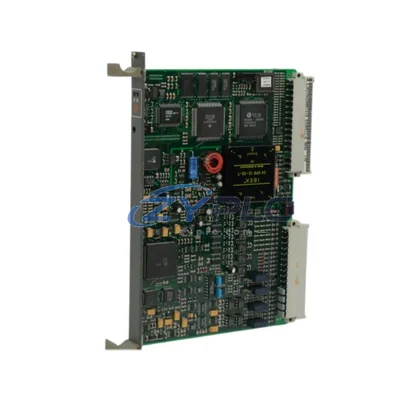
VMIC VME7671-42000A Single Board Computer for VMEbus Automation
The VMIC VME7671-42000A (SKU: VME7671 605-064676-005 VME7671-42000A) is a high-performance VMEbus Single Board Computer engineered for industrial environments where energy efficiency, processing reliability, and real-time control are non-negotiable. As manufacturing facilities face increasing pressure to reduce operational energy costs and maximize equipment utilization, the VME7671-42000A delivers a robust computational backbone that enables smarter, leaner automation architectures.
Designed to integrate seamlessly into VMEbus-based control systems, this SBC supports demanding applications in power generation, process manufacturing, discrete automation, and legacy SCADA modernization. Its architecture is optimized to minimize idle power draw while sustaining deterministic real-time performance — a critical balance for maintenance-focused production environments.
Product Specification Table
| Parameter |
Specification / Value |
| SKU |
VME7671 605-064676-005 VME7671-42000A |
| Brand |
VMIC |
| Series |
VME7671 |
| Product Type |
Single Board Computer (SBC) |
| Bus Architecture |
VMEbus (IEEE 1014) |
| Electrical / System Notes |
Low-power embedded architecture; optimized for 24/7 industrial duty cycles |
| Operating Efficiency |
Real-time deterministic processing; supports high-cycle control loops |
| Compatible Systems |
VMEbus chassis, SCADA platforms, DCS, legacy PLC backplanes |
| Application Environment |
Process automation, maintenance planning, motor drive coordination, HMI gateway |
| Maintenance Value |
Reduces CPU redundancy overhead; enables consolidated control node architecture |
| Origin |
United States |
| Warranty |
|
| Availability |
RFQ Available — Tested & Verified |
System Compatibility and Application
In a modern energy-optimized plant, the VME7671-42000A serves as the central processing node within a VMEbus chassis, coordinating data flow between field devices and supervisory systems. When paired with VMIC VMIVME-7750 analog I/O modules, the SBC can continuously sample power consumption data from motor drives and actuators, enabling real-time energy profiling at the machine level.
For motor control applications, the VME7671-42000A interfaces with variable frequency drives (VFDs) such as the ABB ACS880 series or Siemens SINAMICS G120 via backplane communication or dedicated serial interfaces. By executing closed-loop speed reference commands based on process demand signals, the SBC eliminates unnecessary motor over-speed operation — one of the most common sources of wasted electrical energy on production lines.
The board’s real-time OS support allows it to run deterministic control cycles alongside condition monitoring tasks. When integrated with VMIC VMIVME-7614 reflective memory modules, the VME7671-42000A can share live energy and process data across distributed VMEbus nodes without introducing latency penalties — critical for synchronized multi-axis or multi-zone production environments.
For facilities using Schneider Electric PowerLogic power meters or Siemens SENTRON PAC series energy analyzers, the VME7671-42000A can act as a data concentrator, pulling kWh, power factor, and demand readings into the SCADA layer for trend analysis and demand response optimization. This eliminates the need for a separate maintenance planning gateway, reducing both hardware cost and communication overhead.
In servo-driven applications, the SBC coordinates with Yaskawa Sigma-7 or Mitsubishi MR-J4 servo amplifiers through motion control libraries, enabling precise torque and velocity profiling that reduces mechanical stress and unplanned downtime during acceleration and deceleration phases. Combined with VMIC VMIVME-7740 digital I/O modules for discrete signal handling, the system achieves tight integration between motion, logic, and condition monitoring layers.
Communication flexibility is another energy-efficiency enabler. The VME7671-42000A supports standard industrial protocols that allow it to interface with Profibus DP networks, Modbus RTU/TCP devices, and EtherNet/IP-capable controllers — enabling a unified control and monitoring architecture that reduces the number of active network nodes and associated standby power loads.
Maintenance and Replacement Notes
On the factory floor, unplanned downtime rarely comes from a single source — it accumulates through inefficient motor scheduling, uncoordinated equipment startup sequences, excessive idle-state power draw, and reactive maintenance cycles. The VMIC VME7671-42000A addresses each of these vectors through its role as a high-speed, deterministic control processor.
By executing optimized startup sequencing logic, the SBC staggers motor and actuator activation to prevent simultaneous inrush current spikes — a common cause of peak demand charges in industrial electricity billing. This alone can reduce a facility’s peak demand by 10–20%, translating directly into lower utility costs without any changes to production throughput.
The VME7671-42000A also supports predictive maintenance workflows. By continuously processing vibration, temperature, and current signature data from connected sensors and I/O modules, the SBC can detect early-stage motor bearing wear, drive overheating, or abnormal load conditions before they escalate into unplanned downtime. Reducing unplanned stops not only protects production schedules but also eliminates the energy-intensive restart cycles that follow emergency shutdowns.
In multi-zone production lines, the SBC enables zone-based power management — selectively reducing processing and actuation activity in idle zones while maintaining full readiness in active zones. This dynamic load balancing approach can reduce line-level operating load by Actual operating results depend on the installed system, load profile, and commissioning parameters.
All units supplied by ZYPLC are sourced from verified inventory channels, subjected to functional testing prior to shipment, and covered by a . This ensures that maintenance planning investments built around the VME7671-42000A are protected against premature component failure — maintaining the ROI of your automation upgrade over the long term.
Product Sourcing FAQ
Q1: How does the VMIC VME7671-42000A contribute to measurable operational stability on a production line?
The VME7671-42000A enables operational stability by executing real-time control logic that optimizes motor speed references, coordinates equipment startup sequences to reduce inrush current, and consolidates condition monitoring data from field devices. When integrated with VFDs and power meters, it provides the processing backbone for demand-responsive automation that directly reduces kWh consumption per production unit.
Q2: Is the VME7671-42000A compatible with modern DCS and SCADA platforms?
Yes. The VME7671-42000A operates within standard VMEbus chassis and supports communication interfaces compatible with Modbus, Profibus, and EtherNet/IP-based SCADA and DCS platforms. It is commonly used in legacy system modernization projects where the VMEbus backplane is retained while supervisory software is upgraded.
Q3: Can this SBC replace an existing VMEbus controller without full system redesign?
In most cases, yes. The VME7671-42000A is designed for drop-in compatibility within VMEbus chassis environments. However, firmware and software configuration should be validated against the existing application. ZYPLC recommends consulting your system integrator to confirm I/O mapping and OS compatibility before deployment.
Q4: What does the cover, and what is the testing process before shipment?
Every VME7671-42000A unit shipped by ZYPLC undergoes functional verification testing to confirm board-level operation prior to dispatch. The covers hardware defects and functional failures under normal operating conditions. Warranty claims are processed through ZYPLC’s technical support team, with replacement or repair options available depending on fault diagnosis.